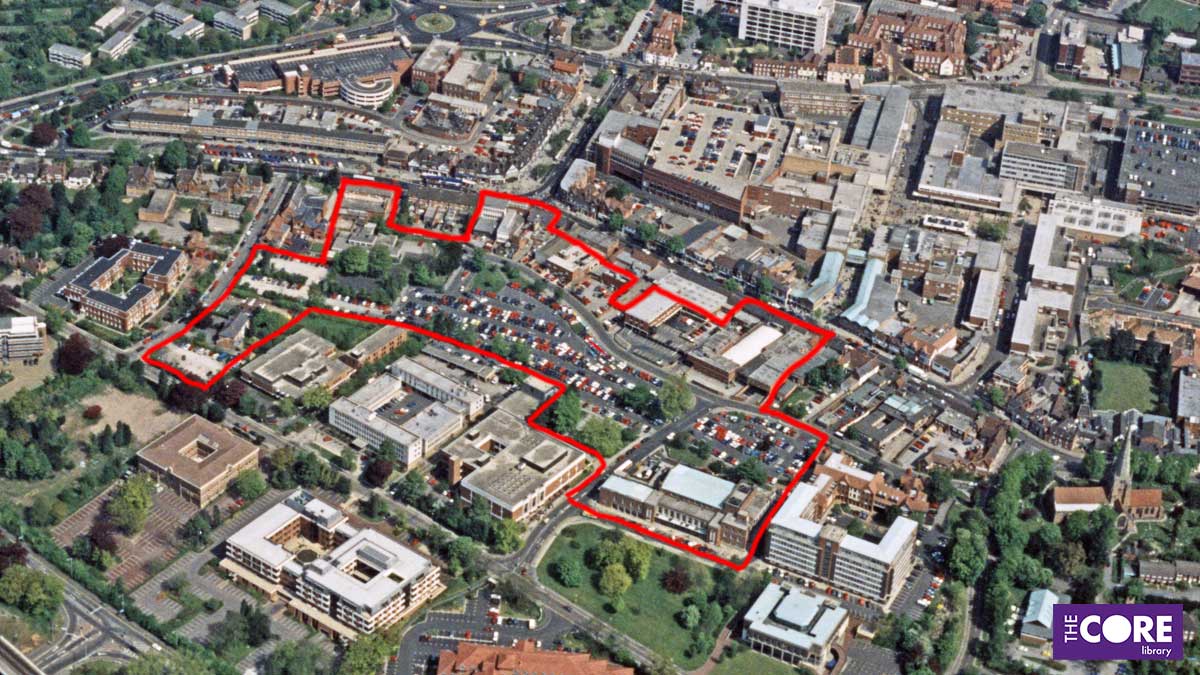
Construction of Touchwood began in 1999 – 11 years after the idea of a new shopping centre was first publicly revealed, and seven years after it got the go ahead in February 1992. The shopping centre opened to the public on 5th September 2001.
Solihull Council’s plan to increase the size of the town centre’s shopping offer came from the desire to guard against the development of out-of-town retail parks. It was felt that allowing retail parks would drain trade from established town centres and destroy the green belt.
Nationally, retail developers and operators were responding to and fuelling customer demand for a variety of shops with easy access and parking. In Solihull, no new premises had been built since the Poplar Way thoroughfare was completed in 1979, and it was reported that some of the town’s best-known shops were frustrated at not having the scope to expand.
Proposed Mell Square extension
In November 1982, plans were unveiled for a new £10 million extension to Mell Square, which would have entailed the demolition of homes in George Road and New Road. A residents’ group was formed under the chairmanship of Miss Joyce Griffiths, former teacher at Malvern Hall School, after residents received letters indicating potential compulsory purchase.
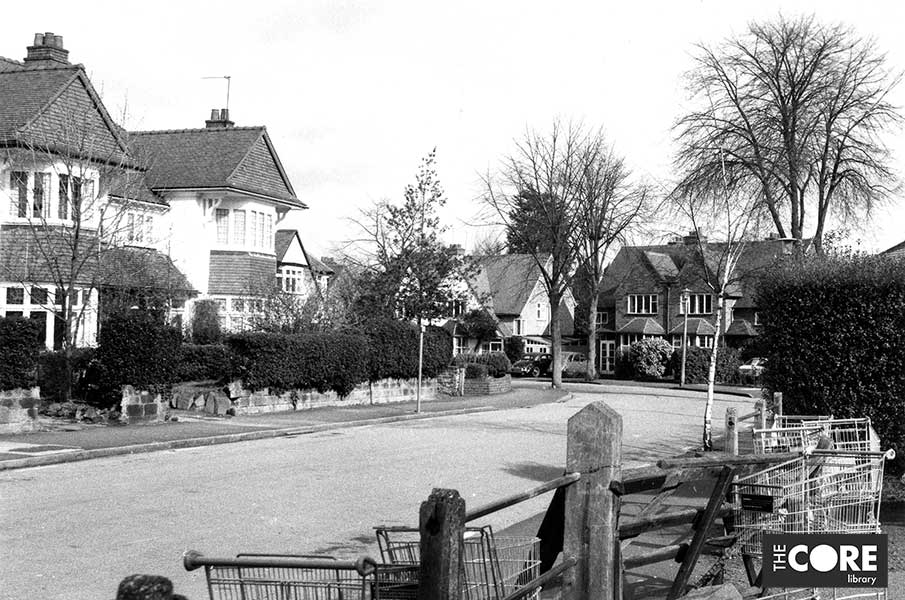
The plan was called in by the Secretary of State for the Environment and, in July 1984, the Minister, Patrick Jenkin, refused permission for the demolition of the 69 houses. In December 1985, the Council lost its subsequent High Court appeal against the ruling but council leaders vowed to press on with the development of the town centre.
Retail parks
Several schemes for retail parks in Shirley were rejected by the Council in 1986/7 on the basis that the land in question had already been earmarked for residential or industrial development. Had the Council wished to approve any retail park schemes, special government permission would have been required from the Secretary of State for the Environment.
Government permission was given to Tesco to develop a superstore on the site of Notcutts garden centre in Monkspath, despite Solihull Council’s rejection of the scheme. However, Tesco temporarily put its plans on ice whilst Solihull Council took its appeal against the refusal of permission for the town centre shopping expansion to the High Court.
The Council argued that it made no sense for the Tesco plan to be approved by the Government, as the decision ignored the West Midlands Structure Plan guidance that large stores should be built in town centres rather than out-of-town locations.
In 1988, J. J. Gallagher Ltd was given permission to develop the former Joseph Lucas Alternator plant (previously BSA Shirley shadow factory) in Marshall Lake Road as a retail park. A condition of the planning approval was that the six planned retail warehouses would not sell food, drink, clothing, fashion accessories, toys, books, or stationery. Opening hours were to be restricted to 8am-8pm Monday-Saturday and 10am-5pm on Sunday. Deliveries were not permitted on Sundays.
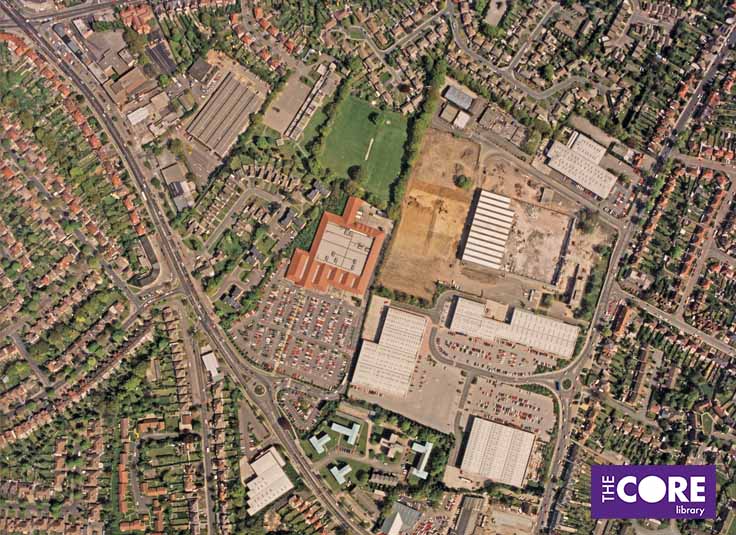
Construction of Solihull Retail Park was completed in 1989 and units were let to Habitat (opened 9th November 1989), Comet, B&Q, Halford’s, Allied Maples (opened 23rd November 1989), MFI and Lounge House.
Independent consultants, Donaldson, produced a report suggesting that Solihull was “under-shopped” with insufficient floor space to satisfy the aspirations of retailers and the demands of shoppers. In 1987, members of Solihull Council’s Policy Committee approved in principle the idea of extending the town centre.
Councillor George Hill OBE JP FCA (1914-2005), a Solihull councillor for 37 years from 1957-1994, was a notable dissenting voice. He contended that Solihull was adequately provided for and may even be over-shopped, and suggested that the Council should focus its efforts on parking. He said “We are in grave danger of ruining one of the most attractive town centres in the country.” (Solihull News, 3rd July 1987).
Lyndon ward councillor, Ian Gillett, wrote to the Solihull News, 8th July 1988, saying that he was not against the town centre development, which he felt was essential to meet the needs of residents for the next 20 years. Without it, he said:
we will be faced with vast out of town stores that will both help to destroy the green belt and at the same time reduce the town centre to a few building societies and banks.
However, he was opposed to the demolition of houses in George Road, on the grounds that:
- The demand for a major food store had not been proven, and the case was even more uncertain with the opening of Tesco at Monkspath and the withdrawal of Sainsbury’s interest in the George Road site. Any new food store should be accommodated within the civic car park development
- The houses in George Road were part of Solihull’s heritage, typifying much of this area. He said it was important to retain housing in the town centre and destroying people’s homes on such a flimsy argument would be “an act of vandalism.” Demolishing all residential buildings would increase the existing problems in the town centre at night
- Over-development of the town centre would be as bad as under-development, putting at risk existing shopping areas that were struggling.
Car park housing scheme
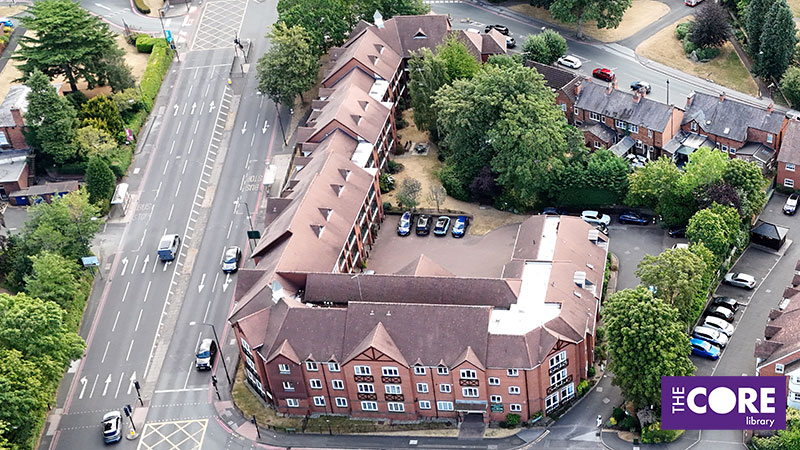
It was reported in February 1988 that a £900,000 sheltered housing scheme was planned for a site on Warwick Road, opposite Solihull School, which was in use as an unsurfaced pay and display car park and was described as always “earmarked for development.”
The intention was that the scheme would accommodate elderly residents displaced from their homes in George Road as a result of the demolition of houses to make way for the proposed major food store. A previous scheme in which the Council backed the development by a housing association was blocked when the Government did not agree a land subsidy arrangement.
In the event, a private “Very Sheltered Housing” scheme was built on the site by Bovis Retirement Homes, providing homeowners with an environment that offered 24-hour domestic and personal care. Deerhurst Court, with 40 self-contained flats and communal areas, was launched in 1993 and completed in May 1994.
The name of the development derives from the association of St Alphege (c.953-1012), Archbishop of Canterbury, to whom Solihull’s parish church is dedicated. He began his ecclesiastical career as monk at Deerhurst Priory, Gloucestershire.
Solihull 2000
The renovation of Mell Square, which took place in 1987/88 was part of the plan to ensure that retail development was concentrated in the town centre. The Solihull News 21st August 1987 described the plans as heralding:
the start of the most exciting decade in the history of Solihull as a major shopping centre.
On 5th January 1988, Solihull Council unveiled plans to transform the town centre:
- a shopping complex would be built on the civic car park, including a department store, two large stores and more than 50 small shops. It would be covered by a glass roof, which would be open in summer.
- Solihull High Street would be pedestrianised
- Mell Square would be modernised with glass-covered walkways in Drury Lane and Mill Lane.
- a new 50,000 sq ft store would be built in Drury Lane
- Beatties would be extended and the ‘wind tunnel’ effect would disappear with a new arcaded Drury Lane entrance to the enlarged department store
- a major new supermarket would be built either in George Road (requiring the demolition of 50 houses) or in Station Road/Herbert Road (requiring the demolition of Saint Martin’s School). Since the defeat of the previous proposals for George Road, the Council had managed to buy all but a handful of the properties in the road. In February 1988, the George Road site was confirmed as the preferred scheme.
The plans, which were drawn up by local architect Stanley Sellers (1933-2013), had a completion date of 1993, with the work being undertaken in three phases. In the event, Mell Square was refurbished 1987/88, and the High Street was pedestrianised in 1994, but the new shopping centre took rather longer to come to fruition.
Public consultation took place and it was suggested that all of the development activities should be co-ordinated as part of an overall campaign, called “Solihull 2000,” perhaps with signs erected at each entrance to the town centre and each development site.
A public competition in the autumn of 1988 to design a Solihull 2000 logo was advocated but appears not to have taken place, although a new logo started to appear on publications in 1989.

Touchwood Court
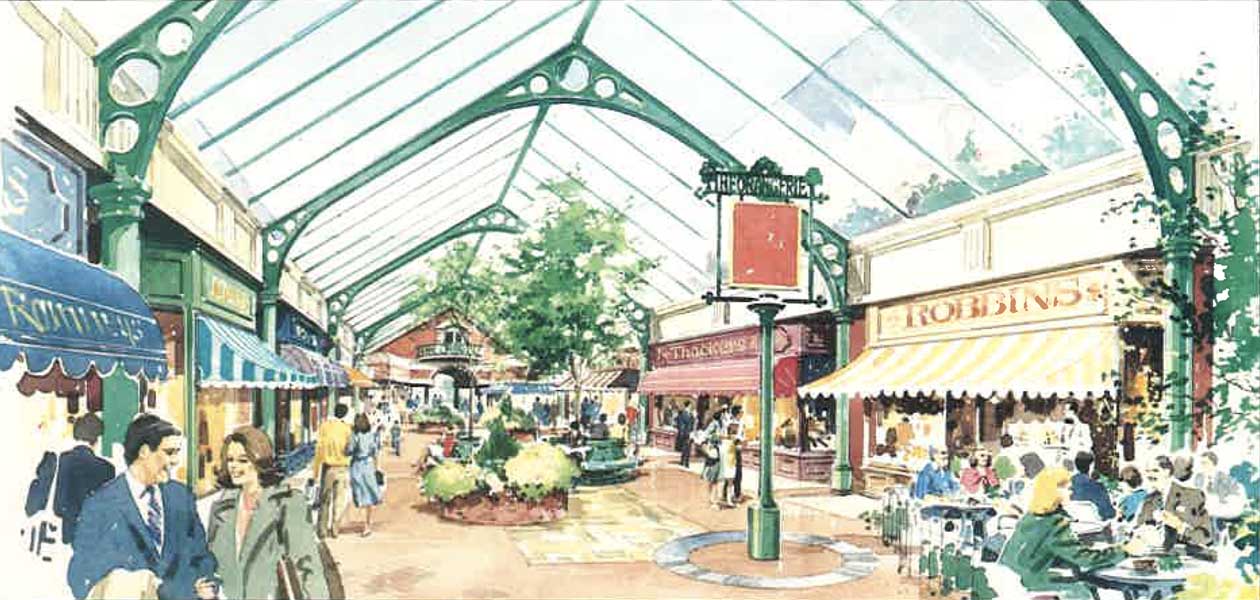
A detailed plan for the new Touchwood Court shopping centre was announced in the Solihull News on 7th April 1989 said that the idea was to create:
- a series of interlinked spaces giving intimate lanes and walks from the High Street
- courts with a warm and friendly atmosphere
- an airy arcade running parallel with the High Street
- The “Orangerie” – a square of small shops
- a garden setting around St Augustine’s church
- a screen in front of the council’s offices
- a courtyard in front of the library
A cultural/heritage centre, a tourist information office and a public meeting/function room were also intended to be included in what was described as “The Town of Tomorrow.” It was announced that the proposed development would be undertaken by Bredero-Citygrove – a consortium of Citygrove in Town Ltd, High Street, Solihull and Bredero Properties plc of Epsom, Surrey.
Citygrove in Town Ltd was set up by Paul Jillard and Keith Johnson, previously managing director and development director of Bryant Properties plc, while Bredero had worked with other local authorities and built up a reputation for work in sensitive conservation areas.
The developers said that the joint design approach considered the area as a real extension to the town, rather than just a shopping centre. New lanes and walks would be laid out like traditional streets, while open, public spaces would be covered over to give protection from the weather. At the heart of the scheme would lie Touchwood Arcade, described as the first major arcade to be built in England for more than 60 years.
Of formal design, it would have an entrance described by the developers as “classical,” with a balcony with a 150-seat self-service restaurant and carvery, small shops in the arcade and major stores at either end. The plan was to have local traders as well as larger multiples and to include restaurants, cafes, 13 one-bedroomed flats and offices as well as shops.
Some of the names pencilled in on the plans were Malvern Lane, Beech Lane, Manor Walk, Gardiners Walk, Touchwood Arcade and The Orangerie – a distinctive square of small shops to link Gardiners Walk with Malvern Lane.
There was provision for 1,350 car parking spaces, 800 more than in the existing central car park, and 200 more than originally suggested by the council.
The shopping centre development was linked to the pedestrianisation of the High Street that had first been proposed in the 1970s and eventually took place in 1994.
Complaints and concerns
Plans for the transformation of Solihull’s shopping centre were not universally welcomed.
The Solihull News received complaints from readers that include concerns over the loss of easy-access car parking and fears that shop rental prices could force small traders from the town.
One correspondent said that the effect on Homer Road, Church Hill Road and Lode Lane would be so heavily affected that traffic would grind to a halt.
Original plans for 1,304 car parking spaces were cut by 1994 to 1,193, leading some Solihull councillors to warn that they believed frustrated drivers unable to park in the town centre would take their custom elsewhere. One correspondent wrote to the Solihull Times of his dismay at the proposals, exclaiming that perhaps Solihull should be twinned with Merry Hill!
The owner of Heydon Fabrics in Solihull High Street tried to sell his business in 1991 as a result of an increase in the rent of his shop. As a result of the proposals for Touchwood Court, which would involve the demolition of his shop, he was unable to find a buyer. He told the Birmingham Daily Post, 19th January 1995 that he was forced to liquidate the business as delays meant that the Compulsory Purchase Order he was told would be issued was not made.
In October 1993, the Local Government Ombudsman ordered Solihull Council to pay the shop owner compensation. However, the Council rejected the judgement of maladministration and refused to pay, saying that they felt the Ombudsman had failed to take into account other factors such as the recession and the increase in rent. Whilst sympathetic to the hardship suffered by the owner, the Council noted that his other businesses elsewhere had also encountered similar difficulties owing to the wider contributory factors.
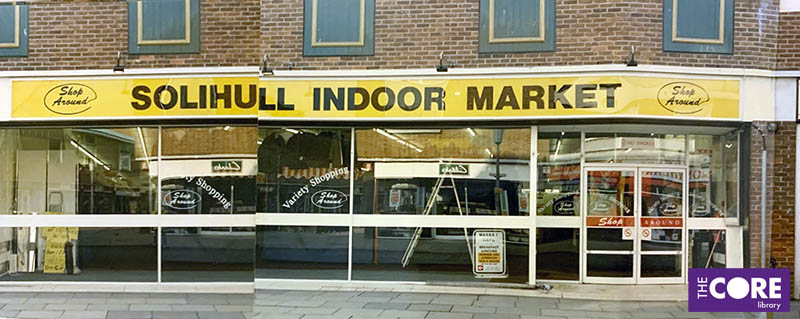
There were also concerns about the fate of the indoor market, which was situated where one of the planned entrances to Touchwood would be. The market had opened on 19th August 1989 as Solihull’s first regular indoor market, with an address of 100-106 High Street
The Hon. Secretary of Solihull Ratepayers’ Association wrote to the Solihull News 14th August 1998, urging that consideration be given to the needs of the users of the market. He noted that it was particularly popular with pensioners, and included a café, the only traditional butcher in the town centre, and a host of independent small traders.
When construction was underway, one resident of Church Hill, who had lived in Solihull since 1942, wrote to the Solihull Times in July 1999. The correspondent lamented the loss of mature trees that had been removed for the shopping centre, commenting that the town’s motto should be changed to “Urbs in Urbs.”
Revised plans
A start on the scheme was due to be made before the end of 1990 but was delayed after CityGrove, a company linked to one of the two developers of the scheme, fell into receivership in the summer of 1990. Although Touchwood Court developer, CityGrove in Town, was a separate entity from the collapsed CityGrove, it immediately reconsidered its own position in the Bredero-CityGrove Touchwood Court partnership.
The Solihull News 7th February 1992 announced that the £100m Touchwood Court project would still go ahead, despite the collapse of CityGrove. Epsom-based Bredero said they were keen to proceed and it was announced that new backing had been received from Grand Metropolitan, one of the UK’s largest developers. Solihull’s chief planning officer, Mr John Wilson, told the newspaper: “Solihull is such a strong retail area that the scheme is certain to happen, it’s just a question of when.”
Gracemount Developments was established in 1991 and was part-owned by Grand Metropolitan although, by January 1996, it was wholly owned by Paul Jillard and Keith Johnson from the former CityGrove in Town Ltd.
It was announced in March 1992 that plans for an underground service yard for trucks to deliver goods to the complex had been scrapped in favour of using open first floor delivery areas. It had apparently been realised that digging out an underground service yard would hit the water table.
The plans were approved by Solihull’s Policy Committee in March 1992 and the intention was for a planning application to be submitted in autumn 1992.
In the event, it wasn’t until March 1993 that plans were revealed, with Solihull’s Planning Committee giving its approval on 8th March 1993. The Solihull Times 12th March 1993 featured plans and artist’s impressions of the new centre.
Gracemount Developments/Bredero submitted a revised planning application (93/1867 – renumbered on the Public Access Planning Portal as PL/1993/00306/FULL) in December 1993. The application was for the comprehensive redevelopment of land at High Street/Station Road/Herbert Road and Homer Road for shopping, offices, multi-storey car parking and restaurant use, including associated servicing arrangement and highway improvements.
The revised plans saw the proposed Orangerie replaced with some medium-sized shop units. The entrance to the scheme from Manor Square was also redesigned with some changes to part of Beech Lane to form a group of small units to be called “The Cloisters.”
Plans to remove the Co-operative building in Station Square and replace it with an open area called St Augustine’s Square were also scrapped, although the developers said the Square could be provided as a future phase if they could acquire the building. In fact, the building was acquired after developers Lend Lease took over the Touchwood Court development, and the building was demolished to provide an entrance into John Lewis. Occupiers Midlands Co-operative Funeral Services moved to a new base at 677 Warwick Road in March 1999.
Proposals to site a large retail store next to a department store on the Magistrates Court side of the development were also switched to a site on the High Street. A basement car park was omitted and the deck was extended slightly to make the number of parking spaces 1,193 with 60 allocated for people with disabilities.
The Conservation Advisory Committee said they were disappointed at the loss of St Augustine’s Square and The Orangery from the scheme and were concerned about the design of four shops in Manor Walk.
Ian Such from Erdman Lewis, letting agents for Mell Square, said that he did not believe Touchwood Court would be able to attract the good anchor stores and without these the new centre would struggle to let the other units. The Estates Gazette said that Mr Such’s comments reflected the feelings of many, and that some experts viewed the development as “over ambitious.”
In April 1994 it was announced that work on Touchwood Court would begin within two years and that officials at Solihull Council were preparing Compulsory Purchase Orders for some High Street shops.
Solihull Carnival in June 1994 was thought to be the last in Tudor Grange Park as a result of the site being required by the Council for a car park during the construction of Touchwood Court.
The carnival was the highlight of Solihull Round Table’s fundraising activities and required extensive space as it included Bob Wilson’s funfair as well as local stalls and attractions. In the event, the Carnival went ahead in 1995 on the existing site.
In August 1994, Solihull Council, who owned the land on which the shopping centre was to be constructed, signed a contract with Gracemount Shopping Centres Ltd to develop Touchwood.
Compulsory Purchase Orders
In February 1995, it was announced that compulsory purchase orders would be served on shop owners who had failed to agree terms with the Council.
A public inquiry into the development was due to be held in autumn 1995 to consider objections from landowners. The Council owned six of the seven acres of the proposed site, and was planning to issue Compulsory Purchase Orders on the 30 remaining properties on the land it didn’t own.
Around 80 objections were received, the largest objector being the IM Group of Warwick, owners of five shops, the Indoor Market and a number of offices fronting Solihull High Street.
However, in January 1996, about a week before the expected start of a public inquiry, it was announced that IM Properties had been given permission to form a 50-50 joint venture with Gracemount Developments of Solihull to develop Touchwood. The new company would be known as Civic Shopping Centres Ltd.
The Commercial Director of IM Properties told the Birmingham Daily Post, 11th January 1996, that Solihull was under-shopped and that the lack of space for expansion meant that major department stores were locked out. He said that the development of Touchwood Court would “complete the retail circle with existing stores in Mell Square on the other side of the street.”
Trustees of the Manor House in Solihull High Street told the Solihull News in 1996 of their concerns for the Manor House’s garden, planted in 1994 and then the subject of a CPO, which would last for two years. The trustees said that they were not opposing the CPO as any damage would be rectified.
It was anticipated that construction would start in early 1997 for completion in 1999.
The public inquiry opened on Tuesday 16th January 1996 and lasted for three days, with only a handful of objectors turning up in person. Most objections related to the loss of the rear service road. Solihull Council expected to hear from the Department of the Environment in the summer of 1996. However, Solihull Council had to wait for a year for the all-clear, which was a surprise as it had been expected that approval would be a formality following the withdrawal of the bulk of the objections.
Government permission to proceed with the Compulsory Purchase Orders was finally announced in February 1997. However, developers Gracemount Developments, IM Properties plc and Solihull Metropolitan Borough Council, still needed to secure funding for the construction of the 27,870 square metres (300,000 sq ft) centre.
The delay meant that construction was then planned for completion in 2000 and for shops to open for Christmas 2000. It was announced in October 1997 that the long-awaited construction would begin around June 1998.
Construction works
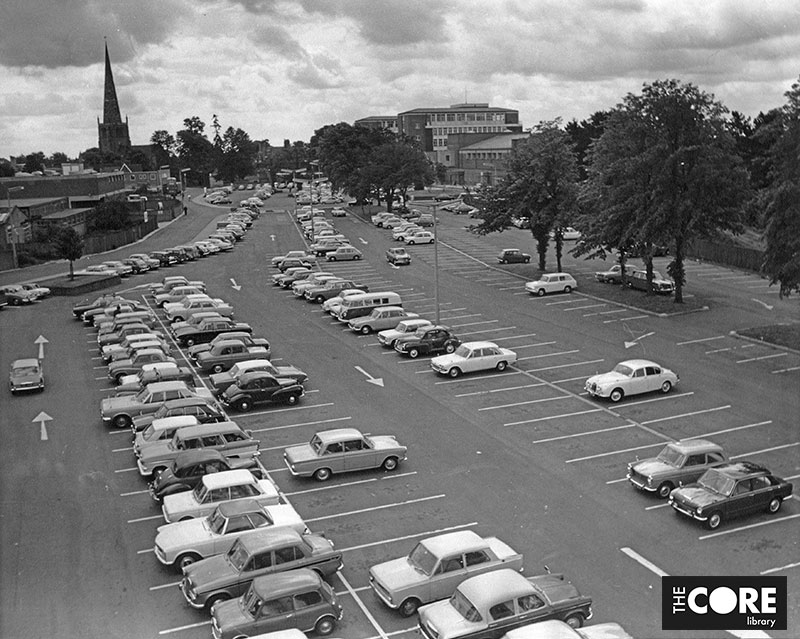
During the construction works, alternative provision was made to offset the loss of 558 car parking spaces for visitors to the library, theatre, and town centre shops.
Members of THUGS (Solihull Library Theatre Users’ Group) expressed concern about having to move scenery 100 yards from the nearest parking space, which they said would turn what was previously two hours’ work into a whole evening.
Long-stay parking at Monkspath Hall Road car park was increased with an additional 180 spaces.
Anchor store
In April 1996, House of Fraser announced that it would be taking 102,000 square feet of space at Touchwood Court for a new department store in Solihull. The anchor store would employ more than 250 staff and be direct competition for the recently refurbished Beatties store in Mell Square.
House of Fraser, owner of Rackhams in Birmingham and Leamington, had said that it had scoured the Midlands looking for suitable premises and had considered Merry Hill and Sutton Coldfield before deciding that Solihull was a better prospect. The retailer cited an affluent market of 200,000 people and a new shopping centre in the pipeline as being deciding factors.
However, in October 1997, it was announced that, although House of Fraser was keen to take the anchor store, alterations to the planned layout of the store could be needed to meet retail needs.
In July 1996, fashion retailer C&A confirmed that it would take on one of two 26,000 square feet “variety stores” at Touchwood Court, which would open in time for Christmas 1999.
Street trading
The forthcoming closure of the indoor market led to Solihull Council ending its 10-year ban on street trading and granting the first outdoor pitch to flower seller, Steve Parker, in September 1997.
He beat 15 other businesses to claim the prime spot at the junction of High Street and Drury Lane. Solihull’s Licensing Committee chose the florist over stalls proposing to sell baked potatoes, ice cream and hot dogs.
A new developer
In January 1998, it was announced that international developer Lend Lease had bought the Touchwood development rights from IM Properties for an undisclosed fee and that the anchor store would be John Lewis, which had close ties with the firm.
The decision was described as a blow for Birmingham, which had been wooing the John Lewis Partnership for two years, and for the other possible location, Merry Hill.
Motorway links and “the nature of Solihull” were given as deciding factors for the retailer choosing Solihull. Luke Mayhew, Director of John Lewis, said “The centre’s scale, quality and location suit our particular mix of trade.” (Solihull Times, 30th January 1998).
The deal saw Lend Lease becoming the owner of the Indoor Market and several shops. The Solihull News 30th January 1998 said that the signing up of John Lewis almost certainly guaranteed that Touchwood Court would be a success and that other retailers would be flocking to sign up for the remaining 50 units.
Expansion of Touchwood site
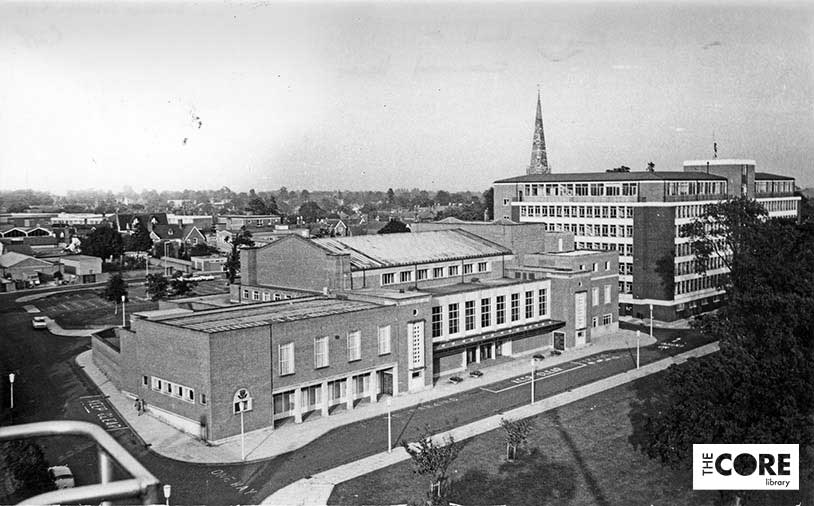
Solihull Civic Hall closed at the end of May 1998 and was demolished to create an entertainment complex including a cinema. The banqueting centre was costing the Council £170,000 per annum to run and was deemed to be in need of major refurbishment.
In February 1998, developers were invited to put forward ideas for the land, including the Civic Suite and its car park, as well as the Council House and Solihull Library. In the end, only the Civic Hall was redeveloped as part of Touchwood, after Lend Lease was selected as the preferred developer.
Revised plans
In October 1998, Lend Lease confirmed that 200 retailers had applied for the 80 available shop units.
An exhibition of the revised plans by partners in the project – Lend Lease, Gracemount, the John Lewis Partnership and Solihull Council – was held at Solihull Central Library 20th July – 8th August 1998. The partners said that they would listen to feedback before submitting revised proposals later in the summer.
Following consultation, the principal changes were:
- integration of a new entrance for John Lewis Partnership department store in Station Road
- environmental improvements on Station Road
- enhanced facilities for disabled people
The revised plans came before Solihull Council’s Planning Committee on 4th November 1998, which gave its approval but narrowly voted to allow the plans to go before Full Council in December 1998.
John Prescott, Secretary of State for the Environment, wrote to the Council in December 1998 with his decision not to intervene in the planning application, meaning the project could continue.
Site work was expected to start at the end of January 1999 as the ground was prepared for construction, which commenced on 7th April 1999. The planned completion was September 2001. The Birmingham office of Bovis Lend Lease was responsible for the project on behalf of its parent company, Lend Lease Corporation.
Solihull Indoor Market ceased trading at 5:30pm on 9th January 1999 in preparation for demolition works to begin for the creation of one of the main entrances to the new Touchwood Court shopping centre. The indoor market and adjacent vacant shop units were scheduled for demolition in June 1999.
On 6th May 1999, the count in Solihull’s local elections took place for the first time at North Solihull Sports Centre, as the traditional venue in Solihull – the Civic Hall – was being demolished to make way for Touchwood.
By April 2000, the skyline of Solihull town centre was dominated by eight giant tower cranes, the last of which was removed in January 2001.
The topping out ceremony for John Lewis was planned for July 2000, which also signalled the start of fitting out ready for opening in September 2001. Six custom-built escalators, each weighing around 10 tonnes and costing £100,000 were installed in January 2001.
At 650,000 square feet, Touchwood was the biggest shopping centre to open in the UK in 2001. It doubled Solihull’s retail floor space to 1.25 million square feet, making the town a regional shopping destination. A report in the Birmingham Post, 25th September 2001, said “it is difficult to over-estimate the opening of Touchwood on Solihull,” and referred to the town being in the Top 20 UK shopping destinations in the country.
Lend Lease’s project director told the newspaper that Touchwood would end the spending drain that “was taking wealth outside the West Midlands” as people now had the shops they used to travel for on their doorstep. Pre-Touchwood town centre sales of some £109m were expected to double to £251m, with John Lewis and Cineworld leading the commercial boom.
At the time of opening on 5th September 2001, Touchwood had a 97 per cent occupancy rate, with its 69 retailers and bars reading like a “who’s who of the retail and leisure world,” according to the Birmingham Post, 17th August 2001.
Retailers included:
- Gap
- H&M
- French Connection
- Top Man
- Next
- Top Shop
- Mango
- Miss Selfridge
- Karen Millen
- Ernest Jones
Restaurants and bars included:
- TGI Fridays
- Yellow River Café
- Casa
- Fish!
- Tiggis
- Harry Ramsdens
The shopping centre created 2,300 jobs, with Solihull’s Employment Service and Training & Enterprise Council being closely involved in recruitment.
Awards
Within a year of its opening on 5th September 2001, Touchwood won three major awards for its in-town integrated shopping and entertainment:
- UK Retail Destination of the Year
- Best Major New Shopping Centre
- Best Opening – Purple Apple marketing award from British Council for Shopping Centres
The opening of Touchwood also enabled Solihull to improve access to the town centre, with improvements to pedestrian signage, cycling facilities, public transport and the opening of Shopmobility in Touchwood. As a result, Solihull was shortlisted by the British Council for Shopping Centres in their Accessibility and Transport Awards 2002.
Lend Lease paid for a £3m package of road improvements to the town centre including:
- Herbert Road was made one way to help ease congestion.
- A large detached house on the corner of Station Road, used by Solihull Social Services as a Family Centre, was demolished in October 1999 to enable the Blossomfield roundabout to be widened and equipped with traffic lights at each of its five junctions.
- A powerful computer system to automatically control the traffic flows
Touchwood welcomed 16 million shoppers in its first year, 20 per cent more than forecast. 97 per cent of shoppers reported a high level of satisfaction with their visit.
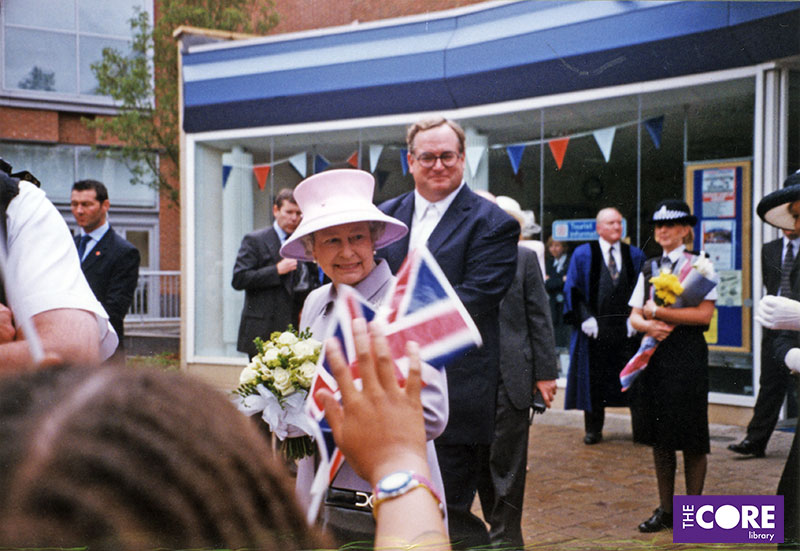
H. M. Queen Elizabeth II visited Solihull during her Golden Jubilee year, being given a tour of Touchwood by its architect, Eric Kuhne, on 2nd July 2002. A commemorative pillar in Theatre Square marks the visit.
Story telling through architecture
Architect Eric Kuhne (1951-2016) said that he had tried to reflect Solihull’s unique “town in the country” heritage and the family feel of the borough in his designs for Touchwood.
A covered street theme and smart arcades, modelled on the traditional English design of London’s Picaddily and Burlington Arcades, complete with street names and “leisure knuckle” meeting places or “atria halls” were key to his design. These meeting places included one with a countryside theme and the other with a map of the British Isles on the ceiling.
The Solihull Sonnet frieze on the bulkhead above the Crescent Arcade linking the two meeting places, was designed to tell “the history of Solihull from its early medieval days as a chartered market town, to the new Elizabethan era of Touchwood and beyond.” Read more about the Solihull Sonnet in our earlier article.
At the Mill Lane entrance to Touchwood is the “Mindship” a striking sculpture by artist Brigit Hegarty, who was commissioned by Eric Kuhne Associates through Free Form Arts Trust. The artist said:
The design of 25 feet is reminiscent of a boat in form inviting the visitor at the entrance of the arcade to journey through the space of the Touchwood shopping centre evoked into the arts and crafts local history.
The sculpture brief was to base the design for Mill Lane entrance on the arts and crafts movement and be made of wood. The artist used inspiration from the architect and designer Charles Rennie Mackintosh and wood forming bentwood techniques which inspired designs such as the Power Play chair for Knoll by Architect and designer Frank Gehry.
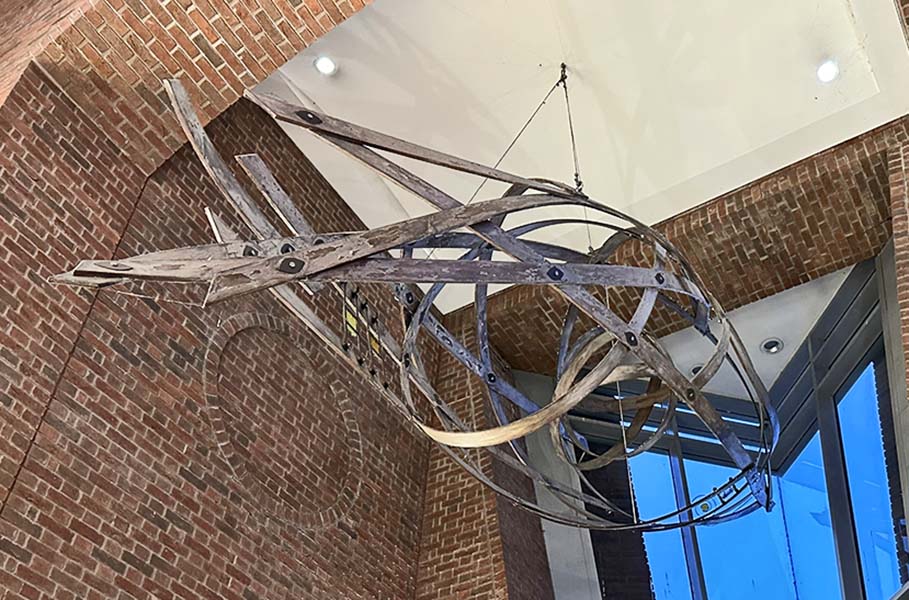
The final sculpture was made in Dalston London at the Free Form Arts Trust warehouse. Construction team was Brigit Hegarty, the lead construction was Rupert Allen, a specialist boat maker and woodworker from Wales, and Doug, construction assistant.
The sculpture was steam formed and fixed with tailored brass fixings which also displayed the coloured glass features at the front and rear of the sculpture.
Touchwood II
Even before Touchwood had opened to the public, it was understood that a future expansion would extend the shopping centre in due course.
At the time of the 10th anniversary of the opening of Touchwood, the centre’s general manager told the Solihull News of his long-term hope for “Touchwood 2” – a major expansion of the shopping centre.
At its meeting on 20th December 2012 Solihull’s Cabinet gave in principle its approval to a proposal for the expansion of Touchwood and for further negotiations with Lend Lease.
In October 2014, Touchwood’s owners, Lend Lease, signed an agreement with Solihull Council for the expansion of Touchwood.
The Priory, Orchard House and Civic Suite were planned for demolition as part of Touchwood 2, which would also have seen a new opening onto Solihull High Street with a number of businesses, including Mervyn Danes estate agency, BB Boutique, Revital Health Shop and Letting Places forced to move. The Missoula bar and nightclub would also close as part of the development.
Planning approval was granted in 2015, and Lend Lease said that it was intending to be on site in 2016 with the project being completed in 2018.
Although much part of the land affected was owned by the Council and the Lend Lease Retail Partnership, there were a number of other ownerships that were required to complete the site, requiring Compulsory Purchase Orders to be made.
Following public objections to the proposals, it was announced in January 2016 that the Department for Communities and Local Government would conduct a Compulsory Purchase Order (CPO) inquiry. The five-day inquiry opened on 17th May 2016, at which time there were 12 remaining objections, plus 29 non-qualifying objections.
In December 2016, the Secretary of State for Communities and Local Government confirmed the The Metropolitan Borough of Solihull (Touchwood Extension, Solihull) Compulsory Purchase Order 2015.
However, Lend Lease Retail Partnership announced in 2017 that, following a strategic review, it wasn’t in a position to proceed with the proposed expansion of Touchwood. Planning consent for the proposed 30 retail outlets and restaurants expired before work began.
In 2021, US retail giant The Ardent Companies bought Touchwood from Lend Lease Retail Partnership (LLRP).
Tracey
Library Specialist: Heritage & Local Studies
The Core Library, Solihull
© Solihull Council, 2026.
You are welcome to link to this article, but if you wish to reproduce more than a short extract, please email: heritage@solihull.gov.uk


Leave a Reply