On 3rd August 1944, Solihull Urban District Council purchased Elmdon Hall and its grounds from Mr Walter Waters (1881-1963) for use as a public park. Mr Waters, a wholesale fish merchant of St Bernard’s Road, Olton, had purchased the Elmdon Estate in 1931 but never actually lived there.
Spooner family
Abraham Spooner (c.1690-1788), a Birmingham banker, had purchased the Elmdon Hall estate c.1760 from Paul Baine, who was Lord of the Manor of Elmdon in 1752. Paul Baine was described as “at Elmdon Hall” in an article in Aris’s Birmingham Gazette, 5th March 1759.
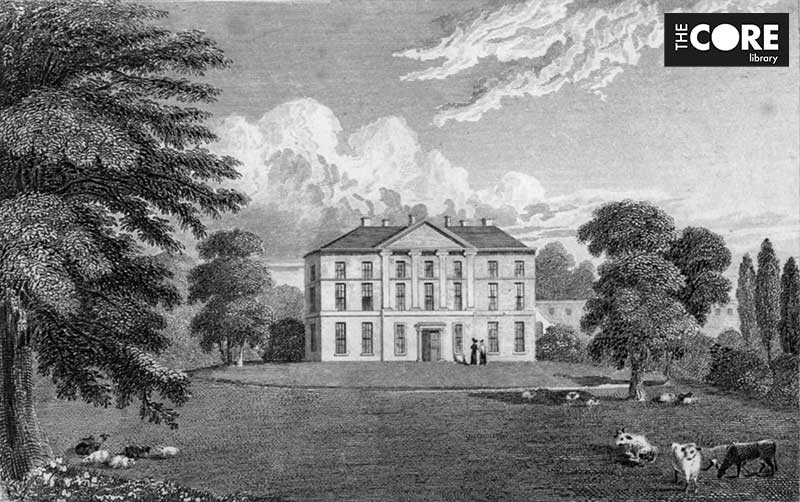
Elmdon Hall was built between 1785 and 1795, initially for Abraham Spooner (1690-1788) and then continued by his son, Rev. Isaac Spooner (1736-1816). Nick Kingsley, in Landed Families of Britain and Ireland, suggests that, given Abraham Spooner’s advanced age when the construction of Elmdon Hall began, it was likely that Isaac Spooner was actually the driving force behind the building of the hall.
Engraving of Elmdon Hall
Abraham Spooner Lillingston
In 1797, Isaac Spooner’s eldest son, Abraham, born on 6th November 1770, married Elizabeth Mary Alice Lillingston, daughter and heir of Luke Lillingston of Ferriby Grange, Yorkshire. King George III granted them the right to assume the surname of Lillingston:
From the London Gazette, Whitehall, August 16 The King has been pleased to give and grant unto Abraham Spooner, Esq. (son and heir apparent of Isaac Spooner of Elmdon, in the County of Warwick, Esq.) and to Elizabeth Mary Agness Lillingston, Spinster, only child and heir of Luke Lillingston, late of Ferriby Grainge, in the county of York, Esq., deceased, his royal licence and authority that, immediately upon the solemnization of their intended marriage, they may, in compliance with the injunction contained in the last will and testament of the said Luke Lillingston, take and use the surname and bear arms of Lillingston, and that the said surname and arms may be used and borne by their issue; such arms being first duly exemplified according to the laws of arms, and recorded in the Herald’s office. And also to order that his Majesty’s said concession and declaration be registered in his College of Arms.
Aris’s Birmingham Gazette, Monday 28th August 1797
Abraham Spooner Lillingston enlarged the estate by purchasing the Manor of Hampton-in-Arden from the Crown in 1823.
Abraham Spooner Lillingston died on 29th May 1834, after being hit by a falling oak tree whilst supervising the felling of timber on the estate. Following his death, there was a five-day sale of his furniture and effects, beginning on 19th October 1835. The first three days were occupied in the sale of “the needful appendages of nearly 50 chambers, dressing and sitting rooms.” The fourth day saw the sale of “the Drawing-Room, Dining Room and Parlour Suits” whilst the final day was occupied with “kitchen requisites, effects of house-keeper’s store room, the Laundry, Mangle, and Dairy utensils… etc.”
Abraham Lillingston was succeeded by his eldest son, Isaac William Spooner Lillingston (1802-1850), who was apparently known as William.
It was stated in 1831 that the heir apparent to the estate “was so partial to Scotland, that the family estate… is to be disposed of for the purposes of investing the proceeds in that county.” (Worcester Journal, 1st December 1831).
An advertisement appeared in Aris’s Birmingham Gazette, 21st November 1831:
To be sold by private Treaty, the Mansion House at Elmdon, in the county of Warwick, with the adjoining Estates, containing nearly 3000 acres, together with the Manors of Hampton in Arden and Elmdon. The Game on the estates to be let.
In fact, the Elmdon Hall Estate was not sold until 1840. In the same year, William Lillingston also sold the Manor of Hampton to Sir Robert Peel.
Lillingstons in Scotland
In 1832 (Isaac) William Spooner Lillingston married Katherine Innes Lindsay (1811-1875), great-niece and heiress of Sir Hugh Innes, bart. (1764-1831), of Balmacara, Lochalsh, Ross-shire. The couple had apparently met in 1830 when William Lillingston was in search of land to buy in Scotland and was invited to stay at Balmacara by Sir Hugh Innes.
After their marriage in Edinburgh, the Lillingstons moved to Balmacara House to manage the estate full-time, although it had been left in trust and, according to an obituary in the Gentleman’s Magazine, January 1851 (p.440), didn’t come under William Lillingston’s sole management until 1844.
One of William Lillingston’s first acts on coming into full possession of Lochalsh was to relieve tenants of all responsibility for arrears of rent. He also supported tenants during the failure of the potato crop and allowed crofters to expend half their rent in improving their land. He gave money to those who wished to emigrate. William Lillingston’s health declined from the mid-1840s and he died at Balmacara House on 3rd December 1850, aged 48.
He was so well thought of by his tenants that they contributed towards the erection of an obelisk in his memory at the burial ground of Kirkton in Lochalsh.
Elmdon Hall rented out
Following the death of Abraham Spooner Lillingston in 1834, and with his son and heir, William, settled in Scotland, Elmdon Hall was leased to Jane, Countess Dowager of Rosse, until her death, aged 83, on 25th January 1838.
Lady Jane King, as she was before her marriage, was the daughter of Edward King, 1st Earl of Kingston. She married Laurence Harman Parsons, 1st Earl of Rosse (1749-1807), in 1772 and is the only non-family member to be interred in the Spooner family vault at Elmdon. An announcement of her death described her as a “charitable and aimiable lady.”
After the death of the Dowager Countess of Rosse, the contents of Elmdon Hall were sold by auction at the hall, beginning on 9th July 1838.
Sale of Elmdon Hall 1840
The sale of the Elmdon estates by William Lillingston took place on Thursday 8th and Friday 9th October 1840. An article in Aris’s Birmingham Gazette, 5th October 1840, describes the sale of the “capital mansion house called Elmdon Hall, formerly the residence of A. S. Lillingston, Esquire, and lately of the Countess Dowager of Rosse, deceased, and about 2400 acres of land.” The article gives an extensive description of the hall and the 40 Lots included in the sale.
William Charles Alston (1794-1862) purchased the hall and, the following year, on 8th December 1841, he married Elizabeth Anne (1812-1891), youngest daughter of the late Charles Fetherston (né Dilke) (1763-1832) of Packwood. The marriage took place at the bride’s parish of Yardley, and the couple then set up home at Elmdon Hall.
A story in the Evening Despatch, 30th July 1936, suggests that W. C. Alston happened to hear of the hall being up for sale whilst he was staying at a hotel. He allegedly strolled into the auction hall and half an hour later had bought the Elmdon Hall estate which he apparently had never seen!
Alston family
William Charles Alston died at Buxton, Derbyshire on 18th August 1862. Under the terms of his Will, dated 2nd July 1858 he gave the Elmdon Hall estate, together with his Olton estate (which he purchased in 1858 from the Rev. Archer Clive and his wife) to his wife during her widowhood.
The Will specified that after her death the estate would then be for the use of each of his sons first and then to the use of his sons’ other sons successively according to their respective seniorities in tail, and to his sons first and other daughters successively according to their respective seniorities in tail.
Anyone who inherited the estate who did not have the surname Alston was required to take the surname – either alone or in addition to their existing surname – within one year of receiving their entitlement to the estate.
The first tenant in tail for life under the will was the testator’s widow, Elizabeth Ann Alston who died on 14th November 1891. Known locally as “Lady Alston,” she presented the children of the village with red cloaks every Christmas, resulting in the “Little Red Riding Hoods” of Elmdon being instantly recognisable when they ventured into neighbouring areas.
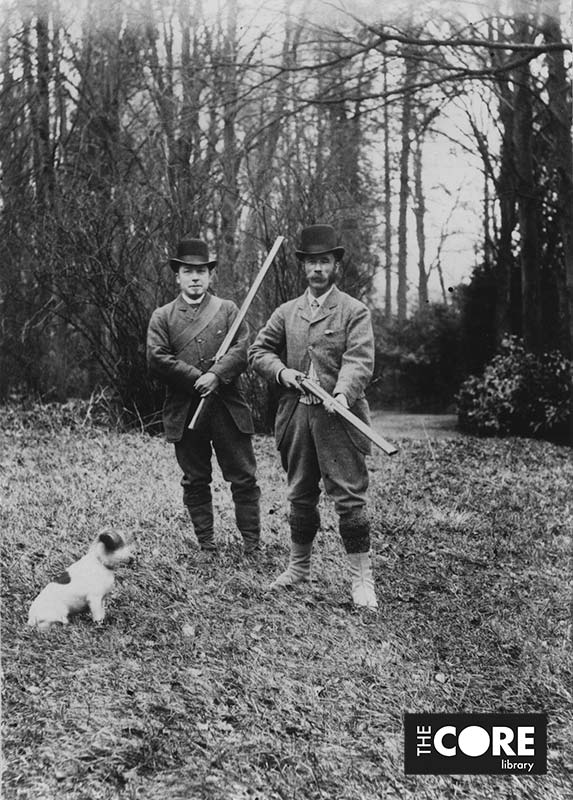
Squire Alston (r) with Frank (surname unknown) and dog, Ruby, in Elmdon Park, c.1900
Mrs Alston was succeeded as tenant for life by her eldest son, William Charles Alston (1842-1917) – popularly known as Squire Alston – who never married and died on 27th June 1917, aged 74.
Reminiscing to the Solihull News in 1962, an 85-year-old whose husband had worked at Elmdon as a young man said:
It was a very large house with huge very cold rooms – it was definitely a bachelor’s establishment. There was a lot of gold panelling and ornamental carving in the downstairs rooms and I remember that the bedroom doors were very beautiful red mahogany.
As a younger man, Squire Alston was prominent in the Warwickshire Yeomanry, attaining the rank of Major and honorary Lieutenant-Colonel. He was one of the founders of the Birmingham Conservative Club and a founder member of Arden Golf Club. In earlier life he was a fine cricketer and he and his brother, J. F. Alston, were regular members of the old-time Warwickshire cricket eleven, with Elmdon Park hosting many of their county matches.
Squire Alston’s only brother, James Fetherston Alston – apparently known locally as “Mr Jimmy” – had died in 1897 aged 52. Therefore, in accordance with their father’s Will, William Charles Alston was succeeded in 1917 as tenant in tail for life of Elmdon Hall by the eldest of his sisters, Elizabeth Louisa Roberts West (née Alston) (1845-1929).
Alston-Roberts-West family
Elizabeth Louisa Alston had married James Roberts West on 25th November 1869, thus taking her husband’s surname instead of her maiden name. Therefore, under the terms of her father’s will, she adopted the name Alston within a year of becoming entitled to the estate. A Royal Licence was issued on 27th April 1918, giving and granting:
unto James Roberts West and Elizabeth Louisa his Wife that they might take and thenceforth use the Surname of Alston in addition to and before those of Roberts West AND that J. Roberts West might bear the Arms of Alston quarterly with those of his own family AND that the said surname and Arms might in like manner be taken borne and used by the issue of their marriage
Mr & Mrs Alston-Roberts-West seem to have lived in Leamington Spa in the early years of their marriage, although they were recorded at Ryde, Isle of Wight at the time of the 1881 census. James Roberts-West succeeded to his family’s estate at Alscot Park, Stratford-upon-Avon in 1882, so the couple was mostly based there from this date, although still apparently retaining a home in Ryde.
James Alston-Roberts-West died in June 1918 and, his widow returned to Elmdon after his death (according to her obituary in 1929), although she then moved to Ryde House, Isle of Wight.
She was known still to visit Elmdon Hall from time to time, and she allowed the grounds to be used for special events. For example, in 1919, a Welcome Home Gala Day was held in Elmdon Park to welcome home those from Birmingham and Coventry with a cycling connection who had served in the First World War.
Mrs Alston-Roberts-West’s sister, Mrs Mary Anne Smythe, died on 14th May 1927, aged 77, at her home in Newbold Beeches, Leamington Spa. Her Will expressed a wish that her remains be borne into Elmdon Hall via the front door, into the hall, and then out through the South door, along the private walk to the church. Her husband, Mr William Mynors Smythe, had been interred in Elmdon churchyard on his death 10 years earlier.
1920 sale of outlying portions
On 18th November 1920, by direction of Mrs Alston-Robert-West, “outlying portions” of the Elmdon Hall Estate were sold at auction. These included: Olton Hall; Dunstan House, Elmdon; Olton golf course and club house (formerly Olton House Farm); the Gables, corner of Coventry Road and Damson Lane, Elmdon; the Anchor Inn and Solihull Wharf; Foredrove Farm, Elmdon Heath; Dunstan Farm; Moat House Farm; Row Wood Farm, Lode Lane; Olton Farm; Tan House Farm; Odensil Farm; Dove House Farm; Ulverley Hall Farm; Olton Mill and Mill Pool Spinney. A PDF of the sale catalogue is available via our online catalogue.
By the time of the 1921 census, Elizabeth Louisa Alston-Roberts-West was recorded as living at Ryde House, Isle of Wight, which is where she died on 8th June 1929. She was buried at Preston-on-Stour, Warwickshire.
Elmdon Hall at this time is known to have been in the care of housemaid, Hannah Mary Just (1864-1952), although Mrs Alston-Roberts West was a regular visitor to Elmdon and left a legacy of £200 to her housemaid, Hannah Just, “in the hope that she will take care of my three cats so long as they live.”
Mrs Alston-Roberts-West was succeeded as tenant for life in tail by her eldest son, James Bowmont [sometimes recorded as Beaumont] Alston-Roberts-West (1871-1942). The Abstract of Title of the estate describes him as being “at the date of her death and still is a person of unsound mind.”
The estate was advertised for sale by auction in 1930, but a dispute in Chancery meant that the sale actually took place in 1931.
1930/1 sale of Elmdon Hall
The 1930 sale particulars included eight lots described as the “remaining portion of the Elmdon Estate” and covering 647 acres. The catalogue notes that shooting over the whole estate was let until February 1931 at a rental of £50 per annum. Fishing in the lake was also let for the same period at £10 per annum.
Although the contents of Elmdon Hall were sold over three days 19th-21st August 1930, the right of the tenant for life to sell the estate itself must have been questioned.
Mr Justice Maugham, in the Chancery Division, ruled on 25th February 1931 that Mr J. Bowmont Alston-Roberts-West, the tenant for life of the Elmdon Hall estate, near Birmingham, was entitled to sell the estate without prejudice to his interests, under the will of his uncle, the late Mr William Charles Alston.
It was stated that a large portion of the estate was sold during the time of the previous tenant for life. What was left was a large mansion house, “in which it was impossible for anybody to live in these days“, and about 650 acres of land. A PDF of the 1930 sale catalogue is available via our online catalogue.
The sale finally took place by auction at the Grand Hotel, Birmingham on 6th May 1931. Lot 1 – Elmdon Hall, including pastures, gardens, farm buildings, village school, a lodge and a number of cottages, together covering an area of over 114 acres – reportedly sold for £3,700. Whar Hall Farm (a sporting estate of over 338 acres) sold for £7,900 whilst the Village Farm, with 80 acres, sold for £5,500.
The conveyance between the seller, James Bowmont Alston-Roberts-West of “Moorcroft,” Hillingdon, Middlesex, acting by Reginald Montagu Alston-Roberts-West of Alberton, 107 The Drive, Hove, Captain (retired) in the Royal Navy, and Charles Robert Roberts West of Cheam, Surrey (The Trustees) and the purchaser, Walter Waters of Oakleigh, St Bernards Road, Olton, was dated 8th July 1931 and the price given in the conveyance was £4,388.
On 24th March 1932, Ludlow Briscoe & Hughes, agents for Walter Waters, agreed to let the village school to Canon Harrison Goodenough Hayter on an annual tenancy for an annual rental of £13, payable quarterly upon each of the recognised quarter days. The first payment of £3 5s was to be made on 24th June 1932.
James Bowmont Alston-Roberts-West died in 1942 at Moorcroft House, Hillingdon, London a private asylum, which was established by 1810 and closed in 1947.
Walter Waters never lived at Elmdon Hall, and by 1939, the Coventry Herald was referring to the “derelict Elmdon Hall.”
An article in the Birmingham Daily Gazette, 5th November 1936, stated that Elmdon Park was “in the market for building development purposes; the future of Elmdon Hall itself, which is in the extensive picturesque grounds adjoining the Park, is at present uncertain.”
Presumably, the plans for the site were affected by the outbreak of war.
Second World War
It has been said that during the Second World War the house was acquired by the local council for use by the Home Guard, but that after 1945 it was largely abandoned and left empty. However, this is apparently untrue.
The house was described in a 1939 newspaper article as “now derelict” and, by 1940, as “falling slowly to ruin in a jungle garden.” Although the Home Guard carried out manoeuvres in the grounds of Elmdon Hall, it seems that they were not actually stationed at the Hall itself, which was already uninhabitable.
On Thursday 10th April 1941 some 60 soldiers spent the night sleeping at Elmdon Park School, having been evacuated from the airport as a result of a delayed action bomb. Gerald Davison in A Model Country School notes: “This entry also shows that Elmdon Hall was already too dilapidated and unsafe to use for any purpose, or the soldiers would have stayed there. Claims that the Hall was used by the Home Guard, or Fire Watchers, have little to substantiate them.”
In November 1942, surveyors and auctioneers, Ludlow, Briscoe & Hughes, acting as agents for Walter Waters, agreed a contract with F. Claridge of Sheldon, Birmingham, for the demolition of “Elmdon Hall and Buildings on the Western side of the drive leading from the Rectory to Damson Lane.” The demolition was to take place “within 12 months of the termination of the present war.”
A public park
J. Webb wrote a letter to the Birmingham Weekly Mercury, 19th February 1989 reminiscing about visiting Elmdon Park after moving there as a child in the 1930s:
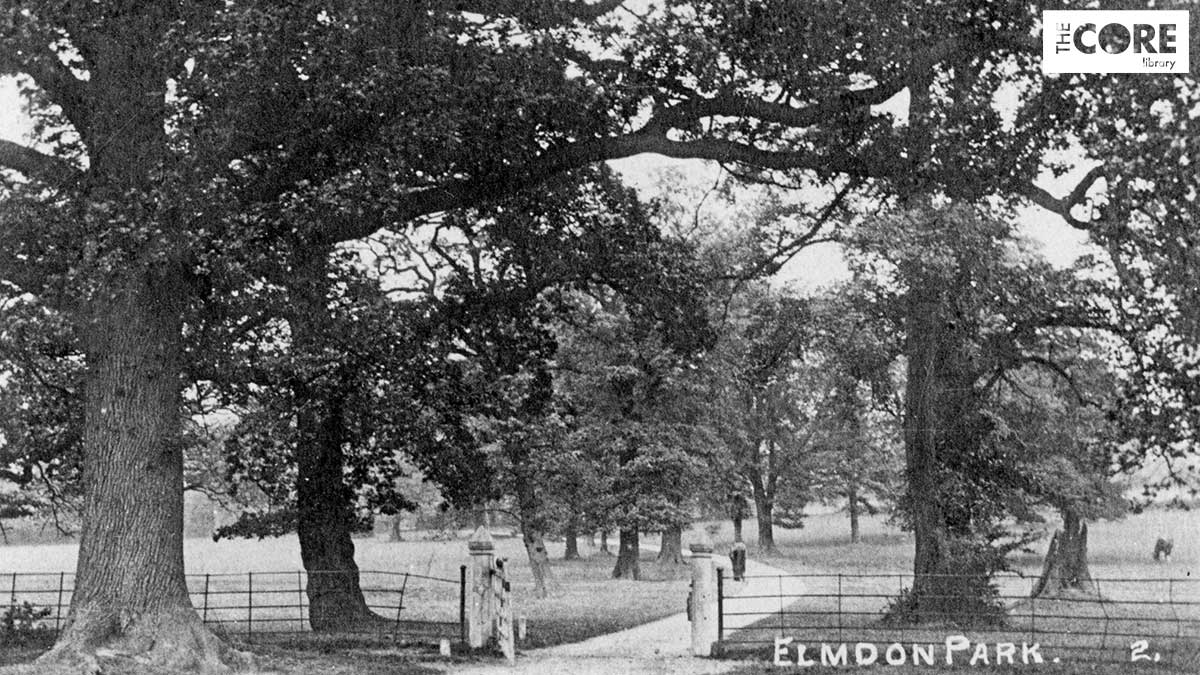
Elmdon Park was beautiful. It had all types of trees, woodlands carpeted with bluebells, and rolling meadows with every kind of wild flower… When it snowed the whole park was a winter wonderland, and everyone assembled at the top of the hill by the Great Manor. Sledges sped down the steep slopes at terrific speeds. Occasionally someone ran into the brook.
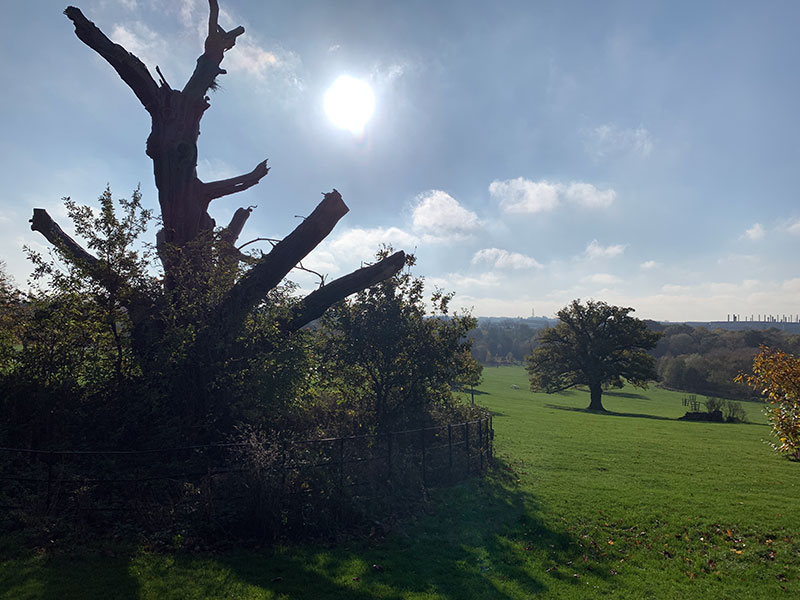
Increment dating suggests that the veteran Sweet Chestnut (Castanea Sativa) in Elmdon Park dates from 1518
Before the end of the war, and so before the demolition of the hall, Solihull Council had purchased Elmdon Hall estate for use as a public park.
The Birmingham Daily Post, 20th May 1944, noted that the purchase was being made from revenue, out of a sum specially set aside for land purchase. The purchase formed part of the open spaces plan prepared by the Post-War Development Committee, and was described as the third large estate recently to come into the possession of the Council for parks or open spaces. The other two were Jobs Close Estate at Knowle, and Brueton Park, the gift of Mr Horace J. Brueton.
The same article noted that the “new estate cannot, owing to certain tenancies and for other reasons, be opened to the public immediately. Notice will be given when formal opening is possible.” We haven’t been able to find any details of a formal opening and researchers from Elmdon Park Support Group tell us that there was no official opening of the park.
Demolition
Although some sources give the date for the demolition of Elmdon Hall as 1957, this is apparently not the case. Warwickshire County Record Office’s catalogue gives the demolition date as 1948, and the Coventry Evening Telegraph, 25th August 1948, refers to the “empty shell of what, not so many years ago, was a handsomely-furnished mansion amidst wide lawns.”
Researchers from Elmdon Park Support Group tell us that the 1948 date is supported by anecdotal evidence from local residents who were around at the time.
A newspaper cutting from the Evening Despatch in 1946 (exact date unknown) notes that Elmdon Hall “may shortly be dynamited.” The hall was due for demolition and it was decided that the cheapest and quickest way to carry this out would be to blow it up. However, there was a delay because of the shortage of licensed dynamiters.
An article in the Coventry Evening Telegraph 8th December 1950 mentions the church “standing in the park of a now-vanished Elmdon Hall.”
By 1954, the site was described as “Now shamefully nothing but a mass of rubble” (Solihull News 13th March 1954). Charles Lines, writing in the Coventry Evening Telegraph on 9th December 1955 mentions the “vanished ‘seat’ of the Spooners and Alstones,” and notes “bricks, mounds and a few pieces of coping-stone now indicate where Elmdon Hall stood with its pillared saloon, vast servants’ quarters and seemingly endless passages.”
The rubble from the demolished hall was left in situ for some time, with the Coventry Evening Telegraph of 6th December 1957 referring to “a pile of rubble” marking the site of Elmdon Hall.
The Coventry Evening Telegraph, 4th October 1969, reported that some of the old woodwork from Elmdon Hall had been incorporated into Meadow Croft, an enlarged former farmhouse or cottage, at Fen End, near Kenilworth.
In 1987, the owner of Elmdon Cottage, which was formerly the home of the estate manager of Elmdon Hall, stated that he had the “only piece of the hall which remains” – a 5ft pillar from the porch, which he had incorporated into the cottage’s walled garden.
Development of the park
The Birmingham Daily Post, 31 December 1959 notes:
Solihull Council has approved recommendations by its Parks Committee for the development of Elmdon Park. The Ministry of Housing has already announced that it is prepared to issue loan sanction for the first stage of the development of the park, estimated to cost about £17,500.
The Solihull News 27th January 1962 reported that “work on altering the course of the stream has been virtually completed and an outfall to the lake has been provided. The lake has been refilled and covers an area of two acres. Planting and other work around the lake is in progress.”
In 1983, part of the park containing the remains of the estate’s walled garden was leased to Warwickshire Wildlife Trust for use as a nature reserve.
Elmdon Nature Park is a designated Green Flag Park and a Local Nature Reserve.
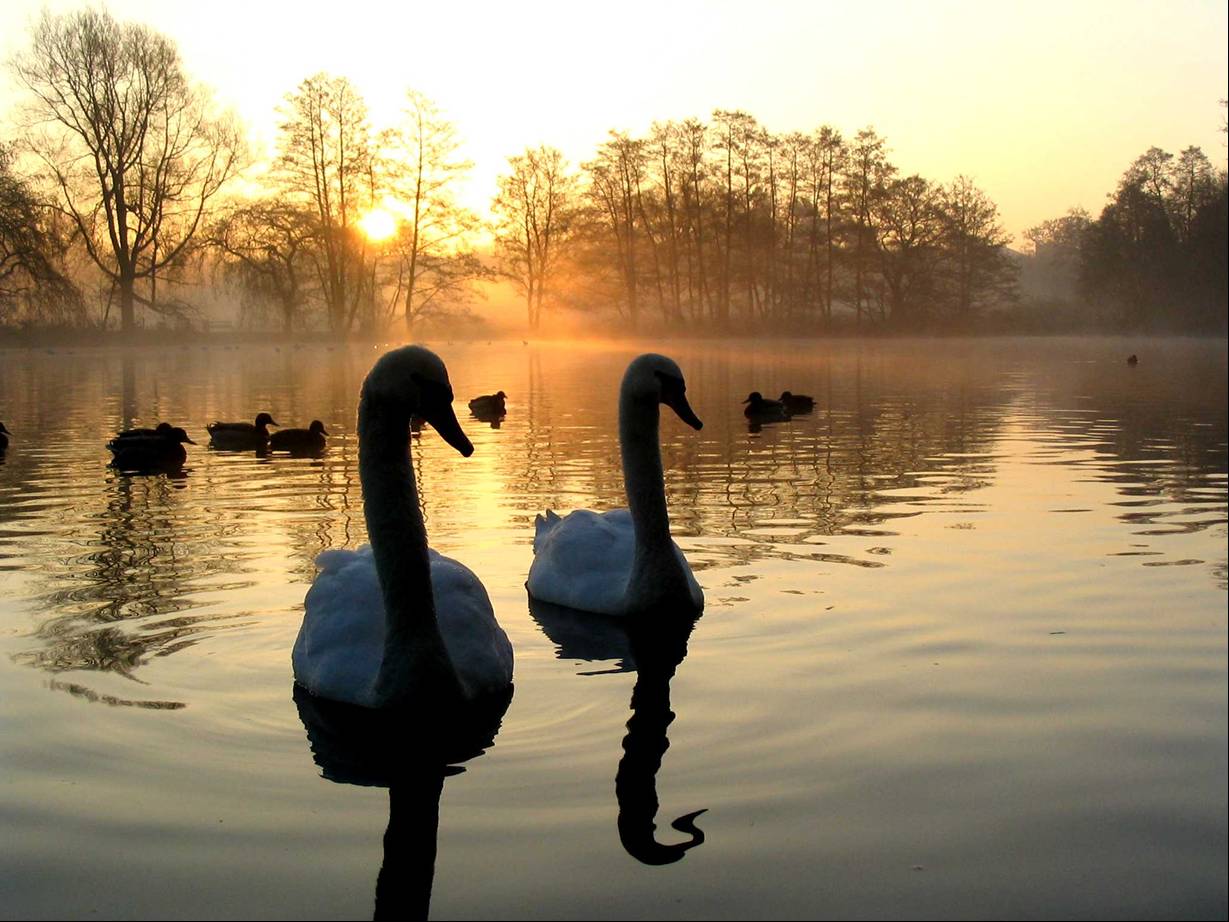
Swans at Elmdon Park lake, 2005
Elmdon Terrace
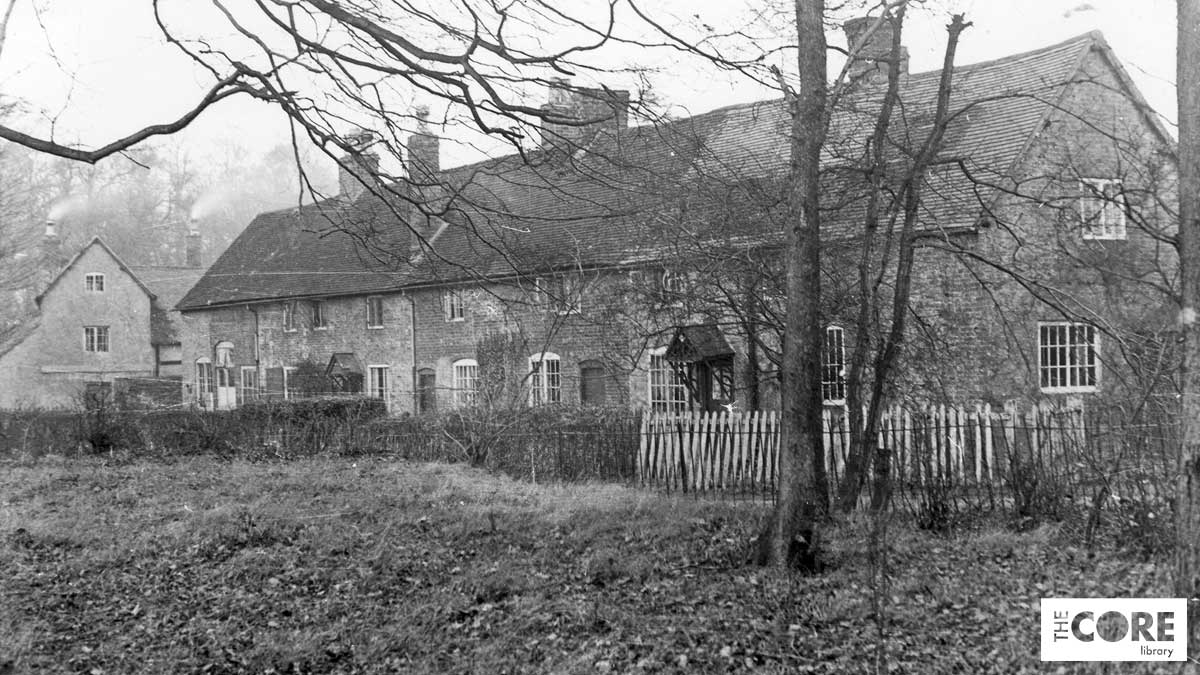
The inhabitants of Elmdon Hall were not the only residents of the park – a row of 19th-century cottages, Elmdon Terrace – also stood in the park until the 1960s, with one of the cottages forming the local elementary school.
Elmdon Terrace. The school was in the end cottage on the left.
The isolated cottages did not have running water until the 1950s when Solihull Urban District Council decided to lay a water main to the six cottages, at a cost of £760. This would not involve providing a water supply to each individual cottage but would just be a single standpipe and tap. In response to complaints about the cost, it was pointed out that, over 12 years, the cost would be less than the existing system of twice-weekly delivery in tanks (Evening Despatch, 22nd February 1950).
Holiday Camp at Home
On Monday 22nd 1960, a week’s “holiday camp at home” opened at Elmdon Park. Organised for children in the Elmdon area by church workers and theological students, the aim was to help children to overcome boredom in the summer holidays, to train them in leadership and let them see the church in action.
Children would eat and sleep at home and go each day to the camp in Elmdon Park. They were offered the opportunity to take part in sports and competitions, produce their own play, give puppet shows and attend special services at Elmdon Parish Church.
Elmdon Park Beacon
The beacon that now stands on the site of Elmdon Hall was installed in 1992 as part of “Beacon Europe” project when over 1000 beacons were lit across the 12 countries of the European Community to mark the start of the Single European Market. The beacon in Elmdon Park was lit for the first time on 31st December 1992 by the Mayor of Solihull, Councillor Brian Chapple.
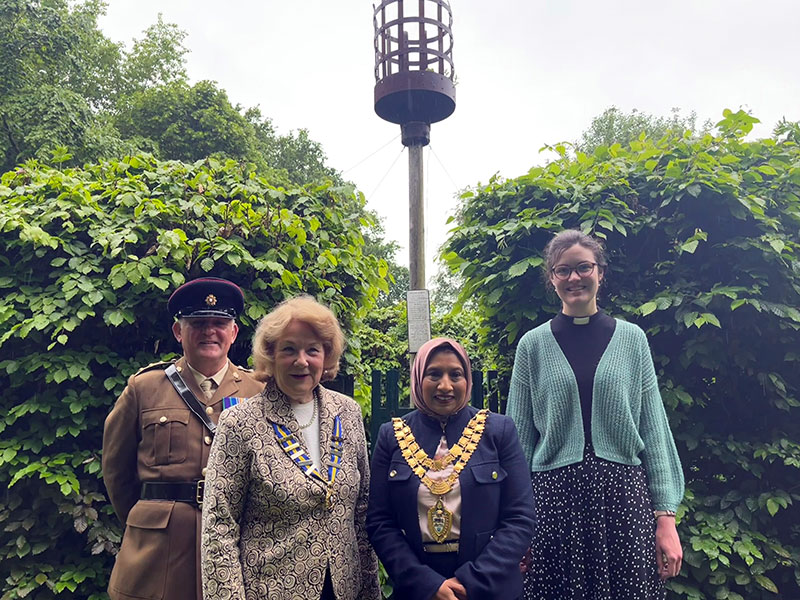
The Mayor of Solihull, Councillor Shahin Ashraf MBE, with (l-r) Captain Alan O’Brien of the Royal Logistic Corps, Elaine Butler from the Royal British Legion, and Elmdon Church rector Rev. Bekah Clark, 2024
The beacon is also known to have been lit for the following occasions:
15th May 1994 for the “On Fire Celebrations” celebrating the Christian religion
8th May 1995 for the 50th anniversary of VE Day as part of a national chain of beacons
31st December 1999/1st January 2000 for the Millennium
21st April 2016 to mark Queen Elizabeth II’s 90th birthday
2nd June 2022 for Queen’s Elizabeth II’s Platinum Jubilee
6th June 2024 to mark the 80th anniversary of D-Day
8th May 2025 to mark the 80th anniversary of VE Day
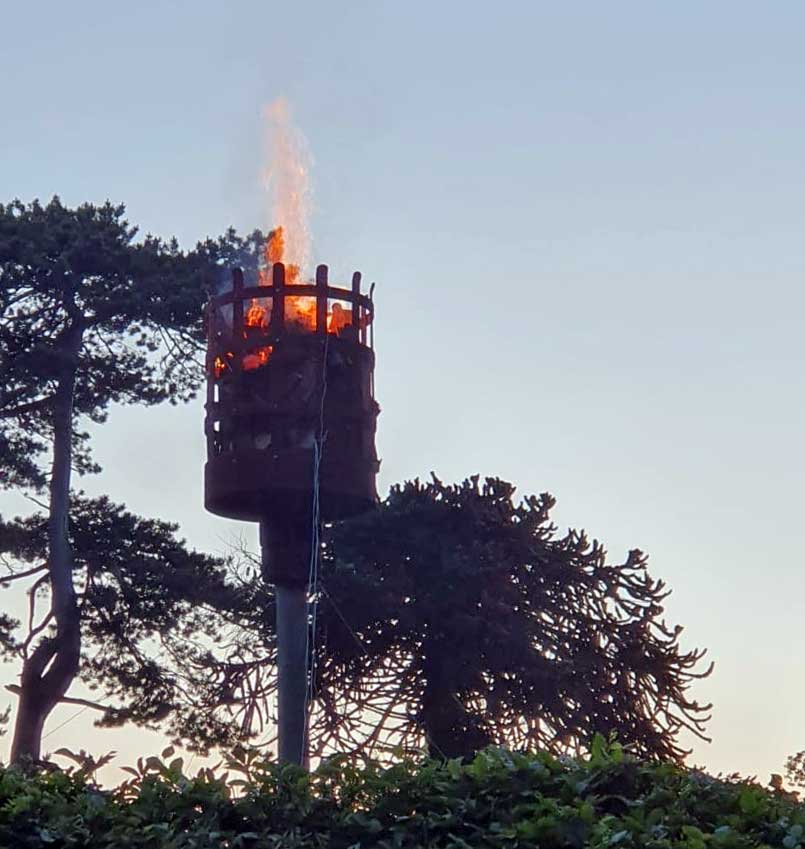
Elmdon Park beacon lit to commemorate the 80th anniversary of D-Day, 6th June 2024
If you have any further information about Elmdon Hall or Elmdon Park, please let us know.
Fascinating stuff – thanks so much for this. Just a couple of quick additions.
Mary Anne Smythe and Wiliam Mynors Smythe are buried together, not in the Spooner family vault as stated, but in the churchyard outside, alongside other Alston family members in a row of graves opposite the east window of the church. (William Mynors Smythe was the 3rd son of Revd Patrick Murray Smythe, Rector of St Alphege Solihull.)
Following the estate’s sale to Mr Waters, and at some point after Canon Hayter’s death in 1934, land to the north east of the existing churchyard was generously gifted to the church, and now forms the majority of the current churchyard. Burials in the churchyard extension began in 1953.
 Solihull Life
Fascinating stuff – thanks so much for this. Just a couple of quick additions.
Mary Anne Smythe and Wiliam Mynors Smythe are buried together, not in the Spooner family vault as stated, but in the churchyard outside, alongside other Alston family members in a row of graves opposite the east window of the church. (William Mynors Smythe was the 3rd son of Revd Patrick Murray Smythe, Rector of St Alphege Solihull.)
Following the estate’s sale to Mr Waters, and at some point after Canon Hayter’s death in 1934, land to the north east of the existing churchyard was generously gifted to the church, and now forms the majority of the current churchyard. Burials in the churchyard extension began in 1953.
Thanks, Richard – I’ve updated the information about the burial of Mr & Mrs Smythe.