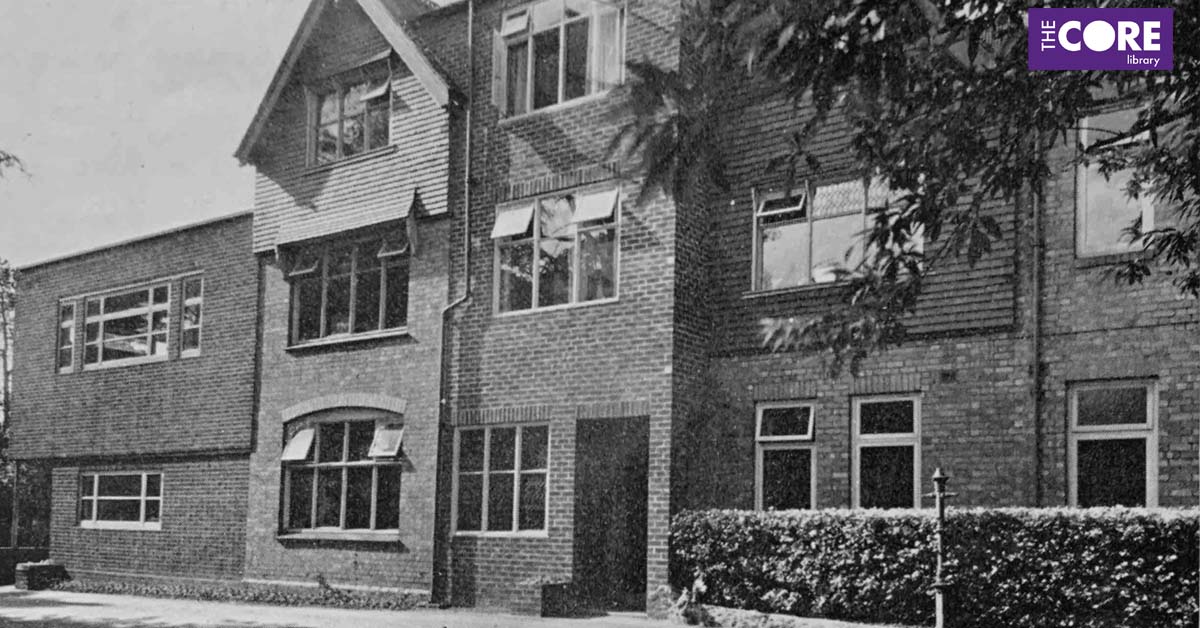
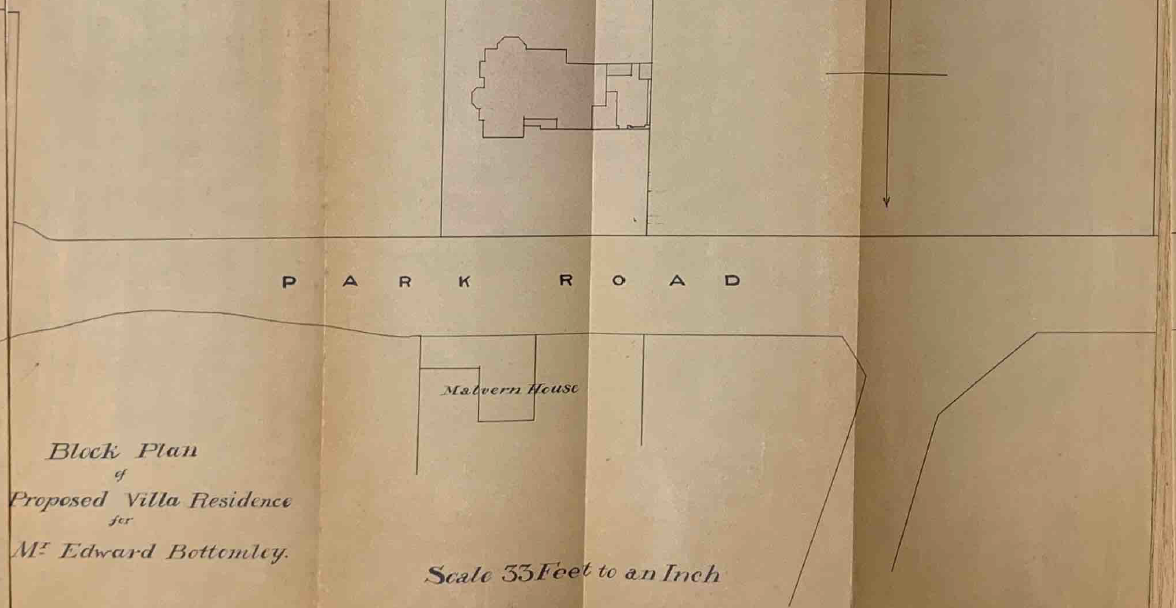
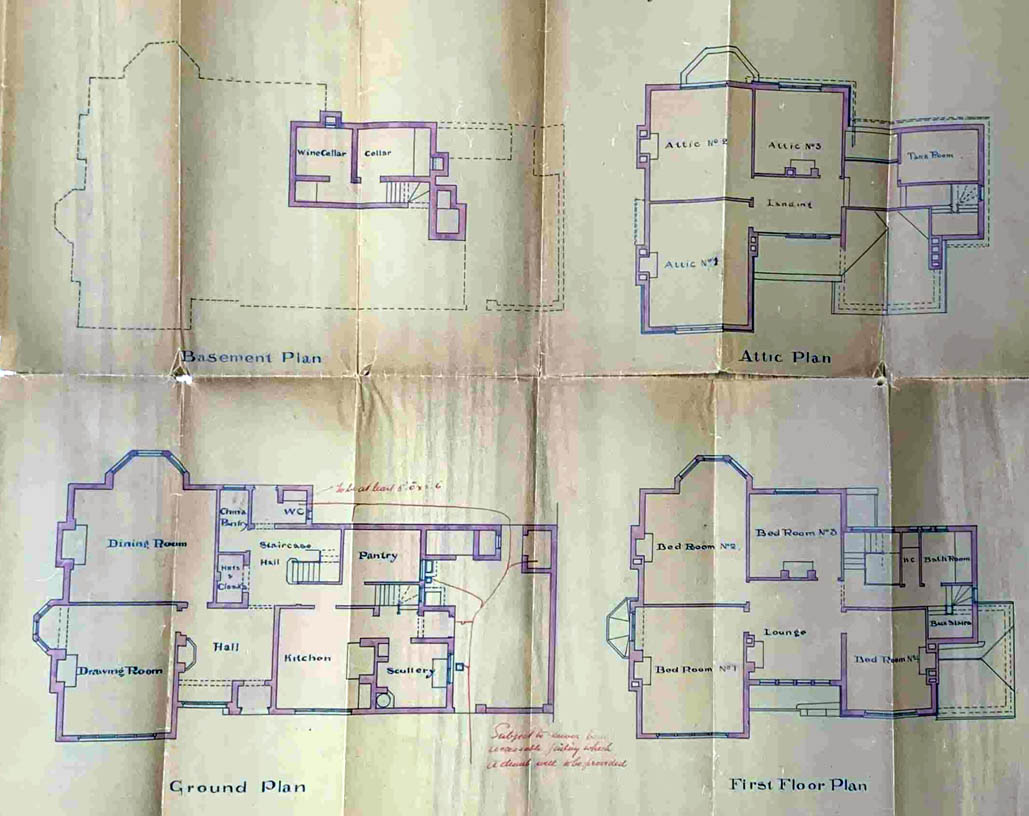
It looks as if Cedarhurst, Park Road, Solihull was built in the mid-1890s and was demolished around 1973. A building control plan at the Core Library Solihull (ref.: SOL/PS/1/1/647), dated March 1894, depicts one detached villa in Park Road, opposite Malvern House, which appears to be Cedarhurst, although not named as such.
The plan shows that the property was designed by architect John Henry Hawkes and built by Charles Bragg. The owner was Edward Bottomley, a grocer from Deritend, Birmingham.
Cedarhurst is known to have been home to Benjamin Horton Eberhard (1839-1916), retired ironmaster, from at least 1897 (when he added stabling to the house) until his death in 1916.
From at least 1935 until at least 1938, Cedarhurst was occupied by Mr Bertram Llewellyn Boston, coal merchant.
It seems that Mr Boston had vacated the property by 1939 as, on 29th July 1939, the Birmingham Daily Post carried an announcement regarding the forthcoming move of Fowgay Hall School, Dingle Lane, Solihull, “to a central position.” Although Cedarhurst was not mentioned by name, the proprietor of Fowgay Hall School was Edgbaston-born Harry Bernard (“Mike”) Callaghan (1908-1980), who also founded Cedarhurst School.
The Callaghan family
Harry Bernard Callaghan was born in Edgbaston, Birmingham on 10th December 1908 and baptised at Edgbaston on 16th January 1909. His parents were Henry James Callaghan, school master, and Beatrice Fanny (née Bolton) who had married at Edgbaston in 1907.
Bernard, as he seems to have been known at the time of the 1911 census, was the eldest of the couple’s four children. His younger brothers were: Eric Kenneth Frank Callaghan (1910-1986); Desmond Patrick Callaghan (born and died 1911) and Hugh Conrad Edwin Callaghan (1912-1975).
Eric was also a schoolteacher, teaching at Rhos School, Colwyn Bay at the time of the 1939 Register.
The Callaghan family had lived at Fowgay Hall since at least 1935, when the engagement of Harry Bernard Callaghan and Muriel Edith Franks was announced. H. B. Callaghan’s father, Henry James Callaghan (1874-1936) died, aged 62, at Hockley Heath Nursing Home in July 1936 but his home address was given as Fowgay Hall. His widow, Beatrice, died just three months later, aged 58, in October 1936. Her address was also listed as Fowgay Hall.
Harry Bernard Callaghan married Muriel Edith Franks of Tunbridge Wells, at St Mark’s Church, Broadwater Down in January 1937 and they went on to have six children – three sons and three daughters. The couple’s future home, it was announced, would be at Fowgay Hall, Solihull.
Fowgay Hall School
It seems that Fowgay Hall School was also founded around the time of the couple’s marriage. It was described in the Birmingham Daily Post of Saturday 16 September 1939 as being “situated in one of the safest spots in Solihull” and having “gas-proof rooms.”
The final Speech Day at Fowgay Hall School was made in March 1940, with the Headmaster stating that the school would be moving to “bigger and more central premises.” This suggests that Cedarhurst School opened to pupils for the first time in September 1940.
By October 1940, Fowgay Hall was occupied by Mr G. E. Wake, who subsequently sold the hall in 1946. The property was demolished in 2006 and replaced by a block of apartments.
Cedarhurst School
In 1943, Cedarhurst School collected 5.5 tons of paper during the Summer Term – the best school effort recorded by the Waste Paper Recovery Association. For the second year running, the school won a shield presented by Solihull Urban District Council for competition among schools in the area.
By 1966, Cedarhurst was one of about eight private schools in Solihull and it had 400 pupils and 25 teachers. The Birmingham Daily Post of 15th July 1966 commented that about one in ten of Solihull’s school-age population of 15,000 children were believed to attend private school, particularly in the pre-preparatory stage.
Cedarhurst, according to a brochure from the 1960s that was kindly donated to the archives at the Core Library, Solihull, took pupils in the Kindergarten from the ages of 4½ to 7 and in the Preparatory School from the ages of 7-14. Pupils were prepared for Grammar School and Common Entrance examinations.
The School House, as the main building was called, had “large and lofty classrooms, including a number of recent extensions, giving the maximum of light and air.” There was also a gymnasium, large dining room and a carpentry workshop, where boys “with natural aptitude” were taught the use of tools and the making of useful and interesting objects.
The reading of books of all kinds was strongly encouraged, and there was a library under the charge of the Senior English Master. A contribution of one shilling per term enabled a pupil to borrow a book at any time.
Outdoor sports facilities included large asphalted playgrounds for boys and girls, a tennis court and a netball court. The school had playing fields in Hillfield Road, Solihull, at which cricket, football and hockey were played, and where the annual sports day was held. Boys played cricket, football and tennis, whilst girls played netball, hockey, tennis and stoolball. Swimming was also encouraged and pupils were conveyed by specially chartered Midland Red omnibuses to the Sparkhill baths.
The curriculum comprised:
- English (reading, writing, composition, grammar, spelling, literature, recitation)
- Arithmetic (including mental arithmetic)
- Elementary Mathematics (algebra and geometry)
- Scripture
- History
- Geography
- French
- Latin
- German
- Art
- Nature Study
- General Knowledge
- Singing
- Handwork
- Needlework
- Carpentry
- Elocution
- Drawing
Music appreciation was open to the Upper School, with the aim of encouraging through recitals of records, the appreciation of good music.
Fees were payable in advance during the first week of term, with a term’s notice required for the removal of a pupil from the school. Tuition fees in the mid-1960s ranged from 25 guineas per term for the under-5s to 34 guineas per term for the over-12s. There were additional fees for text books, stationery, games, handwork materials, extra tuition, pianoforte, dancing, elocution, swimming and lunches.
The school hours were:
- Kindergarten – 9am-12pm; 1:45-3:30pm (with a half-holiday on Thursdays)
- Juniors – 9am-12:30pm; 1:55pm-3:45pm
- Seniors – 9am-12:30pm; 1:55pm-4:15pm
A House system was in place at the school to encourage “friendly rivalry, keenness and ‘esprit de corps’ “, with House points being awarded for praiseworthy efforts in all school activities, both in and out of the classroom, and off the premises. Boys were in either Nelsons or Wellingtons, whilst girls were in either Tudors or Stuarts.
The school uniform was for boys:
- school cap
- school blazer
- grey flannel shorts
- school tie
- school grey overcoat
- navy blue raincoat
- school socks
- grey shirts
- brown or black walking shoes
For girls, the uniform consisted of:
- school maroon tunic
- school blazer
- school hat or beret
- white blouse
- grey or white socks
- brown shoes
- school grey overcoat
- maroon raincoat
- grey knickers
- school tie
In the summer, the girls’ uniform also included a white panama hat with a school hatband, and school summer frocks obtainable from Mary Mary’s, The Parade, Solihull.
The school’s final Speech Day was held at Solihull Civic Hall on Thursday 12th July 1973, with prizes being presented by Mr J. Leslie Shepherdson, a friend of the Headmaster and a former Mayor of Solihull. The Birmingham Daily Post of Friday 13th July 1973 included a photograph of the event and noted that the school was closing after 35 years owing to the retirement of its Headmaster and founder, Mr H. B. Callaghan.
In his speech Mr Callaghan asked: “What will Cedarhurst be remembered for? Will it be for the maroon blazers and peaked caps seen by motorists at zebra crossings? I hope it will, but I would like it to be remembered for sincerity, politeness, happiness and above all, integrity.“
Closure
The closure of Cedarhurst School, with effect from July 1973, was announced in 1972. As a result, Solihull School announced in May 1972 that it would temporarily reduce its age limit so that it could admit a dozen seven-year-olds from Cedarhurst, who would be accommodated in a special form in a spare classroom. Alderman George Hill, Chairman of Solihull School governors, said: “These chaps at Cedarhurst would have come to us at eight and would spend a year in the wilderness otherwise. We do not have any thought of lowering the age limit generally.”
In June 1973, the Birmingham Evening Mail reported that a planning application had been submitted by Hampton and Sheldon Building Company to build 21 flats in a four-storey block on the school site, 18-20 Park Road.
Harry Bernard Callaghan died on 12th October 1980, aged 71. His home address at the time of his death was Orchard Close, Earlswood Road, Dorridge.
If you have any further information about Cedarhurst or Harry Bernard Callaghan, please let us know.
Tracey
Heritage & Local Studies Librarian
(with many thanks to Duncan, who kindly sent us the Cedarhurst School brochure and other documents in January 2021 to add to our archives at the library).
© Solihull Council, 2021.
You are welcome to link to this article, but if you wish to reproduce more than a short extract, please email: heritage@solihull.gov.uk
 Solihull Life
I was a pupil at Cedarhurst c1946-47, before my parents moved to Leamington, and remember Mr Callaghan quite well, also the weekly bus trips to Sparkhill Baths.
As an ex. pupil of Cedarhurst (1961-1966), there were actually three school ‘houses’ for boys: these being Nelson & Wellington (as listed above), with the third being ‘Churchill’.
Also, the blazer for the boys was, from memory, exactly the same design as the girls’ blazer, only tailored differently.
I can even remember some of the teachers’ names: Kindergarten: Mrs Clarke & Mrs Pullman; Upper School: Mrs Cook (2A), Miss Watt (2B), Mrs. Watts (3A), Mrs Eyre (fourth form) Mr. Bulmer (Lower Sixth form – and from whom you dodged low-flying blackboard erasers!), Mr. Ross (Upper Sixth), Mrs Kinross (3B?) and the dreaded Miss Hinks of form 5A!
I can’t remember who was the form teacher for 5B though: it MAY have been Miss Callaghan, one of the Head’s children.
Miss Hinks the scary and brutal maths teacher >never to be forgotton> but at that school we all learned good manners> hit at least twice by a Bulmer blackboard eraser> he was a good shot
I was there around about 1970-71. Miss Hinks was just brutal, but so was my last form mistress – Mrs. Littlehales. Indeed, my mother came to the school to complain about my coming home with bruises to my head, only to find out that it was from a teacher. I’d forgotten to say ‘excuse me’ as I passed Mrs. Littlehales and Mr. Callahan talking, and she sent me tumbling into the corner with a swipe to the head.
There was the after-lunch (I think) reading of those wonderful Enid Blyton books, and the small bottle of milk each day. And the sports lessons that took place in Brueton Park in front of the pavilion.
I recall that the rather ‘enthusiastic’ discipline involved raised caps on the zebra crossing outside. And if you didn’t, and Mr. Callahan saw you in his E-type Jaguar, you were for it. You were actually taught to say: ‘Excuse me sir’, or Excuse me ma’am’, whenever you walked past a teacher. And actually, instilling awareness and courtesy like this wasn’t a bad thing at all. Though the trauma of some pretty vicious teachers, and some bullying, were the biggest legacies I left with. I must have learned something educational there – I hope?
From Geoff Davies 1947 to 1952 . Every one is right about Rosie Hinks she lived in Knowle opposite Sumners Shops. My mother was a Sumner and I thought to start with she was horrible to me because they knew on another. I came to realise that she was the same to all but she was a good Maths teacher for which I have been thankful for.
My time at Cedarhurst was Sept 1967 – July 1970
Arrangement of classes in the Upper School (not Kindergarten):
Age 7/8: Form 1A (Mrs. Littlehales) and 1B (Mrs. Morris)
Age 8/9: Form 2A (Mrs. Cook) and 2B (Mrs. Nevin, who left after a while)
Age 9/10: Form 3A (Mrs. Kinross) and 3B (Mrs. Goodridge)
Age 10/11: 4th Form (Mrs. Cutler), 5A (Mrs. Ayres) and 5B (Miss Hinks) (4th Form was a small class for kids needing extra tuition support leading up to the 11+ exam)
Age 11/12: Lower 6th Form (Mr. Bulmer)
Age 12/13: Upper 6th Form (H.B. Callaghan)
Notable memory of mine:
In the Summer for our weekly Games lesson, the boys would play cricket at a set of playing fields away from the school (in Hillfield Rd), being taken there by hired coach. Mr. Callaghan, the Headmaster, would come and watch.
At the end of each session, we would line up and Mr. Callaghan would choose 2 boys whom he thought had tried really hard during the lesson to travel back to school with him in his E-Type Jaguar.
One week in the Summer of 1970, I was chosen (to my great surprise, as I was no good at Games) to go back in the Jag. I remember the drive back, thrilled to bits, sharing the tiny front seat with another boy (Lawrence, I think) without a seat belt in sight and Callybags driving like the wind! One of the highlights of my time at Cedarhurst.
from Robert (Bob) Kemp.
I was at Cedarhurst in the 60s. I agree with the foregoing posts. Miss Hinks was a force to be reckoned with. She had a habit of calling miscreants out to the front of class and rapping them over the head with her silver ball pen whilst explaining what they’d done wrong. I met her many years after the school had shut, when I found she was working for a van hire company in Knowle. I commented on the fact the she was still using the same type of biro, which drew a smile, something I’d never seen from her before!
Mr Bulmer was a lovely old boy and as mentioned by others was a crack shot with the board rubber. He could bring a lighter side to his subjects of Geometry and Triganometry. I used to be a dinner table monitor on his table and used to love his sotto voce exasperations about Miss Hinks who was always to be seen striding up and down the dining hall shouting at kids for talking!
Cally commanded respect as a headmaster. Teachers had a habit of getting disruptive kids to stand facing the bookcase outside his office. If you smelled cigar smoke you knew he was in and prayed he’d not come out to find you as the result of that was a verbal berating whilst being shaken by the lapels of yr jacket. He was a disciplinarian but he taught all pupils politeness and respect. I also met him after the school had closed when I bumped into him in his local pub, the Railway. He was very keen to hear what I was doing by way of career in the legal profession. I never made the grade to ride in the e type though!