
The Metropolitan Borough of Solihull came into existence on 1st April 1974. The new Metropolitan Borough comprised the former County Borough of Solihull, 10 parishes from the former Meriden Rural District and the parish of Hockley Heath from Stratford-upon-Avon Rural District.
District to Borough to District
When local government below county level was first organised in 1894, places were assigned a status based on population. Solihull, being a small parish (population 870 at the time of the 1891 census) became a Rural District (population . It became an Urban District in 1932 as the population increased (30,576 in 1931).
With the population still increasing, it was clear that Solihull was likely to become a County Borough in the future. The population required for this (between 1926-1958) was 75,000. However, Solihull could not become a County Borough until it had first been granted a Royal Charter of Incorporation as a Borough. This happened in 1954, by which time the population was around 70,000.
Acting on behalf of the Queen (who was overseas on a six-month Commonwealth Tour) Princess Margaret visited Solihull on 11th March 1954 – “Charter Day” – to present the Charter of Incorporation as a Borough, which came into effect at noon on 24th May 1954. This set Solihull on a journey to becoming a County Borough – for which, from 1958, it needed a population of 100,000.

On 1st April 1964, ten years after becoming a Municipal Borough, Solihull was elevated to a County Borough, meaning that it became independent from Warwickshire County Council and was a single-tier authority responsible for all its own services.
This independence lasted for 10 years until local government reorganisation took place in 1974 and all county boroughs lost their unitary status and became second-tier district councils.
Solihull was one of 36 Metropolitan Districts created as a result of the Local Government Act 1972, which came into effect on 1st April 1974. The West Midlands County Council was established on the same date but was abolished under the Local Government Act 1985. This meant that, from 1st April 1986, all of the West Midlands Metropolitan Boroughs, including Solihull, became unitary authorities once more.
Solihull’s status as a County Borough helped it to avoid becoming part of Birmingham as part of local government reorganisation in the early 1970s, which had been the recommendation of the Redcliffe-Maud Report, 1969.
The Maud Reports
In March 1964, John Redcliffe Maud was appointed by Sir Keith Joseph, the Minister of Housing and Local Government, to head a committee looking into the management of local government, which had been requested by the local authority associations. The Maud Committee on the Management of Local Government was published on 31st May 1967 and recommended some changes, including that the office of Alderman be abolished.
John Maud was also chosen to chair a Royal Commission on the reform of local government, with the Royal Commission’s first meeting taking place on 31st May 1966. He received a life peerage in 1967, becoming Baron Redcliffe-Maud of the City and County of Bristol.
The Redcliffe-Maud report, published in 1969 as the Report of the Royal Commission on Local Government in England 1966-1969 (Cmnd. 4040), recommended a wholesale reform of local government outside Greater London (which was outside its terms of reference). It proposed the mixing of urban and rural areas in 58 large unitary authorities, plus the establishment of three metropolitan authorities covering the great urban concentrations of Birmingham, Liverpool and Manchester, which would be responsible for planning, transportation and major development.
As regards Solihull, the Redcliffe-Maud report recommended the absorption of both Sutton Coldfield and Solihull into a Birmingham Metropolitan District. The Lord Mayor of Birmingham described the proposal as sensible, saying that the two towns were “overspill areas” inhabited by many people whose “activities are closely directed towards Birmingham.”
The reaction of Sutton Coldfield’s Mayor was to tell the Birmingham Mail, 11th June 1969 that the Royal Town would fight the proposals “tooth and nail.” Solihull councillors and residents’ representatives denounced the report as the “complete annihilation” of Solihull.
The Birmingham Daily Post, 12th June 1969, canvassed opinion and said that people in the streets of Solihull were mostly against the proposed merger with some saying, that if it went ahead, they would move away from the area. The newspaper described Solihull’s “paralytic shock” upon discovering that, “only five years after achieving county borough status, Solihull is being talked about as suitable for absorption by Birmingham.”
Solihull’s M.P., Percy Grieve, expressed initial scepticism and caution, stating that his first reaction was “fear that if you throw the urban into the country areas to form one big administrative unit, the interests of country areas are going to be swamped.”
The proposed Birmingham Metropolitan District would also have included the Meriden Rural District parishes of Barston, Bickenhill, Castle Bromwich, Curdworth, Hampton-in-Arden, Kingshurst, Lea Marston, Little Packington, Maxstoke, Middleton, Nether Whitacre, Shustoke, Water Orton and Wishaw, as well as the parishes of Hockley Heath and Tanworth-in-Arden from Stratford-upon-Avon Rural District.
In July 1970, Solihull Council decided to continue to press for the retention of its identity and the rejection of the proposals in the Redcliffe-Maud report. It said that, if it could not retain its own identity, it would accept as second best a merger with Sutton Coldfield and Meriden.
In the end, the proposals did not turn into a Parliamentary Bill until after the General Election in June 1970, which saw a change of government.
1971 proposals
The Government published its White Paper on Local Government Reform on 16th February 1971.
In a departure from the Redcliffe-Maud recommendations of 1969, the White Paper of 1971 recommended that Solihull should become a new district authority, taking parts of Acocks Green, Hall Green, Fox Hollies and Billesley from Birmingham, as well as the parishes of Balsall, Barston, Hampton-in-Arden and Tanworth-in-Arden from Meriden Rural District, and the parish of Hockley Heath from Stratford-upon-Avon Rural District.
The recommendation for Birmingham was that the city would lose the four areas above but would gain the municipal borough of Sutton Coldfield, as well as the parishes of Bickenhill, Castle Bromwich, Chelmsley Wood, Coleshill, Fordbridge, Great Packington, Kingshurst, Little Packington and Water Orton.
The report recommended that the parishes of Allesley, Berkswell, Keresley and Meriden should become part of the new Coventry metropolitan district.
Warwickshire would have gained five parishes from Northamptonshire – Barby, Crick, Kilsby, Lilbourne, and Yelvertoft.
Alternative proposals
Birmingham City Council objected to the loss of the four areas and, instead, argued that as well as taking in Sutton Coldfield, it should also take in Solihull. The Leader of Birmingham City Council said that it had concerns about Solihull’s population being below the minimum 250,000 recommended for metropolitan districts and that the City Council wanted both Solihull and Sutton Coldfield to “join together in a partnership with Birmingham at the head.”
Alderman Edwin Moore, Chairman of Warwickshire Town and Country Planning Committee said that it would be better for Birmingham to have Solihull than Sutton Coldfield, as the latter had no suitable land for development. He said that Warwickshire understood that Birmingham needed more “elbow room” and that Solihull rather than Sutton Coldfield was likely to have more land available for rehousing people on Birmingham’s housing waiting list.
A Sutton Coldfield town councillor told the Birmingham Mail, 21st February 1972, that Solihull had been “dynamic, enterprising and progressive,” and that “they seized the opportunity to become a county borough and have seized every further opportunity to expand, improve and progress.” He continued: “On its record alone, Solihull had a good case for remaining as a separate entity…“
Another Sutton Coldfield councillor said that Solihull opted to take County Borough status when the opportunity presented itself, but that “the then Council of Sutton Coldfield did not take the same opportunity, believing that … it was in the interests of the people that they should remain partners with Warwickshire County Council. It is extremely easy with hindsight to criticise actions taken years ago.” (Birmingham Mail, 21st February 1972)
Meriden Rural District wanted its parishes to remain within Warwickshire and said that they:
find completely unacceptable the suggestion for the inclusion of part of the present rural district within a Birmingham Metropolitan District.
Coleshill Chronicle, 23rd July 1971
Meriden RDC pointed out that the proposed Birmingham Metropolitan District would have a population of 1,168,000, which was 333,000 greater than the next largest metropolitan district. It offered two alternative proposals, if the existing rural district could not remain within Warwickshire.
Both suggestions were forwarded to the Secretary of State for the Environment for consideration.
The first suggestion was that 14 of the Meriden parishes – (Balsall, Barston, Berkswell, Bickenhill, Castle Vale, Chelmsley Wood, Coleshill, Fordbridge, Hampton-in-Arden, Kingshurst, Meriden, Great and Little Packington, and Water Orton) – should become part of the new 15(f) district, which was later renamed Solihull. The Coventry Evening Telegraph, 12th May 1971, said that Meriden “feels no community of interest with Birmingham or Coventry…”
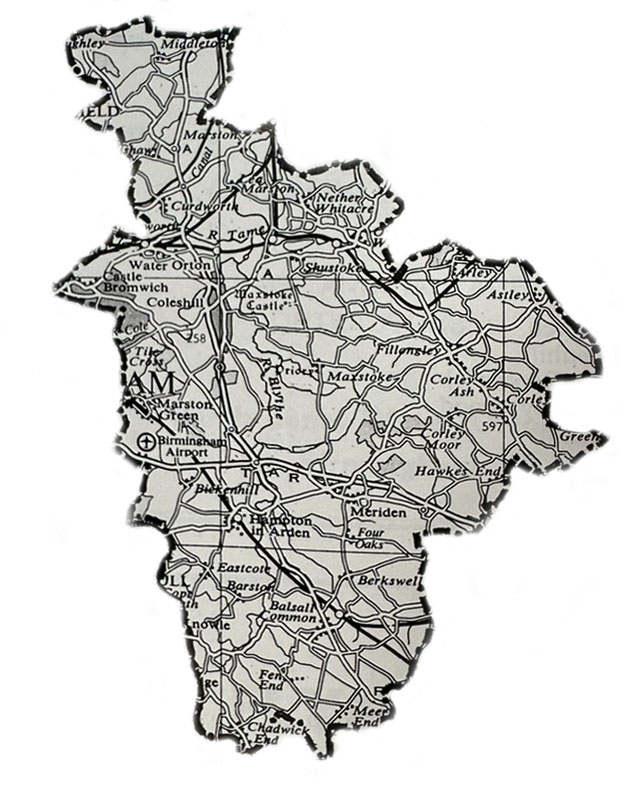
The second suggestion was that nine of the rural district parishes that adjoined the Birmingham boundary (Bickenhill, Castle Bromwich, Chelmsley Wood, Coleshill, Fordbridge, Kingshurst, Great Packington, Little Packington, and Water Orton) should join with Erdington, Shard End, Sheldon, Stechford and Yardley to form an additional eighth West Midlands district council with a population of 238,000.
Five of the Warwickshire parishes – Allesley, Balsall, Barston, Hampton-in-Arden and Meriden – discussed making a formal objection to the White Paper, fearing that absorption into an urban authority would lead to an eventual encroachment into the green belt.
Berkswell Parish Council sent an open letter to the Under-Secretary of State for the Environment, Michael Heseltine, expressing a desire to remain in Warwickshire. A public meeting and door-to-door canvass had found that “99.5 per cent of Berkswell residents deplore the plan to put the parish under Coventry in the proposed metropolitan county.” (Coventry Evening Telegraph, 22nd May 1971).
Castle Bromwich Parish Council suggested an alternative district council, incorporating Castle Vale, Sutton Coldfield and Meriden Rural District.
Whilst the local government reform proposals were still under discussion, Keith Speed, M.P. for Meriden, took Peter Walker, Secretary of State for the Environment, on a tour of the affected areas. Mr Speed advocated a compromise solution which would see Berkswell, Bickenhill, Castle Bromwich, Chelmsley Wood, Fordbridge, Kingshurst and Meriden join Solihull rather than Birmingham. The parishes of Coleshill, Great and Little Packington, and Water Orton should remain in Warwickshire, with the M42 and M6 motorways forming a natural boundary between the West Midlands and Warwickshire counties.
Villagers in Water Orton voted to merge with Solihull if their first preference of remaining in Warwickshire was not deemed to be acceptable.
Compromise
On 4th November 1971 the Local Government Reform Bill was published. Its proposals included that Warwickshire would be one of the 38 non-metropolitan county councils, losing a large part of Meriden Rural District, as well as the municipal borough of Sutton Coldfield.
Five of the parishes destined to be removed from Warwickshire under the original proposals – Coleshill, Great and Little Packington, Tanworth-in-Arden and Water Orton – would now remain in Warwickshire.
Although Meriden Rural District would still see all of its parishes transferred to other authorities, Peter Walker, the Minister of State for the Environment, had accepted a combination of the two alternatives put forward by Meriden so that none of its parishes were transferred to Birmingham.
The M.P. for Meriden, Keith Speed, told the Coleshill Chronicle that it was “good news” for the parishes that were to transfer to Solihull. The Town Clerk of Meriden Rural District, Mr R. E. Hale, said that Solihull had a similar approach to Meriden towards local government and the green belt problem, and that preliminary discussions had shown that “there appeared to be no serious problems that could not be overcome” (Coleshill Chronicle, 5th November 1971).
The newspaper reported that there was “jubilation” in Meriden Rural District at the news that “it was not to be swallowed up by ‘Big Brum’.”
The Birmingham Daily Post, 5th November 1971, described the final proposals as meaning that Birmingham “would lose two of its largest municipal housing estates, the airport, the proposed site for the national exhibition centre, and, the biggest blow of all, receive no land for future housing needs.”
Although retaining the four southern wards that were originally proposed to move to Solihull, and gaining Sutton Coldfield, Birmingham’s hopes of acquiring land in the vicinity of Coleshill on which to build new housing, were dashed.
The newspaper also reported that Birmingham was dismayed that the name of the new county council was to be the West Midlands County Council rather than it being “Greater Birmingham.” It was reported that Birmingham’s neighbours were opposed to the name being Greater Birmingham.
The Local Government Act 1972 was enacted on 26th October 1972 and came into force on 1st April 1974. Under this Act, Solihull again became a lower-tier District Council, losing certain functions to the new West Midlands County Council.
Solihull Metropolitan District Council 1973/74
A Joint Committee, comprising eight councillors from Meriden Rural District and eight councillors from Solihull County Borough, met for the first time on 16th December 1971 to consider the implementation of the proposed local government reorganisation. The committee then held monthly meetings alternately in Solihull and Coleshill, discussing various matters relating to the new district – known as District 15(f) until a decision was made about the new district’s name.
The new Solihull District Council was established in 1973 as part of the transitional arrangements for the new authority, running alongside the existing Solihull County Borough Council. At its first meeting on 22nd May 1973, the District Council elected a Chairman and Vice-Chairman and one of the first matters it considered at the meeting was the subject of Borough status.
A Second Borough Charter
With local government reorganisation in 1974, all boroughs were effectively abolished.
The flower bed in Malvern Park in the summer of 1973 apparently featured Solihull’s Coat of Arms and the dates 1964-1974 as a farewell to its County Borough status. If you have a photograph of the flower bed showing this, please let us know.
Borough status may only be granted by Royal Charter so, without applying for a new Charter, Solihull would have lost its entitlement to a Mayor and would have reverted to having a Chairperson of the District Council instead.
Section 245 of the Local Government Act 1972 enabled the Council of a District to submit a petition seeking the grant of a Charter conferring on the District the status of a Borough. The petition could only be submitted if a resolution were passed by at least two-thirds of the members voting at a meeting of the Council specially convened for the purpose.
It was made clear that a Charter granted under these provisions would not take effect before 1st April 1974, but a petition could be presented before that date. District Councils wishing to apply for the status of Borough to be conferred on the new District were encouraged to submit a petition as soon as possible so that the status would apply with effect from the 1st April 1974.
The Joint Committee recommended that Solihull District Council should seek Borough status for the District. The Council accepted the recommendation, and resolved that a special meeting of the Council should be convened on 10th July 1973 for the purpose of passing the formal resolution to submit “a Petition to the Queen’s Most Excellent Majesty in Council praying for the grant of a Charter conferring on the District the status of a Borough. ”
The Charter was granted on 23rd November 1973, to come into effect on 1st April 1974. It now hangs in Solihull Civic Suite.
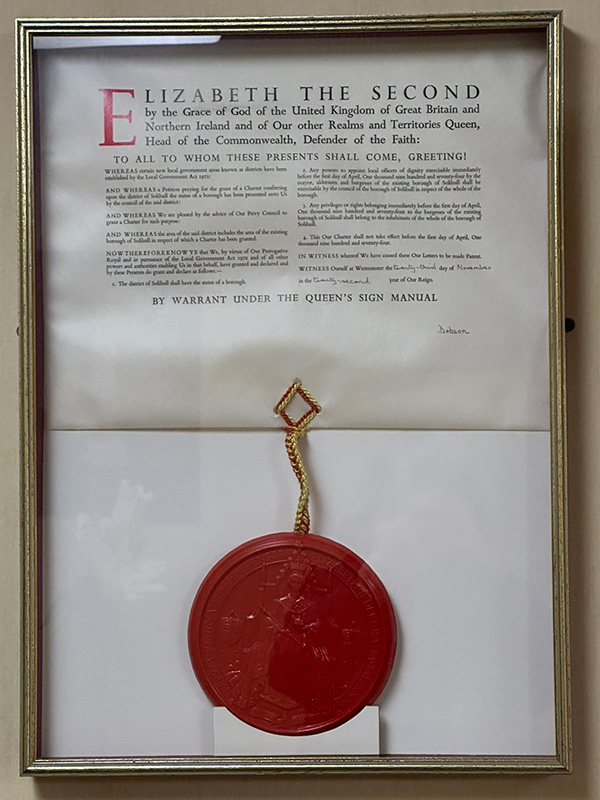
Following the grant of the Charter, the Policy Committee of Solihull District Council resolved at its meeting on 10th January 1974:
That the District Council assume the name “Metropolitan Borough of Solihull” with effect from 1st April 1974.
Meriden Rural District Council
Tuesday 2nd October 1973 saw the final Chairman’s Dinner of Meriden Rural District Council (RDC) before the abolition of the rural district when the parishes of the district were divided between the new Metropolitan Districts of Solihull and Coventry, and the new non-Metropolitan District of North Warwickshire. The latter was to have its headquarters in Atherstone. The 110 staff of Meriden RDC were promised that there would be no redundancies and that jobs would be available for them in the new authorities.
80 per cent of the population of Meriden Rural District was in the 10 parishes that became part of Solihull. Government guidance was apparently that the assets of the abolished authority should follow the majority of the population. This suggested that ownership of Coleshill Town Hall, as the former headquarters of Meriden RDC, would transfer to Solihull, despite Coleshill itself being in North Warwickshire district.
The Town Hall offices had been bought by Meriden RDC in 1939 and extended in the 1960s.
It took two years of discussions before the councils could agree on a solution. The Coleshill Chronicle, 2nd May 1975, reported that North Warwickshire District Council made a payment to Solihull Council of £155,000 to buy out the latter’s claim to the former Meriden RDC offices in Coleshill, together with the mortuary, stores, and vehicle depot.
Metropolitan Borough of Hemlingford…?
Representatives from Solihull County Borough and the 10 affected parishes from Meriden Rural District were unable to agree on a name for the new authority, with “Solihull” being the choice of the County Borough, whilst the Meriden parishes favoured a new name.
With Solihull town centre being the headquarters of the new authority, Solihull councillors wanted to retain the existing name. However, the Meriden parishes felt the new council should start off on a brand new footing with a brand new name, and selected “Hemlingford” as their preferred option. The Joint Committee recommended the name “Solihull” by a majority vote but both suggestions were submitted by the deadline of 15th January 1973 and the final decision was left to the Government.
Senior officers
The Chief Executive and Town Clerk of the new Solihull Metropolitan District Council was the existing Town Clerk of Solihull County Borough – Mr Denys Walter Chapman (1920-2012), who had previously been Deputy Town Clerk 1952-1965. He was appointed Town Clerk on 22nd March 1965 following the death two months earlier of long-serving Town Clerk, Mr W. Maurice Mell.
Mr Chapman served as Chief Executive and Town Clerk until January 1977, when he took early retirement on health grounds. He was succeeded by his deputy, John Scampion, who served in the post until 1995.
Mr Scampion’s successor was Dr Norman Perry, who had previously been Wolverhampton Council’s Chief Executive 1990-1995. Dr Perry was succeeded by:
- Katherine Kerswell 2001-2007
- Mark Rogers 2007-2014
- Nick Page 2014-2023
- Paul Johnson 2023-
At a meeting on 26th July 1973 it was decided that the Chief Officers of the new Solihull Metropolitan District would be the same as for the previous County Borough, namely:
- Mr W. E. Jennings, Director of Finance (previously Borough Treasurer)
- Mr Thomas Ronald Richardson (1916-2014), Director of Technical Services (previously Borough Engineer and Surveyor)
- Mr Dudley Love, Director of Education (who worked for Solihull 1963-1976)
- Mr Malcolm Wren, Director of Social Services (who worked for Solihull 1970-1983)
Council Housing
With the transfer to Solihull of Chelmsley Wood and Kingshurst, newspapers reported that Birmingham would lose some 14,000 of its 145,000 council houses. However, it was agreed that Birmingham City Council would retain responsibility for council housing in the areas for five years.
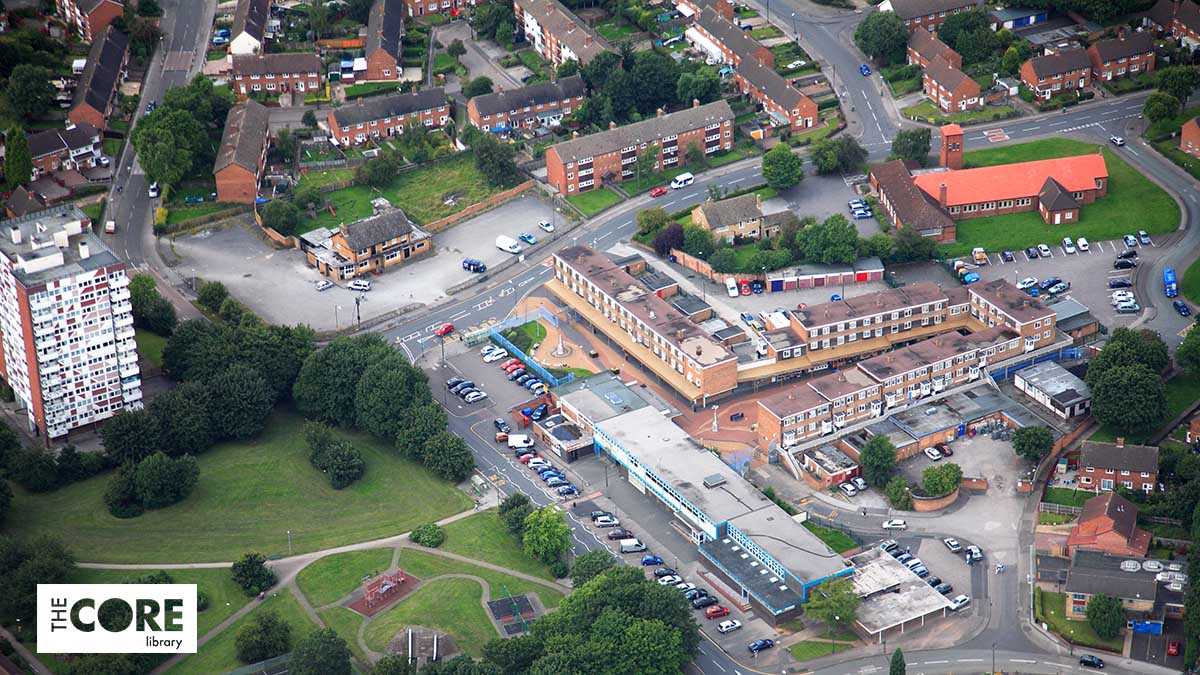
In 1979, Birmingham City Council had to decide whether to transfer responsibility for the 13,500 council homes in Kingshurst and Chelmsley Wood to Solihull Metropolitan Borough Council, which it did with effect from 29th September 1980.
If you have any further information about Solihull’s journey to becoming a Metropolitan Borough, please let us know.
Tracey
Library Specialist: Heritage & Local Studies
© Solihull Council, 2024.
You are welcome to link to this article, but if you wish to reproduce more than a short extract, please email: heritage@solihull.gov.uk
 Solihull Life
Should have all joined and created Greater Birmingham. I live in North Solihull and Solihull being its own borough is just a bit of a joke in 2025.