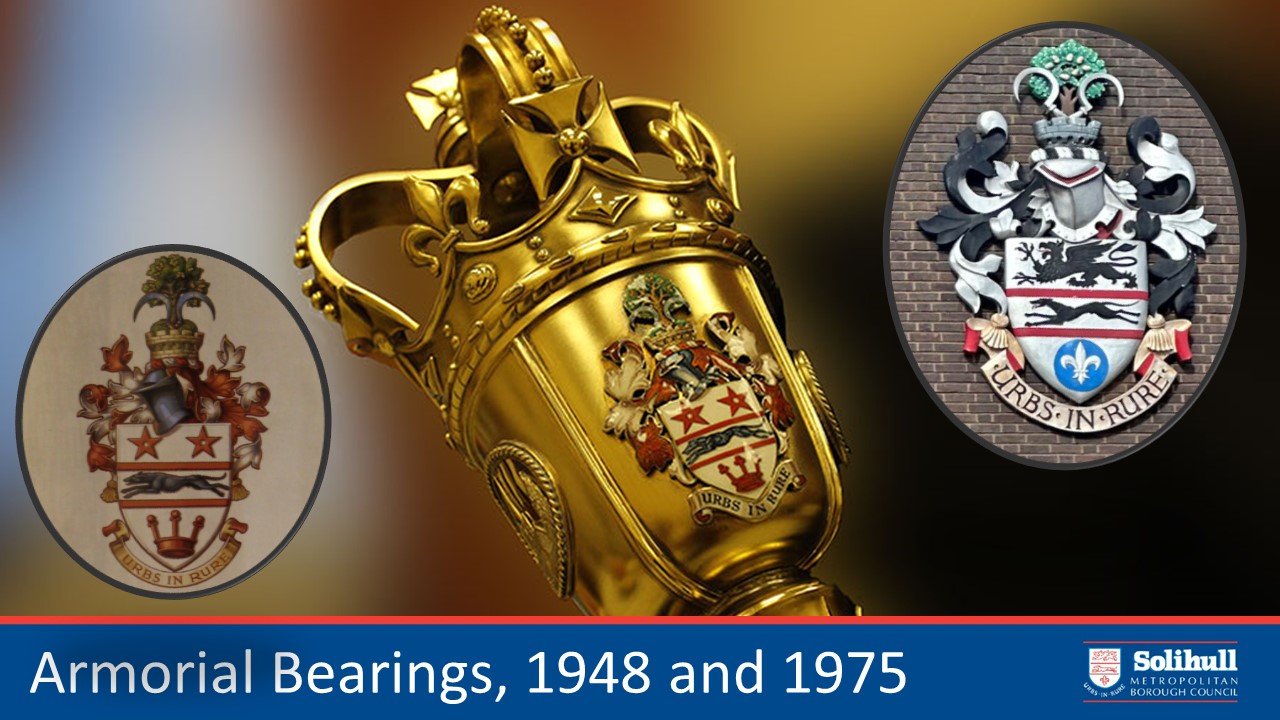
The present Armorial Bearings of the Metropolitan Borough of Solihull were granted on 10th December 1975 from a design created by Miss Brenda C. Hands (1931-2016), who worked in the Council’s Technical Services Department. The new Arms replaced the previous Armorial Bearings granted to the then Solihull Urban District in 1948, which were also used by Solihull Municipal Borough and Solihull County Borough.
Solihull UDC Armorial Bearings 1948
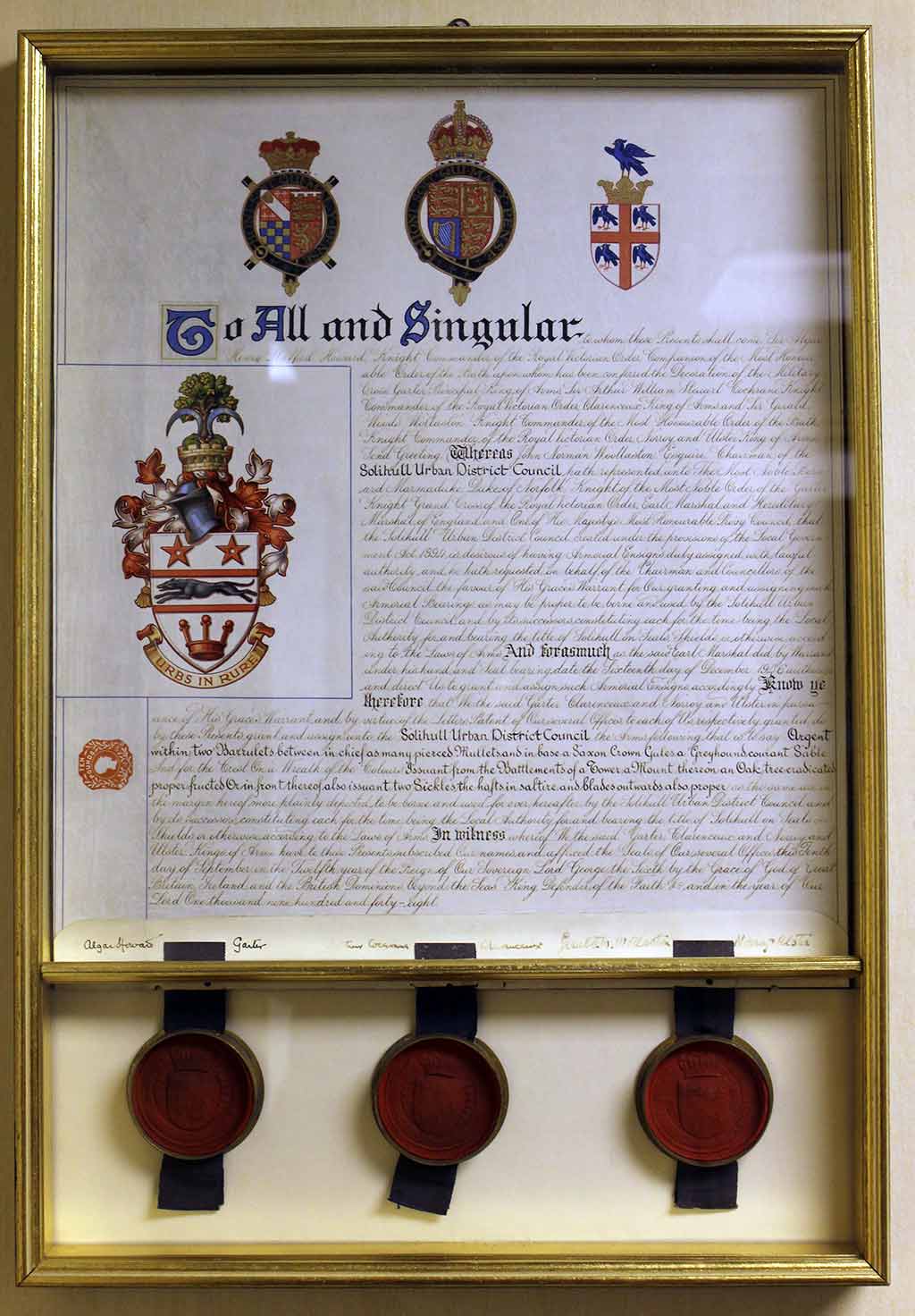
Solihull Urban District Council applied in 1946 for a grant of Armorial Bearings as part of its journey to becoming a Municipal Borough and then a County Borough. The Arms were granted on 10th September 1948 and were used until replaced by the grant of Armorial Bearings made to the new Metropolitan Borough of Solihull in 1975.
The official heraldic description (blazon) of the 1948 Armorial Bearings is:
Arms: Argent within two Barrulets between in chief as many pierced Mullets and in base a Saxon Crown Gules a Greyhound courant Sable
Crest: On a Wreath of the Colours Issuant from the the Battlements of a Tower a Mount thereon an Oak tree eradicated proper fructed Or in front thereof also issuant two Sickles the hafts in saltire and blades outwards also proper
The 1948 armorial bearings are still visible today on the clock in Brueton Gardens, which was erected in 1964 to mark the elevation of Solihull to a County Borough.
Meriden RDC Emblem of Office
Meriden Rural District was in existence from 1894-1974 but does not appear to have had its own Coat of Arms.
It was decided in 1950 that an Emblem of Office would be provided for use by the Chairman of Meriden District Council for use at all official functions. The Chairman’s Consultative Committee was empowered to settle the design of the emblem.
The Emblem was Meriden Rural District’s commemoration of the Festival of Britain, 1951, showcasing the best of British manufacturing and design. The first investiture took place at the Annual Meeting of the authority, held on the 22nd May 1951.
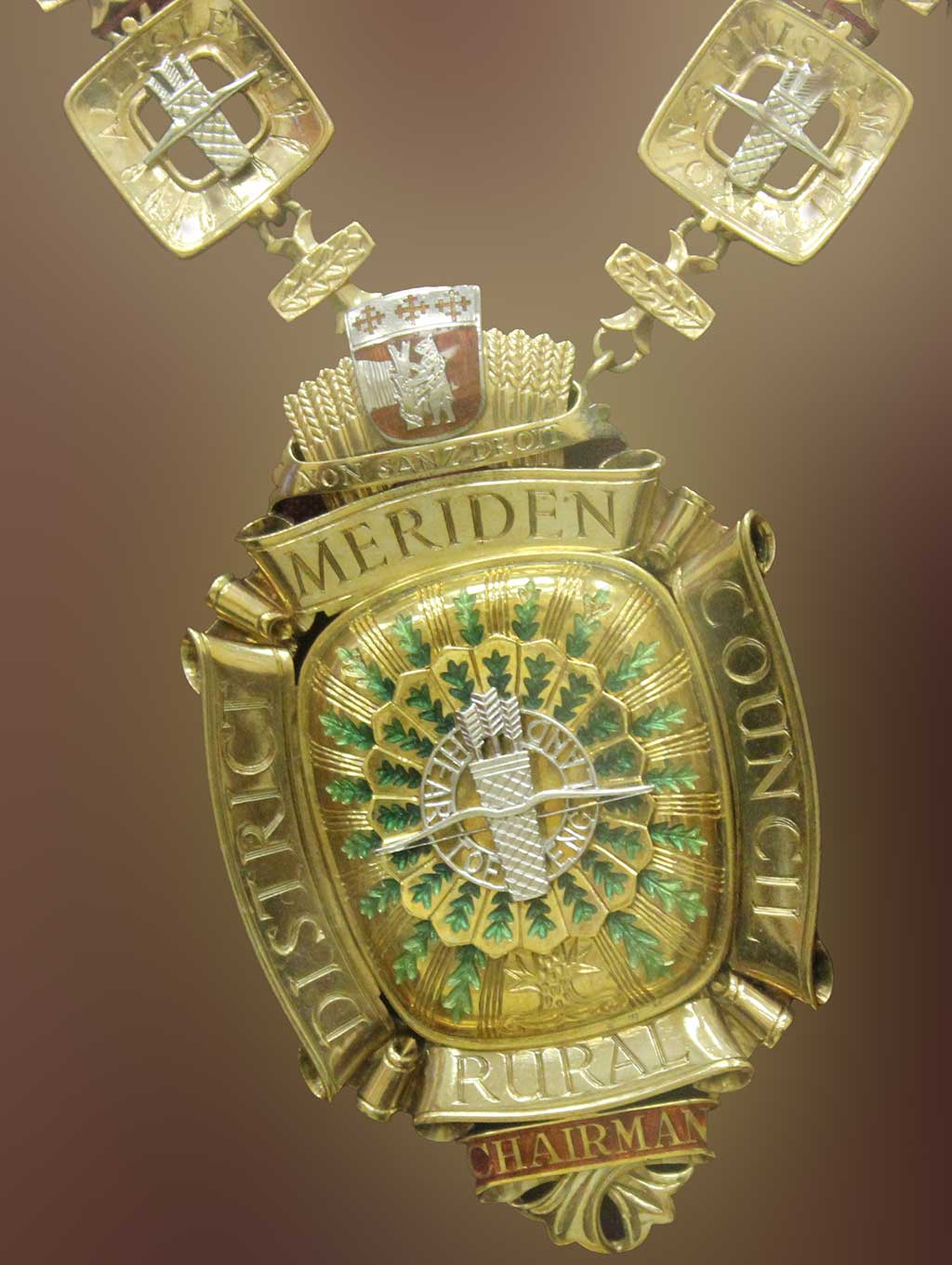
The Emblem was entirely hand-wrought in gold and enamel. The centre piece symbolises the oaks of Arden in green enamel and is surmounted by a bow and quiver of arrows and pierced letters “Heart of England” in white 9 ct gold.
Surrounding the centre piece is a continuous ribbon in 9 ct gold on which is engraved “Meriden Rural District Council.” Above this ribbon is a small enamelled shield using the Warwickshire Arms surrounded on each side by wheat ears and below is a red enamel ribbon with the word “Chairman.”
The Emblem, which symbolises the ancient association of the District with the Forest of Arden and its close connection with agriculture, was designed by Mr Cyril James Shiner ABRSA MSIA (1908-1989), a Birmingham silversmith, and bears the inscription on the back “Presented in commemoration of the Festival of Britain, 1951,” together with the Festival Emblem.
The Emblem of Office was originally suspended on a dark green ribbon but this was discarded and replaced by a gold chain on Tuesday 8th December 1953 in a ceremony at the Old Vicarage, Coleshill, before the monthly meeting of Meriden Rural District Council. The Chairman of the Council, Councillor W. Antrobus was invested with the chain of office by the “father” of the Council, Councillor David Gee.
The chain cost £150 and was a permanent commemoration of the Coronation of HM Queen Elizabeth II. It was also designed by Cyril Shiner, and was originally 47 inches in length with twenty-four medallions suspended at the front symbolising the Parishes comprising the District.
Two further medallions were subsequently added for the new Parish of Kingshurst in 1956 (the 25th link), and the added Parish of Middleton making the final 26th link. Each medallion was engraved with the appropriate name and alternatively superimposed with oak leaves and the bow and quiver of Arden.
At the back, suspended on a chain of oak leaves, is a single medallion, recording the Coronation, and the cipher E.II.R. 1953. The chain is entirely hand-wrought in yellow and white gold and Meriden Rural District Council received a letter from the Design and Research Centre for the Gold, Silver and Jewellery Industries, London complementing the designer and the craftsmen on their outstanding work. It also received the approval of the Crafts Centre Panel for Britain for the high standard of workmanship.
With the reorganisation of local government in 1974, Meriden Rural District Council was abolished, and ten of its parishes merged with Solihull County Borough and the parish of Hockley Heath from Stratford-upon-Avon Rural District. A new Coat of Arms was needed for the new Solihull Metropolitan Borough.
Solihull MBC Armorial Bearings 1975
This was chosen from a shortlist of three, whittled down from an initial list of 37, some of which were designed by students from Solihull High School for Girls and Solihull Technical College.
The design was chosen in July 1974 but the final grant was delayed until 10th December 1975, after the Council was advised that the fleur de lys would have to be encircled by a roundel in order to satisfy heraldic rules.
The official heraldic description (blazon) is:
Arms: Argent within two Barrulets Gules between in chief a Griffin passant Sable and in base a Hurt thereon a Fleur-de-Lys Argent a Greyhound courant Sable.
(translation: on a silver shield within two red Barrulets between, at the top, a black Griffin with one paw raised and, at the bottom, a silver fleur-de-lys on a blue roundel, a black greyhound running at full speed).
Crest: On a wreath Argent and Sable Issuant from the battlements of a Tower in front of a Oak Tree proper fructed Or two Sickles the shafts in saltire the blades upward and outward proper.
(translation: on a silver and black wreath, arising from the battlements of a tower in front of an oak tree bearing golden fruit, two sickles, the shafts crossed and blades upward and outward).
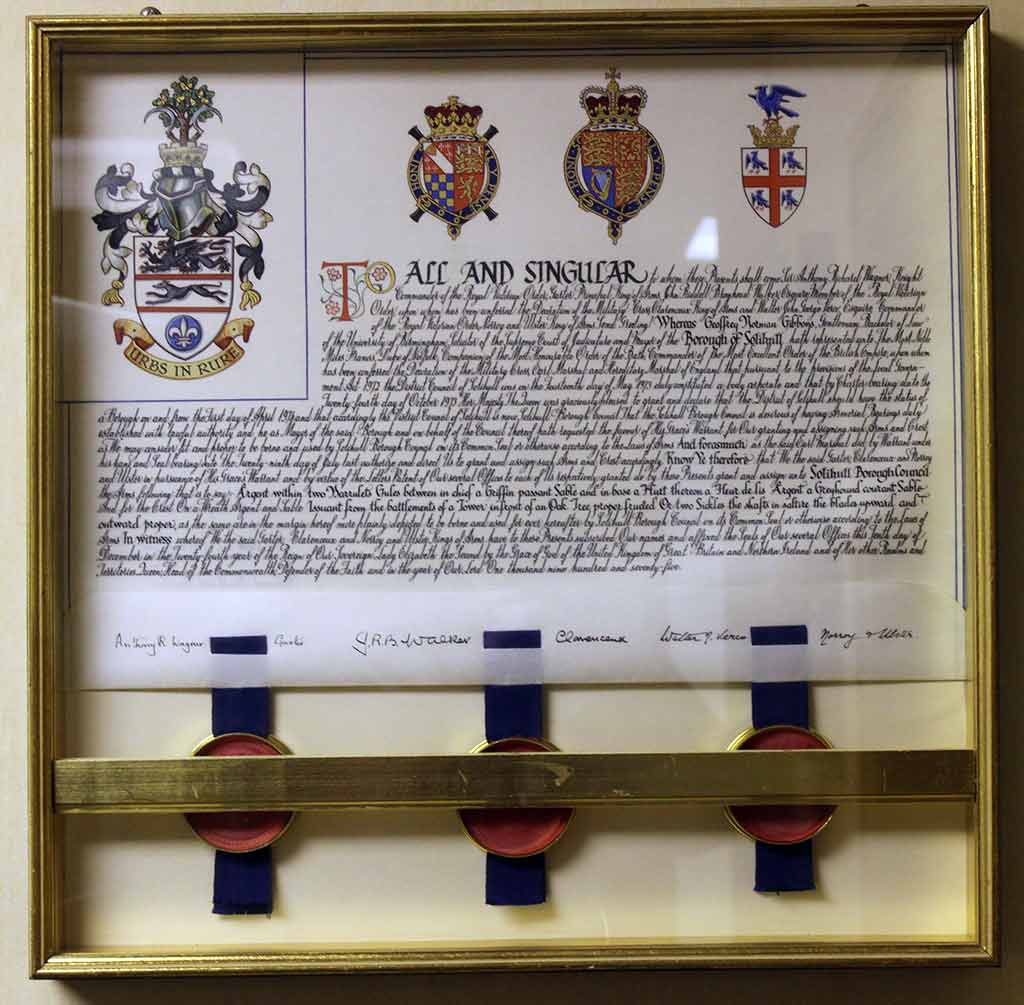
The Council voted unanimously to retain the motto of the District Council “Urbs in Rure”, rather than alternative suggestions of “Soli Prodesse Populo” (“For the Benefit of the People Alone”) or “Heart of England”, which was Meriden’s motto.
Design Elements
Both the 1948 and 1975 Arms have some of the same elements.
The common elements include:
- The two red bars or barrulets on the shield, which are taken from the arms of the Throckmortons who were Lords of the Manor of Solihull from 1528 until 1554. They lived at Coughton Court near Alcester.
- The greyhound in the centre of both shields is from the Arms of the Greswolds of Malvern Hall.
- The sickles at the top suggest the fact that the district was once almost wholly agricultural.
- The walled tower indicates that the district includes considerable residential areas.
- The oak tree is an allusion to the Forest of Arden, which once encompassed the Solihull area.
Some changes were made to include elements relating to the Meriden parishes:
- The two red stars on the original shield were from the Arms of the Odingsell family – Lords of the Manor of Ulverley, who obtained in 1242 a Royal Charter for a weekly market and annual fair. These stars were replaced on the 1975 Arms by a black griffin from the Arms of the Finch family, Earls of Aylesford, who held the lordships of the manors of Bickenhill and Meriden.
- The crown on the 1948 Arms referenced the association of the Manor of Ulverley with the Saxon kings. This was replaced in 1975 by a silver fleur-de-lys, which was taken from the arms of the Digby family, which has held the manor of Coleshill (including Chelmsley Wood, Kingshurst and Fordbridge) since 1496.
If you have any further information, please let us know.
Tracey
Library Specialist: Heritage & Local Studies
© Solihull Council, 2025.
You are welcome to link to this article, but if you wish to reproduce more than a short extract, please email: heritage@solihull.gov.uk
 Solihull Life
Leave a comment