Comprehensive education was introduced in Solihull in September 1974, just over 10 years after Solihull became a County Borough on 1st April 1964 when it took over responsibility for education and schools from Warwickshire County Council.
Education 1944-1974
The Education Act 1944 introduced a system of universal, compulsory, free education for children from the age of five, abolishing grammar school fees and, from 1st April 1947, raising the school leaving age to 15.
Secondary education was intended to be provided through a tripartite system:
- grammar schools for the most academically able
- technical schools for those with a vocational aptitude, e.g. for engineering
- secondary modern schools for everyone else
Some local authorities opted for the tripartite system whilst others, such as Warwickshire, established a dual system of grammar schools and secondary modern schools. From 1947 (when the 1944 Act came into effect) until comprehensive education was introduced in Solihull with effect from September 1974, children in the district were allocated places either at a grammar school or a high school, based on their 11-plus examination results.
Children took an 11-plus test at the end of primary school, which determined which type of secondary school they would attend. Around 20 per cent of children attended grammar schools.
Solihull had a shortage of school places after the Second World War and a development plan drawn up in 1946 by Solihull’s Education Officer, John Orton, included plans for 61 new schools – 11 nursery, 16 infant, ten junior and infant, nine junior and 15 secondary.
In 1961, prefabricated classrooms were installed at nine schools as part of efforts to ease overcrowding.
Following the decision by Solihull School in 1946 to become an independent school, Solihull had no state grammar school for boys until the opening of Tudor Grange Grammar School in 1956. However, a Grammar School Course was introduced at Lode Heath School in September 1951, with the intention that pupils would transfer when the new grammar schools were built.
Fifteen free school places (increasing to 36 in 1953) were also reserved annually for the Local Education Authority by Solihull School until Solihull adopted the comprehensive education system in 1974. Some pupils were also given free places at Olton Convent School or King Edward’s School, Birmingham.
What is comprehensive education?
Comprehensive education is a system in which schools cater for mixed abilities and have a catchment area from which pupils are drawn. There is no selection of pupils on the basis of academic achievement or aptitude.
The first purpose-built comprehensive school opened in London in 1954 and, by 1962, there were 152 comprehensive schools in operation in England.
In 1964, a Government was elected with a Manifesto pledge to abolish segregation of children based on 11-plus results, and to reorganise secondary education along comprehensive lines. Comprehensive education saw academic and non-academic streams provided in the same school.
In July 1965, a Government circular was issued to local authorities requesting them to submit plans for the reorganisation of secondary education in their areas.
Although a change in government in 1970 removed the requirement for local authorities to move to comprehensive education, many authorities continued to submit proposals so, by the early 1980s, comprehensive education was almost universal.
Secondary Schools in Solihull
On 1st April 1964, Solihull County Borough Council took over from Warwickshire County Council the responsibility for education in the Solihull district. By 1966, Solihull County Borough Council had drawn up a tentative scheme for merging its 13 grammar and high schools into seven comprehensive schools with around 13,000 places.
The grammar schools were:
- Solihull High School for Girls, Malvern Hall, which opened in 1931 as a highly selective secondary school for girls. Read more about the school’s history in our previous article Schools at Malvern Hall
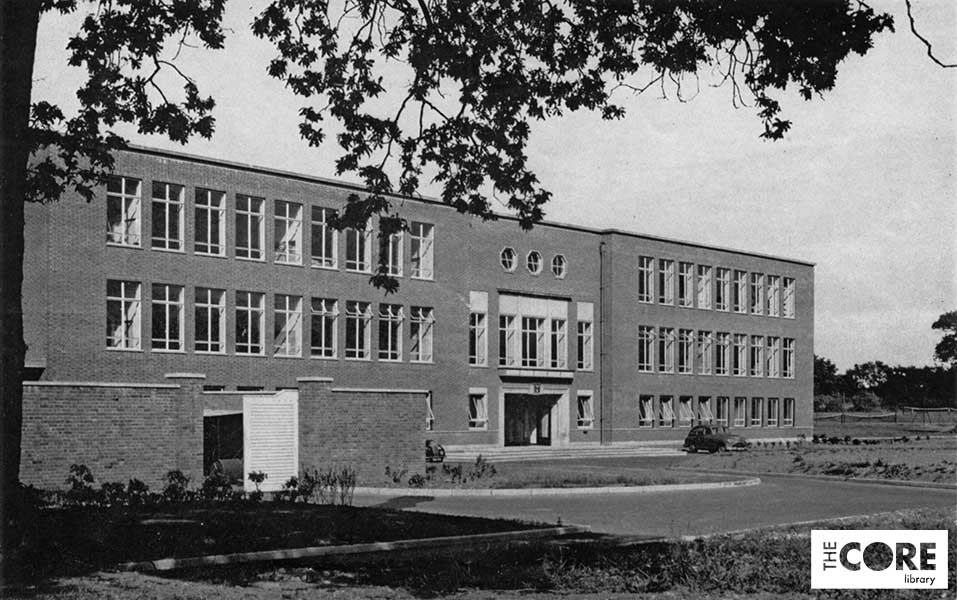
- Tudor Grange Grammar School for Boys, which opened in September 1956 after work began in May 1953. The official opening took place on 23rd July 1957. It was the first boys’ grammar school to be built in Warwickshire since the Second World War. Solihull Education Committee resolved in October 1953 to adopt the name “Queen Elizabeth Grammar School” for the school, but this didn’t come to fruition.
- Tudor Grange Grammar School for Girls opened to pupils on 9th September 1959. Construction was planned to begin in December 1956 but was pushed back to Spring 1957.
Two technical secondary schools were opened on the Tudor Grange Educational Campus in Solihull in 1961, although they were being described as grammar schools by December 1962:
- Harold Cartwright Grammar School for Girls opened in September 1961, at the same time as its boys’ counterpart, although the two schools initially shared the same premises on Blossomfield Road under the joint headship of Roland Henry Collins (1915-2002).
- Harold Malley Grammar School for Boys opened 1961 in the premises of Harold Cartwright Grammar School for Girls, but moved into its own premises in 1964.
The secondary modern schools in Warwickshire were known as High Schools, combining a variety of courses of a practical nature as well as academic courses leading to O-Levels and other examinations.
The high schools in Solihull were:
- Arden School, Station Road, Knowle, which opened in 1958 for children aged 11+ from Knowle and Dorridge.
- Light Hall High School for Boys, which opened on Hathaway Road in 1964. Plans were submitted to Warwickshire County Council in 1961 in anticipation of construction beginning the following year. Headmaster, John Greenfield (1925-2014), was appointed in 1963 and welcomed 96 boys to the still-unfinished school in January 1964. Girls were admitted from September 1967. Mr Greenfield served as headmaster until his retirement in 1983.
- Lode Heath Senior School, which was Solihull’s second senior school to open, having opened on 4th September 1939, the day after Great Britain and France declared that the two countries were at war Germany. The school’s first Headmaster, Mr Arthur Lunnon (1905-1993), served as headteacher 1939-1970.
- Lyndon High School, which opened in September 1952 as a mixed school under headmaster, Mr Jack Moore (1911-1963). It had been hoped that this would be Solihull’s first local authority grammar school, but Warwickshire County Council had earmarked it as a high school. A compromise was reached whereby a small number of grammar school pupils would be accommodated at Lyndon until a separate grammar school was built. Lyndon High School for Girls was completed four years later at which time Mr Moore, who lamented the division of the mixed school, became Headmaster of the Boys’ School.
- Sharmans Cross High School for Boys and Sharmans Cross High School for Girls opened to pupils on 9th January 1934 as Sharmans Cross Senior Mixed Elementary School. This was the first county secondary school to open in Solihull. Children aged 11-14 transferred to the senior schools from the existing elementary schools across Solihull, Olton and Shirley which up until this point catered for all ages. All of the existing schools became junior schools once Sharmans Cross Senior School opened.
In March 1970, Solihull Council was told to decide the day on which it would abolish state grammar schools and change to comprehensive education. The Department for Education had refused to approve plans for a new secondary school at Langley unless Solihull complied with the policy of comprehensive education.
Comprehensive education in Solihull
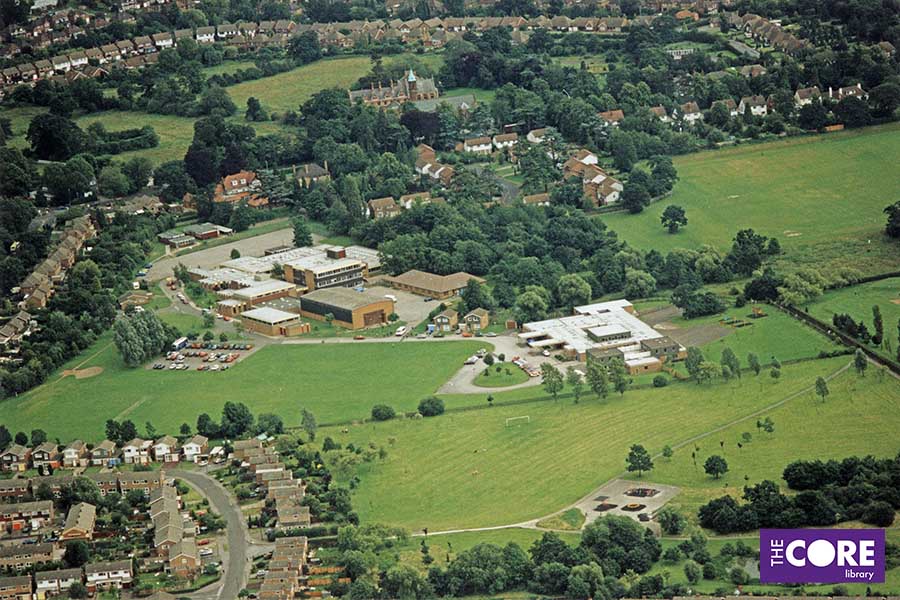
The decision was taken unanimously by Solihull Education Committee on 20th April 1970 that the 11-plus exam would be abolished and that comprehensive education would be introduced by 1974. This would be a complete programme of comprehensive education, rather than keeping a few grammar schools. Plans were agreed for comprehensive schools for 11-16-year-olds and one sixth form college for 17-18-year-olds.
It was also decided that, after September 1973, no further places would be taken up at independent or direct grant schools. Therefore, Solihull would no longer take up its allocation of free places at Solihull School and Olton Convent School, or the assisted places at King Edward’s Schools in Edgbaston. All pupils who had been awarded free or assisted places in those schools, up to and including 1973, would continue to have their fees paid for by the Local Education Authority until the completion of their course, including the sixth form.
Government approval was received in August 1971 for Solihull’s proposal to form eight comprehensive schools from its existing grammar and secondary schools, plus building the new Langley School and a new sixth-form college. Out of a population of 100,000 only 400 people objected to the scheme.
The council’s original intention was to introduce a system of all-in comprehensive schools for 11 to 18-year-olds, but this was revised in 1970 in favour of the sixth-form college for Advanced level students. Councillor Norman Bradbeer, chairman of the Education Committee, explained: “The reason for the change was that we felt that sixth form colleges could provide better opportunities because they were specifically geared for higher education.“
Solihull Education Committee took the decision that medium-sized secondary schools would be best for Solihull, so they set a maximum size, wherever possible, of eight-form entry, meaning a maximum of around 1,200 pupils.
Although selection of pupils based on the 11-plus took place in Solihull for the final time in 1973, it wasn’t until those pupils left after taking O-Levels in July 1978 that schools in the Borough became fully comprehensive. Therefore, it wasn’t until the academic year 1978/79 that all secondary schools in Solihull had a fully comprehensive intake of pupils in every year group.
Schools from Meriden Rural District
By the time that schools had their first comprehensive intake in September 1974, Solihull had become a Metropolitan Borough, as a result of local government reorganisation that came into effect on 1st April 1974.
This meant that Solihull County Borough merged with 10 parishes from Meriden Rural District and the parish of Hockley Heath from Stratford-upon-Avon Rural District, resulting in an increase in secondary schools.
Comprehensive education was already in place in Chelmsley Wood, with Warwickshire Education Committee deciding in 1965 that the six schools to be built in Chelmsley Wood would be comprehensive, reasoning that most children would be moving to the area from Birmingham, where comprehensive education was already in place.
The schools that came into the new Solihull Metropolitan Borough were:
- Archbishop Grimshaw RC Secondary School, Chelmsley Road, Chelmsley Wood, which had opened on 2nd September 1970.
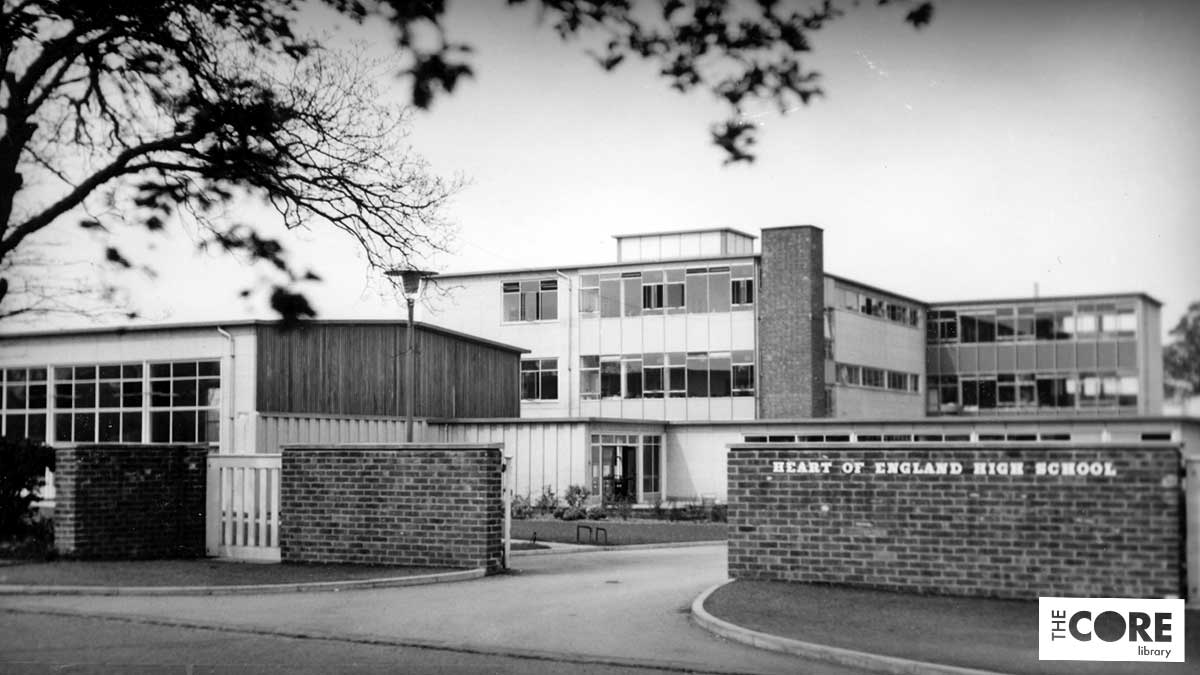
- Heart of England School, Gipsy Lane, Balsall Common opened on 9th September 1957 as a secondary modern school for pupils in Warwickshire. Its official opening took place on 17th June 1958. Mr C. Edgar Richards (1915-2013) was headmaster of the school from its opening until his retirement in 1976.
- Kingshurst Comprehensive School opened in September 1971 after the merger of Kingshurst High for Boys and Kingshurst High School for Girls. These schools, both in Cooks Lane, had opened in September 1958 to cater for the growing population of the Kingshurst Hall estate.
- Park Hall County Secondary School, Water Orton Road, Castle Bromwich, was a secondary modern school and opened to pupils on 1st May 1951 under headmaster Mr George Waite. Pupils from Kingshurst also attended this school until the new Kingshurst High School opened in 1958. Any children who passed the 11+ examination would attend Coleshill Grammar School. The school – also known as Castle Bromwich Park Hall Secondary Modern School – was co-educational for its first two years, until a separate girls’ building was opened in 1953 and Park Hall Girls’ School appointed headmistress, Miss Evans. The schools became co-educational again in 1971.
- Simon Digby Comprehensive School, Partridge Close, Chelmsley Wood, opened to pupils for the first time on 2nd September 1970 with the first 200 of an estimated 1,250 pupils.
- Smiths Wood School, Windward Way, Chelmsley Wood was officially opened in January 1972 and was planned to cater for 1200 pupils. Facilities included a theatre hall with open stage, a library with capacity for 10,000 books, three specialist laboratories and four general ones, two lecture rooms and two art rooms. A contemporary newspaper report noted that “the girls had 20 electric sewing machines, 22 gas and electric cookers, and a flat where they can practise home economics.”
- Whitesmore Secondary School, Chapelhouse Lane, Chelmsley Wood, opened in September 1969, and was the first comprehensive school to be built in Chelmsley Wood. Occupying ten blocks, the school was in Area 2 of Chelmsley Wood, near Tile Cross, and catered for children aged 11-18 living in Areas 1-9 of the estate.
Comprehensive Schools in Solihull, 1974 to date
In 1973 it was stated that Solihull’s 13 secondary schools catered for a capacity of 8,320 pupils, 2,950 attending five selective secondary schools, and 5,300 attending eight non-selective secondary modern schools. In addition, an estimated 11.1 per cent of Solihull’s school population was catered for by some form of private education, compared with a national average of 4.5 per cent (The poverty of education : a study in the politics of opportunity by David S. Byrne, Bill Williamson, and Barbara G. Fletcher, 1975 available at The Internet Archive).
The introduction of comprehensive schools in Solihull initially affected children born between 1st September 1962 and 31st August 1963, who would be commencing their first year at secondary school in September 1974. Nine secondary schools were available across the former Solihull County Borough, plus the seven schools that joined the new Metropolitan Borough from Meriden Rural District. Pupils were offered places based on the school catchment areas. All of the schools were co-educational.
Five headteachers of former Grammar Schools found themselves without a role in the new comprehensive school provision, and most took early retirement.
- Alderbrook School, Blossomfield Road was formed from the merger of Harold Malley Boys’ Grammar School and Harold Cartwright Girls’ Grammar School. The merged school was given the working title “Campus Two Comprehensive School.” The former Headmistress of Harold Cartwright School, Miss Marjorie Willis, took early retirement, whilst the former Headmaster of Harold Malley School, Mr Roland H. Collins (1915-2002) was transferred to the Education Office as Officer for Special Projects, spending much of his time looking after and developing the Maengwynedd Field Centre. He remained in this role until he retired in 1980. Alderbrook School became an Academy in August 2011. In 2015, the school was given permission to establish its own sixth form.
- Archbishop Grimshaw Catholic School, Chelmsley Wood, was rebuilt as part of the Building Schools for the Future initiative, reopening in 2008. It became an Academy in 2011, changing its name to John Henry Newman Catholic College.
- Arden School catered for children aged 11-16 until, in 2007, it was given permission to develop its own sixth form, prompting the resignation of the Principal of Solihull Sixth Form College in protest. Arden’s Sixth Form was established in 2008.
- Heart of England School, Balsall Common established its sixth form in 1998. It became an Academy in 2011.
- Langley School was purpose-built as a mixed comprehensive school – the first to be built by Solihull County Borough Council. The foundation stone was laid on 6th February 1973 and the school opened in Kineton Green Road, Olton in September 1974.
- Light Hall School, Hathaway Road, Shirley became a Specialist College for Mathematics and Computing in September 2003. It saw some of its classrooms destroyed by fire in 2006 and a new building was opened in 2008. Light Hall School converted to become an academy on 1 August 2011.
- Lode Heath School, Lode Lane became an Academy in 2011 and, in 2018, joined Arden and Park Hall Academies in the Arden Multi-Academy Trust (AMAT).
- Lyndon School, Daylesford Road was created in 1974 from a merger of Lyndon High School for Boys and Lyndon High School for Girls. It was a specialist Humanities College 2006-2010 and converted to Academy status in 2015.
- Malvern Hall School, Brueton Avenue, Solihull opened as a co-educational comprehensive school in September 1974, having previously been a highly selective girls’ school – Solihull High School for Girls. On 7th May 1982, official notices were published by Solihull Council stating that Malvern Hall School would cease to accept new admissions in 1985 and would cease to be maintained from 1989 when the last entry completed its five-year course. Malvern Hall School closed in 1989 and the site was taken over by the independent Saint Martin’s School for Girls.
- Park Hall School moved into a new building in November 2008. The school closed officially on 31st August 2009 and opened as Park Hall Academy on 1st September 2009. It was supported by Arden Academy from 2009-2013. However, following a move into special measures in 2013, Arden took over the governance of Park Hall and the Arden Multi-Academy Trust (AMAT) was founded.
- St Peter’s R.C. School, Whitefields Road, a voluntary aided Roman Catholic School opened in September 1974 following a merger of Olton Court Convent School (founded in 1903), an independent secondary school, with Bishop Glancey RC High School. In 1971, Olton Court Convent School had 400 paying pupils and 100 local authority places but, with Birmingham (which reserved 12 places per annum) deciding to discontinue its places as well as Solihull (which had 10 places each year), the financial burden was too great for the school to continue as independent. St Peter’s Catholic School converted to Academy status in 2021 and is part of Our Lady and All Saints Multi-Academy Trust, which was launched on 1st April 2021.
- Sharmans Cross School, Shirley was formed from the merger of Sharmans Cross High School for Boys, Radbourne Road, and Sharmans Cross High School for Girls, Solihull Road. The Radbourne Road site became Upper School and the Solihull Road site became Lower School. The school closed in August 1988 and the Lower School site was sold for housing. The Upper School site was converted into Sharmans Cross Campus of Solihull College of Technology.
- Simon Digby School closed on 31st August 1992 and the site was earmarked for housing in the 2013 Solihull Local Plan.
- Smith’s Wood Comprehensive School became Smith’s Wood Sports College in 2006 and then Smith’s Wood Academy in 2017, sponsored by Fairfax Multi-Academy Trust. In 2009 it was given permission to establish a sixth form.
- Tudor Grange Academy, Kingshurst. On 29th September 1988, Kingshurst Comprehensive School opened as The City Technology College, Kingshurst – the first CTC in Britain. On 1st September 2008, the school became an Academy – The CTC Kingshurst Academy. It closed on 31st August 2018, joining the Tudor Grange Academies Trust under the “Fresh Start” programme on 1st September 2018 and becoming Tudor Grange Academy, Kingshurst.
- Tudor Grange School, Dingle Lane, Solihull was formed from the merger in 1974 of Tudor Grange Grammar School for Girls, and Tudor Grange Grammar School for Boys, with the combined school being referred to as “Campus One comprehensive school.”
- Whitesmore School, Chapelhouse Lane, Fordbridge, opened in Area 2 in September 1969 to serve pupils aged 11-18 living in areas 1-9 of Chelmsley Wood. It closed on 21st July 2006. The school was replaced by the Grace Academy, which opened on an adjacent site in September 2006, catering for pupils aged 11-18. A time capsule of mementos of Whitesmore was buried at the Grace Academy. In April 2019, the Grace Academy Trust became part of Tove Learning Trust, a Multi-Academy Trust.
Comprehensive School Curriculum
Solihull’s Education Committee set up an Advisory Board of Studies. In turn, the Advisory Board set up Working Parties to study the content of education to be provided in the secondary schools. The recommendation was that for their first three years of secondary school, pupils should follow widely-based courses broadly equivalent in all schools, but geared to a pupil’s level of ability. In the latter part of the course, some pupils could be offered a second foreign language or an additional science subject.
During the third year of secondary school, a decision would be made about the more specialised courses to be followed in the fourth and fifth years of school. Pupils would be given “every help and advice” to make an informed choice from a wide range of optional subjects according the their interests, requirements and abilities.
Towards the end of the fifth year courses, pupils would choose either to continue in full-time education by entering Solihull Sixth Form College or Solihull Technical College (or a college elsewhere), or to leave school and enter employment.
Solihull School
With the introduction of comprehensive education from September 1974, Solihull Council stopped taking 36 places at Solihull School for “high-flying” 11-plus candidates. The final offer of 12 free places was made for autumn 1973 to boys in the 11-12 age range. At least one of the free places was aimed at a boy showing promise in music, either as an instrumentalist or a singer. Candidates for day places could live within the school’s normal catchment area of roughly a six-miles radius of the school.
With Solihull Council’s move to comprehensive education, Solihull School instead decided to offer its own scholarships, with 16 places being awarded annually from 1974.
The school introduced its own examination, similar to the 11-plus, including a personal interview. With a scholarship place lasting for seven years, the annual award of 16 places would mean that over the first seven years, 112 boys would benefit from a free place at the school.
Margaret Thatcher, Secretary of State for Education, said that she regretted the council’s decision to discontinue providing places for pupils at Olton Court Convent, King Edward’s School, Birmingham, and Solihull School.
In reply, Councillor Norman Bradbeer, Chairman of Solihull’s Education Committee, said:
I share the Secretary of State’s regret on this point, but you cannot have a successful comprehensive system by continuing to cream off the bright pupils to independent schools. If there was a way we could use these schools without selection, we would do it, but I cannot see an answer to the problem.
Solihull Sixth Form College
The council’s original intention was to introduce a system of all-in comprehensive schools for 11 to 18-year-olds, but this was revised in 1970 in favour of one sixth-form college for Advanced level students, although Solihull Technical College would also offer some A Level courses.
Councillor Bradbeer, Chairman of the Education Committee, explained:
The reason for the change was that we felt that sixth form colleges could provide better opportunities because they were specifically geared for higher education.
The foundation stone of Solihull Sixth Form College in Widney Manor Road, Solihull, was laid on Saturday 5th May 1973 by Councillor Norman Bradbeer, Mayor of Solihull. The purpose-built college was on an open site overlooking Brueton Park and opened in September 1974.
The college was intended to take around 750 students aged 16-19 and to bring together expertise in sixth-form education which was previously distributed across the borough’s grammar schools.
Students were offered a place at the Sixth Form College based on the recommendation of their teachers at secondary school, and subject to O Level/CSE exam results. In order to study an A Level course, it was generally expected that students should have an O Level pass (or CSE Grade 1) in that subject.
A Level subjects offered included: Ancient History; Biology; British Constitution; Classical Languages (Latin, Greek); Chemistry; Economics; Engineering Science; English Literature; Geography; Geology; History; Mathematics; Further Mathematics; Pure Mathematics; Pure Mathematics with Statistics; Modern Languages (French, German, Italian, Russian, Spanish); Music; Physics; Physics and Mathematics; Religious Knowledge.
Students would take a maximum of three subjects at A Level, with the addition of a General Studies paper. They were also required to follow a course of Foundation Studies, occupying about one fifth of the week, with the intention of putting specific studies into a broader context.
Students were also expected to take part in leisure activities, and the inaugural college brochure indicates that students “will be interviewed by members of the Recreative Activities Department to select their activity or activities for the following term or half-term.”
The college aimed to foster an approach to teaching and learning that students were likely to encounter at university, expecting students to work conscientiously and to discover and exploit their own intellectual talents. The college would not spoon feed them, but would guide them to develop habits of independent learning. A tutorial system would be at the hear of the college, with each student joining a tutor set of about 15 young people from a cross-section of the student body under the pastoral guidance of a Senior Tutor.
Solihull Sixth Form College converted to an academy and became part of the Ninestiles Academy Trust on 1st August 2017. The Ninestiles Academy Trust changed its name to the Summit Learning Trust in 2018.
To celebrate the college’s 50th anniversary in 2024, five species of native British trees were planted at the Widney Manor Road campus. A celebratory event was attended by the present Principal with four former Principals, the Mayor of Solihull, and hundreds of current and former staff and distinguished guests.
Solihull Technical College
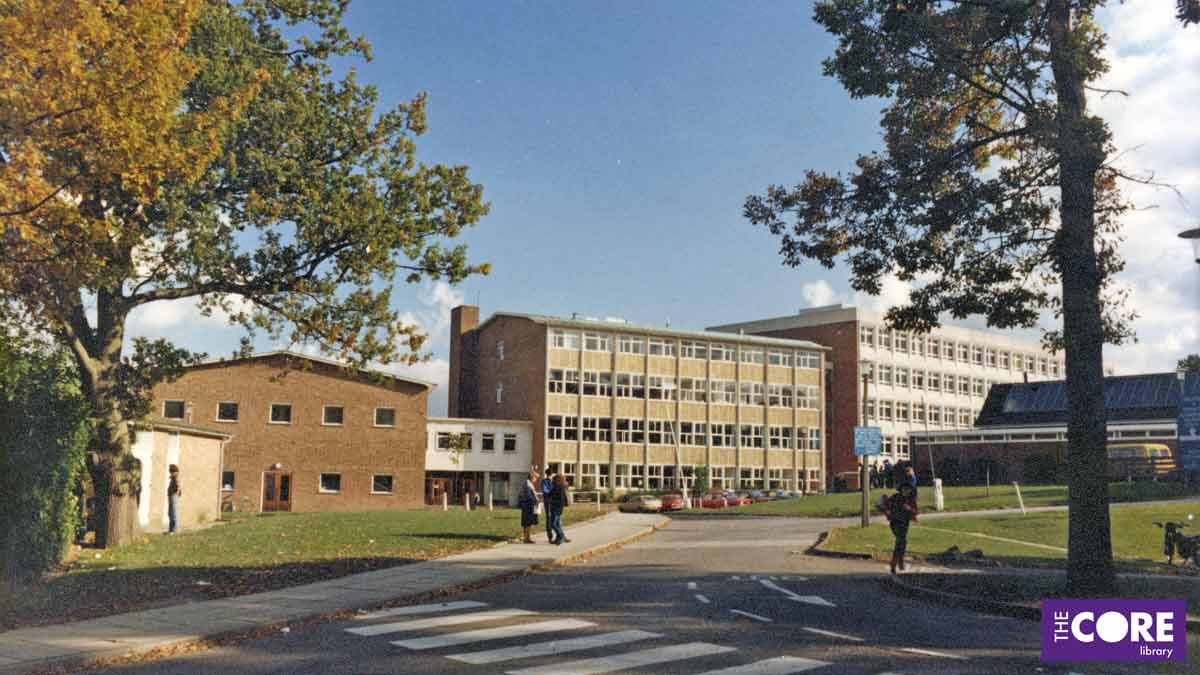
In September 1961, the first phase of Solihull College of Further Education, Blossomfield Road opened as an extension to Solihull Institution of Further Education, Sutton Lodge, which was on the Tudor Grange estate and opened in September 1953. The Institute had five classrooms, an art room and a pottery section which had its own electrical kiln, It offered daytime commercial courses for young people, as well as weaving, basketry, pottery, tailoring and art classes.
The first full-time course at the Institute began on 11th January 1954, catering for 22 children – three boys and 19 girls – who had left secondary modern school in December 1953 and were aged 15/16. The course lasted for 12 months and parents had to sign a declaration that the children would remain for the duration of the whole course. Students were expected to become “better than average” office staff, studying shorthand, typing, commercial accounts, arithmetic, English and current affairs (Birmingham Daily Post, 12th January 1954).
In 1955, Solihull Education Committee had recommended an extension to the Sutton Lodge site as a result of increased interest in further education. In 1956, the “first instalment” of Solihull College of Further Education was included in the Borough’s 1958-59 building programme.
The Birmingham Post, 1st April 1964, reported that growth of the college and the demand for more courses meant that during the next few years it would be necessary to seek the approval of the Minister of Education for the building of the second instalment of the college.
In 1966, it was recommended that the further education college be renamed “Solihull Technical College” because of confusion by the public about its function.
The Technical College offered a complementary range of A Level courses to the Sixth Form College, which opened in September 1974. Students at the Technical College had specialist facilities in new extensions and offered A Levels in: Art; Craft Subjects (including Woodwork, Metalwork and Technical Drawing); Computing Science; Engineering Technology; Home Economics and Needlework.
On 12th January 1990, Solihull’s MP, John Taylor, opened the Sharmans Cross Campus of Solihull College of Technology on the Radbourne Road site of the former Sharmans Cross Upper School.
A return to selective education?
In September 1983, Solihull considered reintroducing grammar schools, with suggestions that Tudor Grange and Arden schools could select pupils based on ability from as early as September 1984.
However, a meeting of parents at Arden School overwhelmingly rejected the proposals, with parents saying that they did not want their children to have to take buses out of Knowle to other schools if they failed to obtain a grammar school place. Teachers across the borough also opposed the plan, saying that it would brand 85-90 per cent of pupils as failures.
Further reading
List of current secondary schools in Solihull
Sharmans Cross Secondary Schools
If you have any further information about Solihull’s transition to comprehensive education, please let us know.
Tracey
Library Specialist: Heritage and Local Studies
The Core Library, Solihull
© Solihull Council, 2024.
You are welcome to link to this article, but if you wish to reproduce more than a short extract, please email: heritage@solihull.gov.uk
 Solihull Life
Leave a comment