On 1st April 1964, Solihull and Luton were both elevated to county borough status – the first county boroughs created since 1927, and the first of Queen Elizabeth II’s reign. The towns exchanged messages of goodwill and congratulations.
When Solihull was incorporated as a municipal borough in 1954 – receiving the first Borough Charter of the late Queen Elizabeth’s reign – the Birmingham Mail noted its expectation that the new borough would undoubtedly be seeking an even higher status: that of a county borough.
What was a County Borough?
When the county councils were established under the Local Government Act 1888, it was thought that it would be impractical for them to have authority over the large urban areas within their boundaries.
Therefore, it was decided that any place that was incorporated as a borough would become a county borough and have the same authority as a county council. Initially, county boroughs had to have a minimum population of 50,000 but this was raised to 75,000 in 1926 and 100,000 in 1958.
As Solihull’s population at the time of the 1951 census was almost 68,000, it seemed likely that it would soon rise to the 75,000 required for a county borough. This would mean that – provided that Solihull had been incorporated as a municipal borough – it would be elevated from its status as an urban district. However, the raising in 1958 of the population threshold for county boroughs to 100,000 meant that it took a little longer than expected for the higher status to be conferred on Solihull.
Timeline to the Solihull Order 1963
The Birmingham Daily Post, 1st April 1964, included a timeline that led to the conferring of county borough status on Solihull:
- 1958, July 23rd:
Local Government Act 1958 received the Royal Assent and the Local Government Commission for England was appointed. - 1959, March:
the Local Government Commission started its review of the West Midlands Special Review Area, which included Solihull. - 1960, March 1st:
Local Government Commission issued its draft proposals for the West Midlands Special Review Area, and these included a proposal to confer county borough status on Solihull but with a reduced area. - 1961, May:
the Local Government Commision issued its final proposals for the West Midlands and confirmed its intention to recommend the conferment of county borough status on Solihull. - 1962, July 30th:
the Minister of Housing and Local Government announced that he had decided to accept the Commission’s recommendations, but proposed to exclude Solihull Lodge from the county borough and add it to the City of Birmingham. - 1963, May 27th:
The Minister stated that because of legal proceedings relating to areas of the Black Country, he could not proceed with the Order under the 1958 Act to the reorganisation proposals by 1st April 1964. - 1963, June 10th:
Solihull Council approached the Minister and asked him to make a separate Order constituting Solihull a county borough. - 1963, June 27th:
the Minister of Housing and Local Government announced that in view of the strongly-expressed views of residents in the Solihull Lodge area, he had decided to alter his previous decision and that he would allow Solihull Lodge to be included in the county borough. - 1963, September 10th:
the Minister agreed to Solihull’s request. - 1963, December 12th:
the Minister signed the Solihull Order, 1963. - 1963, December 18th:
the Minister laid the Solihull Order 1963 before both Houses of Parliament. - 1964, January 22nd:
the House of Commons approved the Order. - 1964, February 5th:
The House of Lords approved the Order, certain provisions of which immediately took effect to enable preliminary work to be carried out by the authorities concerned. - 1964, April 1st:
The Order takes full effect and Solihull becomes (along with Luton) the first authority to obtain county borough status since Doncaster attained it in 1927.
A copy of the Solihull Order 1963 is available to view on our online catalogue.
A residential town with a history of rapid growth
When Sir Keith Joseph, Minister for Housing and Local Government, proposed to the House of Commons on 22nd January 1964 the motion that the Solihull Order be approved, he introduced it by saying:
The House will be aware that Solihull is mainly a residential town with a history of extremely rapid growth… When Solihull was created an urban district in 1932 its population was about 25,000. By the end of the war it stood at 63,000. It obtained its borough charter in 1954. Its population is already past the 100,000 mark, and it is likely to grow a good deal more.
Sir Keith Joseph, 22nd January 1964
He went on to note that, after initial reservations, Warwickshire County Council did not object to the proposal and, although the Local Government Commission had considered the possibility of including Solihull in Birmingham it decided against it on the grounds that they did not want to increase the size of Birmingham and they felt that Solihull had its own identity. Looking at Warwickshire, the Commission decided that the county without Solihull would still have a population of around 480,000 and would therefore remain effective.
However, as the Commission’s policy was to leave green belt areas within the administrative counties, the recommendation was for Solihull’s geographical area to be reduced by as much green belt land as possible.
Parts of the parishes of Barston, Bickenhill and Hampton were transferred to Meriden Rural District. Part of Lapworth was transferred to Warwick Rural District, and part of Wythall (Majors Green and Trumans Heath) was transferred to Bromsgrove Rural District and so became part of the County of Worcestershire. The parish of Salter Street – including Tidbury Green, Fulford Heath, Earlswood, Dickens Heath, Mount Estate, Illshaw Heath, Warings Green and Hockley Heath – became a new parish of Hockley Heath and was transferred to Stratford-upon-Avon Rural District.
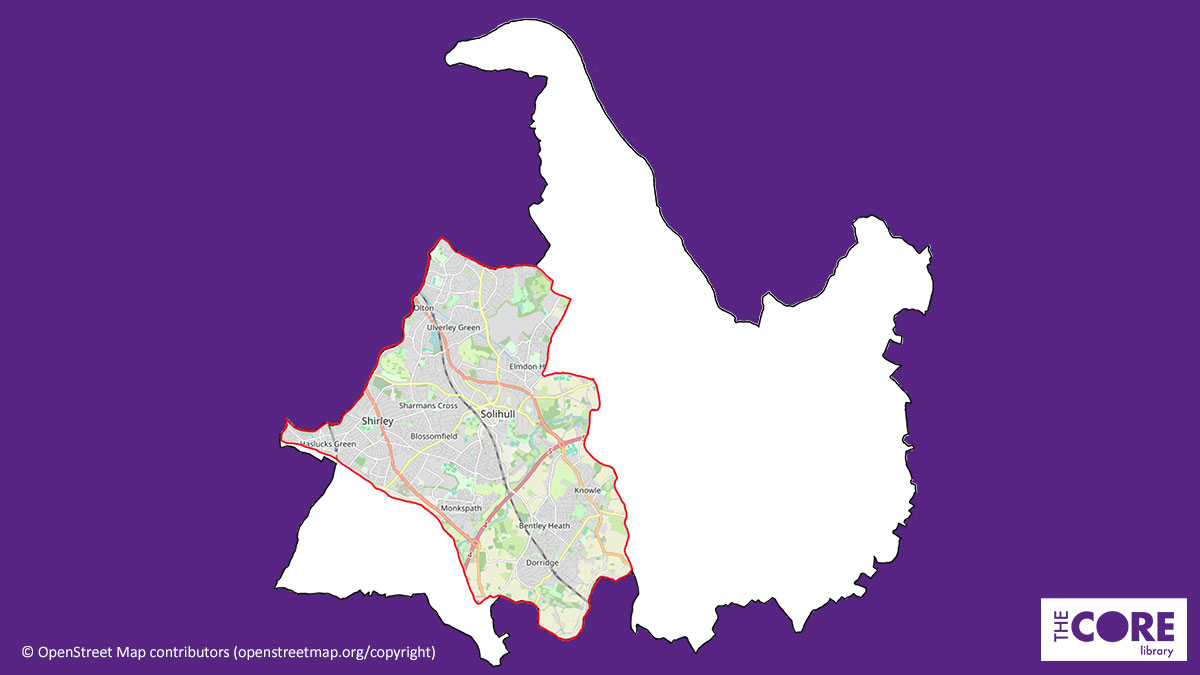
The image at the top of this page shows the County Borough area 1964-1974 compared with an outline of the Solihull Metropolitan Borough that was created in 1974.
If Solihull achieves county borough status its rise from a rural district to a county borough in just over thirty years must constitute a record of growth and civic achievement.
Sir Keith Joseph, House of Commons, 22nd January 1964
The final meeting of Solihull Borough Council took place on 31st March 1964. It was one of the shortest Council meetings, lasting 72 minutes rather than the usual three hours, and was carried out in a “holiday spirit.” Topics debated included meals on wheels subsidies, the danger of car fumes in the new council chamber, the opening of Council greenhouses on Sundays, and the height of future blocks of flats.
One of the councillors, George Holton, a master baker, was pictured in the Birmingham Daily Post of 1st April 1964 putting the finishing touches to a 60-pound cake bearing the borough’s coat of arms. The cake was to be on display in the Civic Hall during Elevation Day before slices were sent to local hospitals and old people’s homes.
Changing responsibilities
By becoming a County Borough, Solihull took on responsibilities previously carried out on its behalf by Warwickshire County Council, notably:
- fire and ambulance services
- education
- health
- welfare
- weights and measures
- vehicle licensing
- aspects of town planning
Elevation Day celebrations
The changes were intended to take place slowly, smoothly and without fuss. One councillor said: “The whole idea is to run the place more efficiently. We should look an odd lot if we achieved it through a period of chaos.”
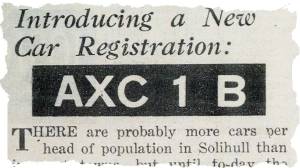
“Elevation Day,” 1st April 1964, began with the first meeting of the new County Borough Council shortly after 10am, followed by a procession to St Alphege Church for a re-dedication service. The bell ringers at St Alphege Church rang a Quarter Peal of Grandsire Triples to celebrate the elevation to a county borough.
After the service at St Alphege there was an official luncheon at the Civic Hall, which had been opened by The Queen in 1962. In the evening, the Civic Hall also hosted a Civic Ball for more than 500 guests, including 22 civic heads. During the reception at the ball, two special cocktails were served – “Elevation No. 1” and “Elevation No. 2”. Unfortunately, the cocktail recipes don’t seem to have been recorded for posterity so, if you have any information, please let us know.
A telegram of congratulation from HM Queen Elizabeth II was read to over 200 guests at the luncheon.
Princess Margaret also sent a telegram of congratulations, referring to the “happiest memories” of her visit in 1954.
The Bishop of Birmingham – Dr J. L. Wilson – proposed a toast to the new County Borough, saying that the measure of a great town or city was not only the business it did, its splendid education and parks, but also the character of the people.
The Birmingham Post suggested good reasons for Solihull’s phenomenal population rise:
- Solihull is an attractive place, pleasant to live in
- Its name is associated with wealth and elegance in many minds
- Many see it as the home of ‘suitable’ industry and the opportunities it brings with it
- It is well governed
- It combines the amenities of town and country
- It is forward looking
On the morning of “Elevation Day +1,” Thursday 2nd April 1964, the Mayor, Councillor H. B. Shaw, inspected the town’s newly-independent fire service at the Fire Station in Streetsbrook Road. In the afternoon, he laid the foundation stone of the new Tudor Grange swimming baths and opened the Council’s new plant nurseries in Tudor Grange Park.
In the evening, there was a civic dinner at the Civic Hall to mark the end of Warwickshire’s administration of Solihull. The farewell to Warwickshire was only as regards administrative matters – for ceremonial and other purposes, Solihull remained part of the County of Warwickshire until 1974.
The Mayor told the members and chief officers of the two authorities:
Our desire for independence must not be taken as an indication of our dissatisfaction with the way in which the county council has administered local government services in our area… Solihull is most grateful to the county council for the great help which has been extended to it
Birmingham Daily Post, 3rd April 1964
On Friday 3rd April 1964 – “Elevation Day +2” – a fireworks display was held in Tudor Grange Park with “dancing to local ‘rock’ and ‘beat’ groups.” We don’t have a record of which bands they were, so please let us know if you have any information.
Beating the Bounds
The Birmingham Mail 26th March 1964 reported that a group of around 20 Solihull Council employees would set off at midnight that evening on a 25-mile walk around the new County Borough boundaries. Starting from outside the Council House in Poplar Road with a send-off by the Mayor, the route was to Catherine-de-Barnes, Elmdon Heath, Coventry Road to Sheldon, Olton, across to Shirley, Solihull Lodge, then to Box Trees Road, Hockley Heath, Packwood, Dorridge and Knowle.
It was organised by Derek Norton, a 35-year-old clerk in the Council’s Audit Department. He told the Birmingham Mail that the walk had a double purpose:
to prove we chairbound types are fit enough to walk 25 miles and more especially to celebrate the town’s promotion… We have Good Friday to recover.
William Maurice Mell
The driving force behind the success of Solihull in achieving County Borough status was acknowledged to be the Town Clerk, W. Maurice Mell, who had steered Solihull through a period of incredibly rapid growth.
He had been Town Clerk (forerunner of Chief Executive) since 1946 having replaced Mr Norman Phillips Lester (1901-1983), Town Clerk 1941-46. Mr Lester’s predecessor, Mr Charles Herbert Cook (1881-1950), had retired as Town Clerk in 1941 after 21 years’ service although he continued as Food Officer until 1949 and Superintendent Registrar until his sudden death whilst at work in 1950, aged 69.
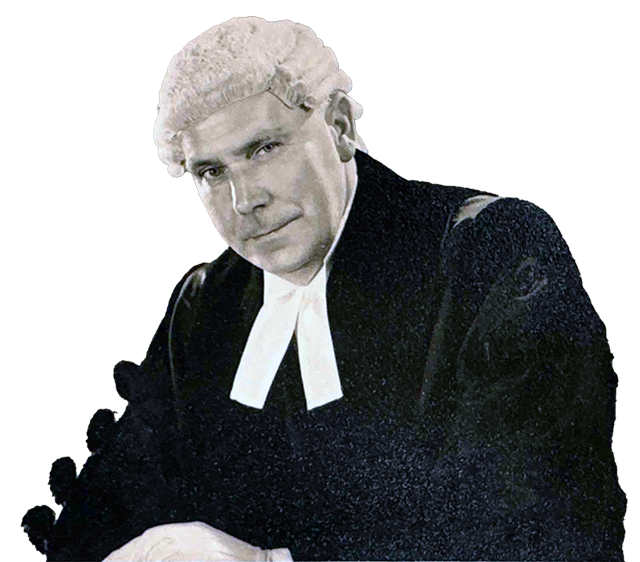
Mr Mell clearly intended to remain as Solihull’s Town Clerk until his expected retirement in 1973 but he died on 19th January 1965, aged 56, less than a year after the County Borough celebrations.
Extensive work was still underway on the redevelopment of Solihull town centre and, knowing his aversion to memorials such as obelisks or clock towers, the Council decided that it would be a fitting tribute to name the new town square after him. The suggested name was “Maurice Mell Place,” but by the time the first shops opened in 1966, the name had become Mell Square.
“The way this town has grown has been exciting, but no one man can take the credit for that… I am only one of a team of officials. The standard of administration here has been extremely high, and so has the quality of the councillors.”
W. Maurice Mell, 1964
A public clock
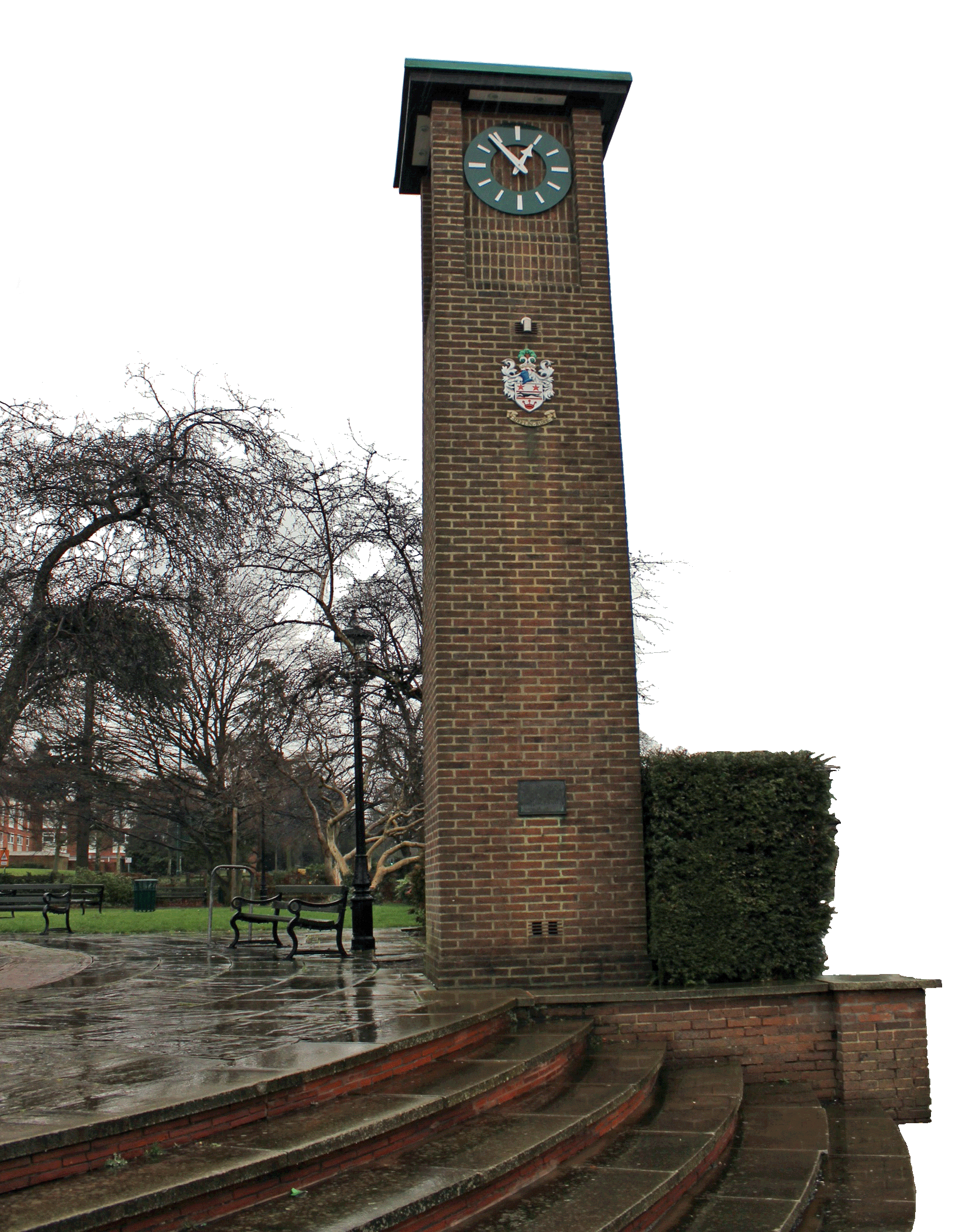
The target of £1,400 for a public clock to mark Solihull’s new County Borough Status was finally reached on 31st March 1964. Shortly before the final meeting of the Municipal Borough Council, the presentation took place of two canvas bags of silver coins, which were the proceeds of a teenage dance at the Civic Hall.
The dance was organised because it was felt that “youth would want to be associated with the progress of the borough to its new status”. Two of the groups appearing at the dance – The Applejacks and The Downbeats – waived their fees to augment contributions to the clock fund and were in attendance when the bags of coins were presented to the Council.
The clock was designed by Mr W. F. Thompson, Deputy Architect in the Borough Surveyor’s Department. The tower was already complete by 1st April but the delivery of the clock mechanism was still awaited. The clock, still in place in Brueton Gardens, was set in motion by the Mayor, Councillor H. B. Shaw, on 5th May 1964.
A record rise
Solihull’s elevation from a rural district in 1932 to a County Borough in 1964 was remarkable.
At the commemorative luncheon on 1st April 1964 marking the creation of the County Borough of Solihull, the Lord Lieutenant of Warwickshire, Lord Willoughby de Broke, spoke of the “quite unprecedented” phenomenal growth of Solihull and paid tribute to all those involved in development plans.
The Lord Lieutenant also paid tribute to the Mayor, Councillor H. B. Shaw, who had the distinction of being, he thought, the only civic leader in Great Britain to have served a town as Chairman of the Urban District, Mayor of the Municipal Borough, and now Mayor of the County Borough.
County Boroughs were abolished when the Local Government Act 1972 came into force in 1974, so Solihull’s County Borough status only lasted for 10 years. However. the 1972 Act permitted existing boroughs to petition for a new Borough Charter, which Solihull duly did. The new charter came into effect on 1st April 1974.
If you have any further information regarding Solihull’s elevation to a County Borough, please let us know.
Tracey
Library Specialist: Heritage & Local Studies
© Solihull Council, 2024.
You are welcome to link to this article, but if you wish to reproduce more than a short extract, please email: heritage@solihull.gov.uk
 Solihull Life
Leave a comment