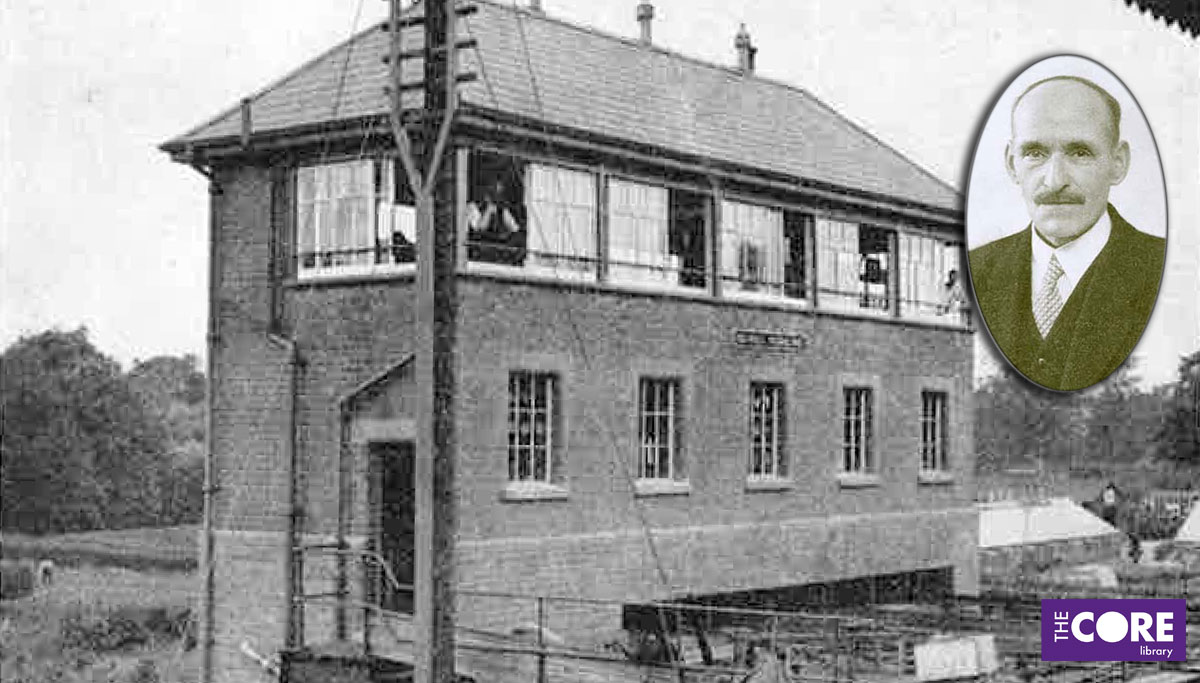
Arthur Stokes was born in Birmingham on 19th February 1871 and was the second of the six children of parents, Peter, a carter, and Ann (née Humphreys) who had married in Bordesley in 1867. He started work on the railways at the age of 13, and spent 44 years as a signalman at Solihull Station. In 1936, he published his memoir, the proceeds of which went towards the Solihull Methodist Church Building Fund.
The family lived in Bordesley before moving to Olton when Arthur was 10 years old. He says that he attended the only school in the area, which was provided by the Congregational Church. He left school in 1883, aged 12, and worked at six jobs a day from 6am until at least 7pm:
- a paper round at 6am
- an errand boy at a shop until 11:15am.
- from 11:30-1pm, he blew the organ at Tyseley Congregational Church
- his first boot-blacking job at Olton 3-4.30pm
- a second boot-blacking job 4.30-6pm
- an hour or so working for a greengrocer at Acocks Green.
Parcel boy and lad porter
In 1884 he began working for the parcel agent in Acocks Green. His memoirs say that he worked 8am to 8pm, but never turned down the chance of overtime as well. He also ran errands for the parcel agent’s daughters, who ran a sweet shop, meaning that several times per week he went into Birmingham to fetch stock for them.
At the age of 14, Arthur began what was to be his 50-year career with the Great Western Railway. His memoirs give the date as August 1885, although railway employment records on Ancestry (available free of charge from library computers) give the date that he started work as a Lad Porter at Acocks Green Railway Station as 19th July 1886. He initially worked 13½ hours per day, shortened to 12 hours a few months later. His working pattern included alternate Sundays 9am-10pm.
Visit of Queen Victoria to Birmingham
On 23rd March 1887, during her Golden Jubilee year, Her Majesty Queen Victoria made her third visit to Birmingham, leaving Windsor at 10:30am and alighting at 1:15pm at Small Heath Station where a covered way was erected for her to pass beneath on her way from her saloon on the platform to the Royal carriages. The platform was carpeted for the occasion and was decorated with flags and bunting. The Queen was greeted by the Mayor of Birmingham, and there was a guard of honour of the 1st Battalion of the York and Lancaster Regiment.
Arthur Stokes, Lad Porter, says in his memoirs that he was elated when the Station Master installed him as Booking Clerk at Acocks Green on this momentous day. He said that, as road transport into the city was limited to a two-horse bus, the railway had a field day with people travelling into Birmingham for the Queen’s visit so, as Booking Clerk, he had to be on top of things with 1st, 2nd and 3rd class tickets in heavy demand.
Birmingham and the Black Country
In February 1889 Arthur became a Parcels Porter at Birmingham for three months before moving to Small Heath for five months and then returning to Birmingham in October 1889 in the same role. In October 1890 he moved to Acocks Green as an adult porter and, as was apparently usual for railway staff on the Birmingham to Leamington line, he then had to spend six months in the Black Country.
He became a signalman at Princes End in December 1890, working in the signal box at Bloomfield Crossing, near Tipton. He seized the opportunity of returning home after six months and, in July 1891 he became a signalman at Olton Station, working 8am to 8pm, before moving to Solihull Station in 1892. His memoirs say that he worked at the Solihull box from January 1892 until February 1936 – a total of 44 years!
Solihull Signal Box
The new signal box at Solihull was opened on Monday 11th July 1932, resulting in the publication in the Evening Despatch of the following day of an article by Arthur Stokes, reflecting on the history of the previous “cabin” where he had worked for 40 years.
He reminisced that when he arrived at the signal box in 1892, the outlook was very rural and the only building visible from the windows of the signal box was the old moated farmhouse of Silhill Hall, Streetsbrook Road, which was then home to Mr Ryland. He described Streetsbrook Road itself as a typical winding Warwickshire lane, fringed with fine old trees, mainly elms.
Mr Stokes was on duty in the signal box during the “Solihull Whirlwind” 1923 and felt a thud, which seemed to come from below the signal box as the storm swirled. He later discovered that the noise was as a result of the fall of about a dozen elm trees a stone’s throw away, and within a few yards of the barn at Silhill Hall where labourer, Patrick Murphy, was killed.
Family
Arthur Stokes married Flora Maria Stride in 1893 and they had two children, Edward Philip Stokes (1897-1976) and Jessie Edith Alice Stokes (1900-1980) who were both born in Shirley. At the time of the 1901 census, the family was living in Longmore Lane, Shirley and, by 1911, were at Colville Villas (now nos. 171/173), Marshall Lake Road.
171 Marshall Lake Road remained the family home for more than 40 years until the deaths of Arthur Stokes on 24th April 1953 and his wife, Flora, in 1955.
eBook
To mark what would have been Arthur Stokes’ 153rd birthday on 19th February 2024, we have converted his memoir into a eBook, which is available to borrow free of charge from Solihull Libraries.
If you have any further information about Arthur Stokes, please let us know.
Tracey
Library Specialist: Heritage & Local Studies
email: heritage@solihull.gov.uk
© Solihull Council, 2024.
You are welcome to link to this article, but if you wish to reproduce more than a short extract, please email: heritage@solihull.gov.uk
 Solihull Life
Leave a comment