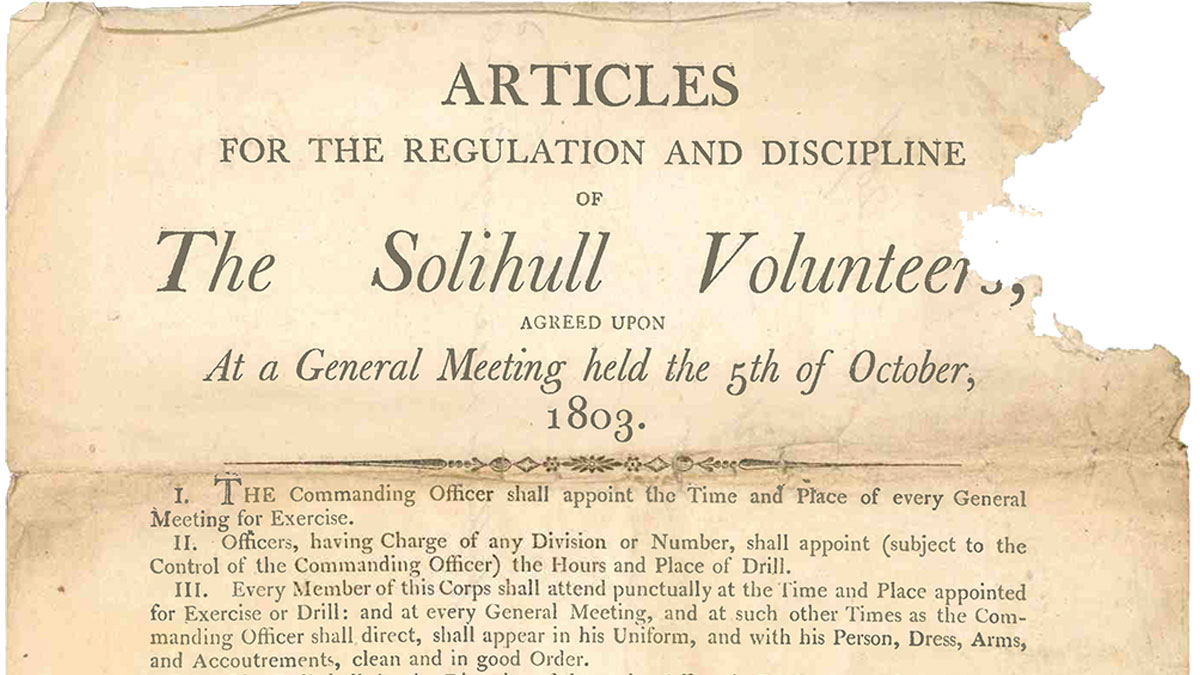
In the face of rising fears of invasion, an association for the defence of Solihull, Knowle and Elmdon was formed in 1797. The association offered to the Lord Lieutenant of Warwickshire a troop of horse at least 50-strong, with volunteers comprising local tradesmen and farmers who agreed to serve only within the bounds of Solihull, Knowle and Elmdon. Unlike the militia, which was raised by public ballot and administered by the War Office, the volunteer forces were self-regulating and would only come under the control of military authorities in the event of an invasion.
We don’t have much information on the local volunteer force from 1797, although it seems that the volunteers were under the management and direction of Henry Greswold Lewis of Malvern Hall:
It is with pleasure we learn, that the inhabitants of Solihull, chiefly tenants of H. G. Lewis, Esq; actuated by motives which do them honour, have nobly stepped forward in defence of their country, and formed themselves into a Volunteer Corps, to the number of about 100, under the management and direction of that gentleman.
Aris’s Birmingham Gazette – Monday 20 March 1797
1st Warwickshire Regiment of Volunteers
Joseph Harding, nominated as the Captain of the Volunteer Corps, also became captain of a later volunteer infantry force, which seems first to have been raised in August 1803. 14 members of the earlier force also joined the Solihull company of volunteers.
The Solihull Company of the Hundred of Hemlingford Volunteers (or 1st Warwickshire Regiment of Volunteers) was established under Public General Act 43 George III c. 121 [1802], which provided for the billeting of troops of yeomanry and volunteer cavalry desirous of training together, and subjecting to military discipline during the war. The Hemlingford Volunteers also included companies from Meriden and Coleshill.
A subsequent Act (43 George III c. 123) exempted those serving (or having a substitute serving) in this additional Military Force from being balloted to serve in the Militia of England.
Enrolment for the Solihull Volunteers began in Solihull on 27th August 1803, with recruits also coming from the parishes of Knowle, Barston, and Hampton-in-Arden. There were 132 effective recruits, and 16 non-effectives or supernumeraries by the time of the first muster in December 1803.
Those enrolled on 27th August were from the Parish of Solihull and included:
- Captain Joseph Harding
- Lieutenants Thomas Chattock and Judd Harding
- Ensign Joseph Adams
- Sergeants John Chinn, John Madeley, William Brooke and John Thompson
- Corporals William King and Robert Haywood
- Drummer Joseph Aston
- 65 private soldiers
Volunteers from Knowle, Barston and Hampton-in-Arden seem to have been enrolled on 14th November 1803 and included:
- Sergeant Richard Sowley and Corporal George Cattell, plus 20 private soldiers (Knowle)
- Corporal John Ashford (Barston), plus 11 private soldiers (Barston)
- Corporal Thomas Glover, plus 11 private soldiers (Hampton)
An order issued on 17th August 1805 (The Core Library ref.: D99/1/3) stated that every individual belonging to the 1st Warwickshire Regiment must “hold himself in constant readiness to march at the shortest Notice.” No luggage was permitted, other than the items permitted in a limited “list of “necessaries,” namely:
- two shirts
- two pairs of stockings
- two pairs of shoes
- two brushes
- black ball
- emery
- oil rags
- spare flints
The last known muster of the Solihull company was on 5th October 1805. It may be that the company disbanded after the threat of invasion was effectively removed by Nelson’s victory at Trafalgar on 21st October 1805, although there was an announcement in Aris’s Birmingham Gazette 19th January 1807 that Lieut. Thomas Chattock had been appointed Captain of the First Warwickshire, or Hemlingford Volunteer Infantry.
If you have any further information about the Solihull Volunteers, please let us know.
Tracey
Library Specialist: Heritage & Local Studies
email: heritage@solihull.gov.uk
© Solihull Council, 2023.
You are welcome to link to this article, but if you wish to reproduce more than a short extract, please email: heritage@solihull.gov.uk
 Solihull Life
Leave a comment