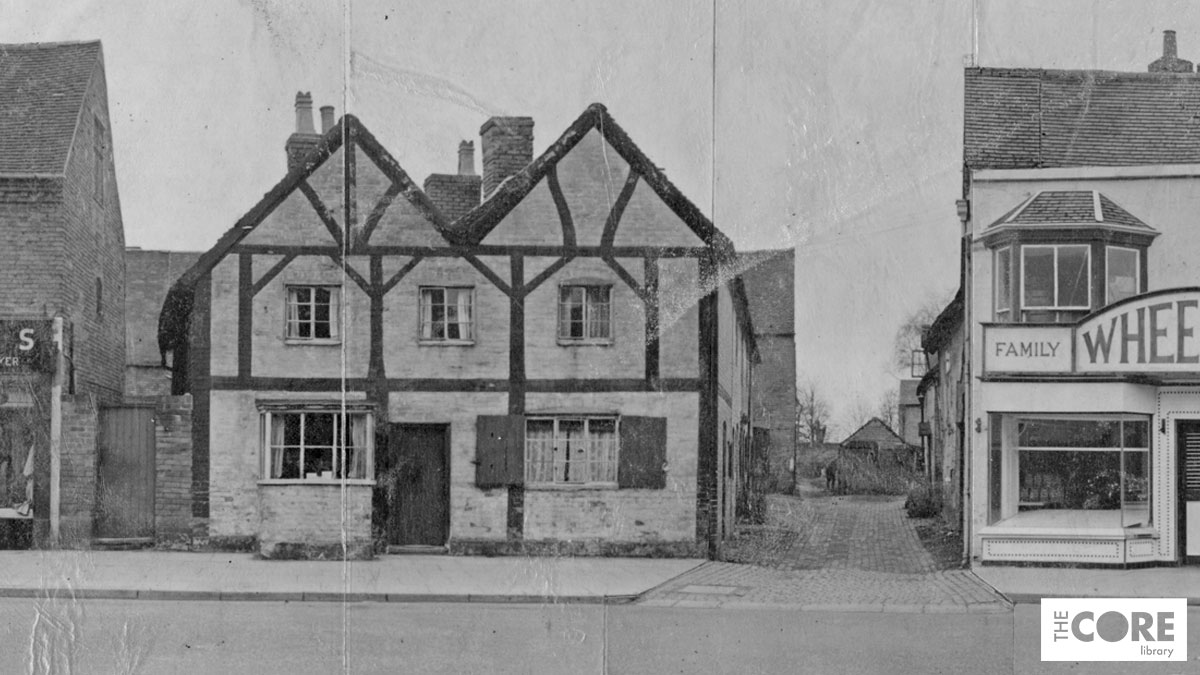
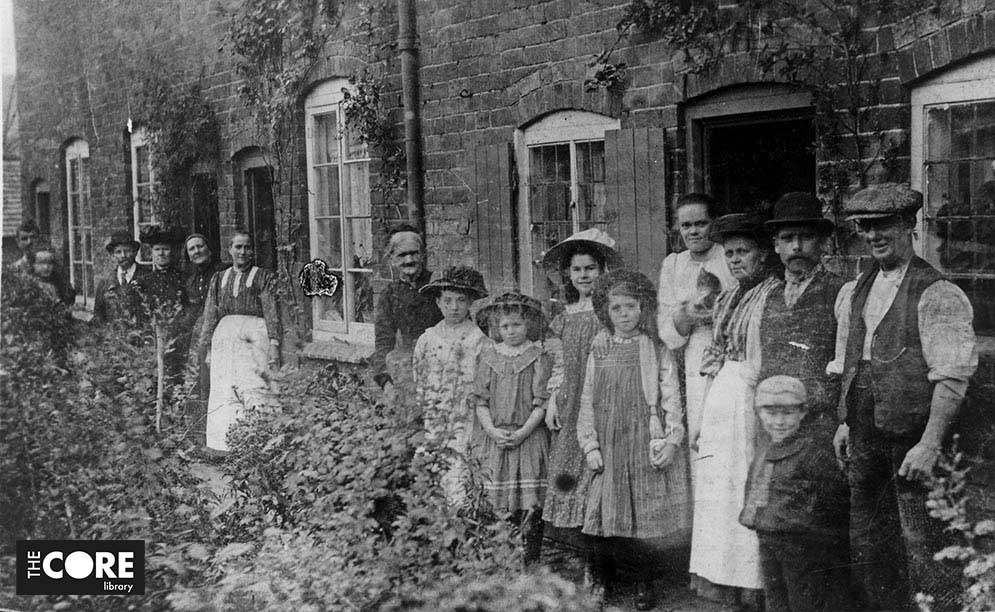
Ramsgate, just off Solihull High Street, was perhaps the closest to back-to-back housing that Solihull had. One of the cottages (no. 20. High Street, pictured above) faced the High Street, whilst 14 other cottages together with wash-houses, water-closets, coal-houses, ash-pits and a communal pump were situated around a courtyard off a party entrance from the High Street.
We have a building plan for one of the cottages, submitted to Solihull Council in 1890 (ref.: SOL/PS/1/2/240), pictured below. The owner was Mrs Susannah Rachel Hunt (c.1840-1909), a widow, of Brougham House, Old Warwick Road, Olton. Her husband, James, a chandelier manufacturer, had died in 1888, aged 42. Mrs Hunt, who was born in Dublin, also seems to have owned the row of cottages on the right-hand side of Ramsgate (looking from the High Street). The cottages on the left-hand side were owned by a Mrs Ball.
The cottage built for Mrs Hunt in 1890 was designed by architect Thomas Ambrose Turner, whose practice was in Martineau Square, Birmingham. The builder was the well-known Solihull firm of Bragg Bros..
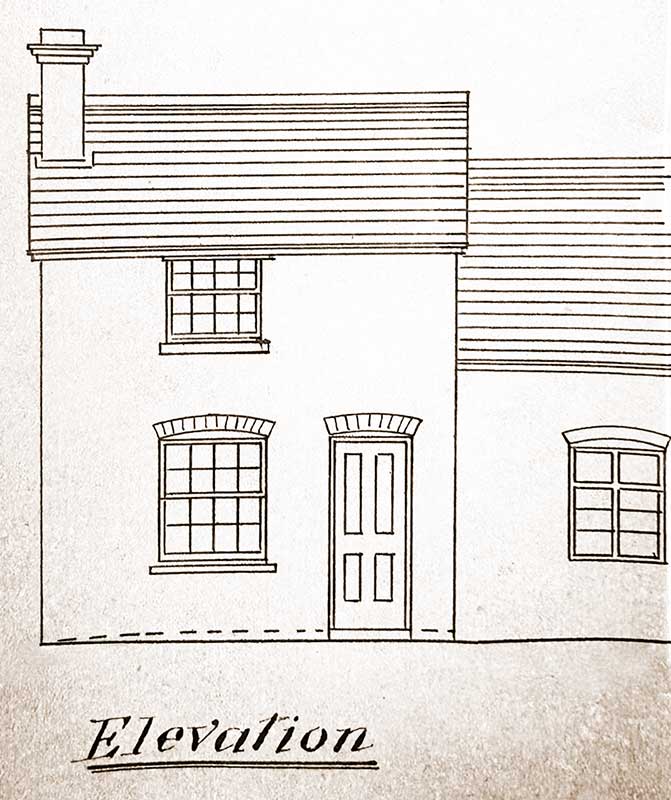
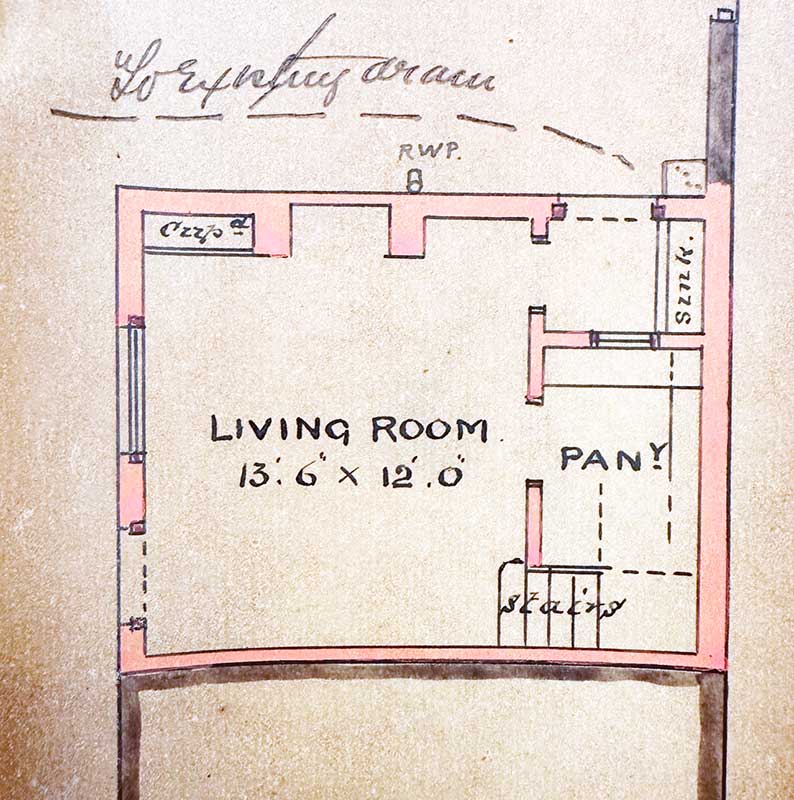
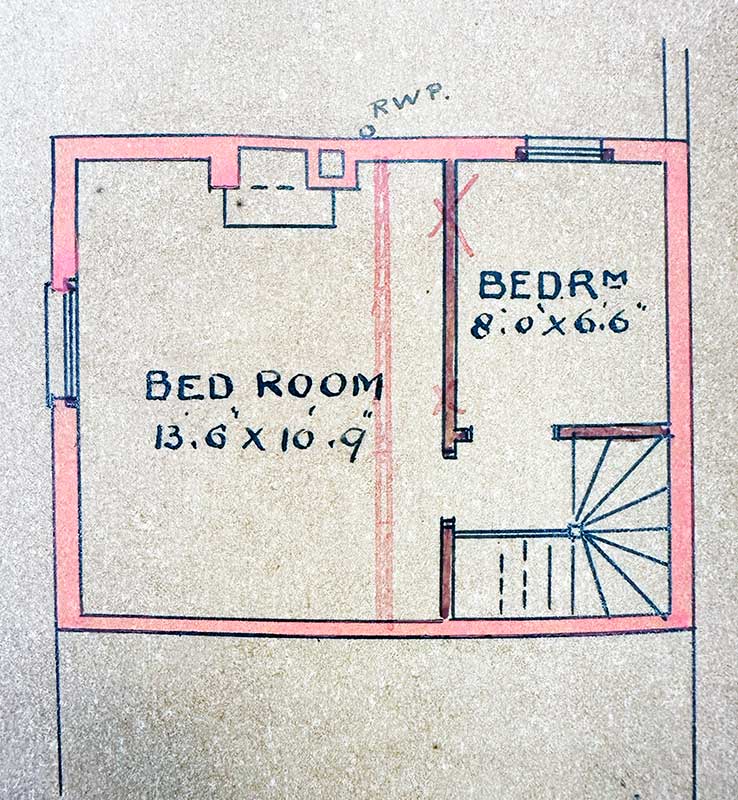
The design was a simple living room on the ground floor, which included a sink by a side door. There was also a pantry and a cupboard. Stairs opposite the front door and alongside the pantry wall led up to the first floor, where there were two bedrooms. Accompanying paperwork shows that ventilation was by means of open fireplaces. Water was supplied by an existing pump. The rooms on both floors had a ceiling height of 8ft 6in.
There was no bathroom or indoor toilet – a situation that was common until the second half of the 20th century. A survey in 1947 showed that only 46 per cent of households in the UK at that time had a bathroom.
An advertisement in the Birmingham Daily Post, 16th September 1890, by Mr Hunt of Brougham House, offered two properties to let – Fern Villa, Warwick Road (opposite the Grammar School) for £29, and a property in the High Street, Solihull for £24. It’s not known if the latter was the new cottage at Ramsgate.
The cottages were rented out, bringing in an annual income for the landlord of £101 8s, according to the sale notice in the Birmingham Daily Post, 4th November 1916, which advertised the “front dwelling house” as being in the occupation of Mr Corbett. There were 11 other cottages at the time, plus outbuildings and gardens, and the freehold was offered for sale by the executors of the late Joseph Ball.
Matthews family
In 1889, Isaac Matthews (a labourer) and his wife, Emma, who lived at Ramsgate were accused of concealing an outbreak of scarlet fever. The affected child was removed to hospital on 9th December 1889 and the parents told the Sanitary Inspector that all other family members were well. However, their son, Walter, continued to attend school and play outside in the street despite being “at the peeling stage”, thus causing the infection to spread and the schools to have to be temporarily closed. The parents said they just thought the child had a bad cold but they were summoned to Solihull Police Court and prosecuted under the Public Health Act.
The Warwickshire Herald 8th September 1892 reported on a case in Solihull Police Court of alleged assault by Ramsgate resident, Emma Matthews, wife of Isaac Matthews. It was alleged that one of the Matthews children had taken a spade from a child of Rhoda Parkes, who seems to have been a neighbour of the family. Mrs Parkes went to the Matthews’ house and Mrs Matthews allegedly slammed the door in her neighbour’s face, trapping Mrs Parkes’ fingers in the process. A witness, Mary Ann Robinson, corroborated the story.
Mrs Matthews denied causing harm intentionally, stating that Mrs Parkes had put her fingers in the door with the aim of keeping the door open. The magistrates dismissed the case.
The Matthews family seem to have had a long association with Ramsgate cottages, having moved in by 1881. Their son, Fred, was still there (at no. 13) in 1939. Their daughter, Jessie, was also living in Ramsgate in 1939 – at no. 2 with her husband, Frank Hirons.
A fatal fire, 1937
Mrs Amy Leonora Bragg (aged 57) of no. 5 Ramsgate was found dead in her home on the morning of Sunday 1st August 1937. A widow, living alone, she was looked after by a neighbour, Ann Shervington, who visited her at 10.30pm on the Saturday night and found she was lying on a couch in her downstairs room. Mrs Bragg asked Mrs Shervington to lock up for the night for her as she wasn’t able to do it herself. Ann Shervington did so and took away the key as she had been asked to do, leaving Mrs Bragg locked in.
The following day, Chief Officer Smith of Solihull Fire Brigade entered the house having received a call from a neighbour. He found Amy Bragg lying on the hearth, with the couch smouldered beyond recognition. Whilst there were no flames, the room was intensely hot. In his opinion, she had awakened in the night, had lit a candle and then knocked it over. She had then made an attempt to escape from the locked room but had been overcome by fumes and died of suffocation.
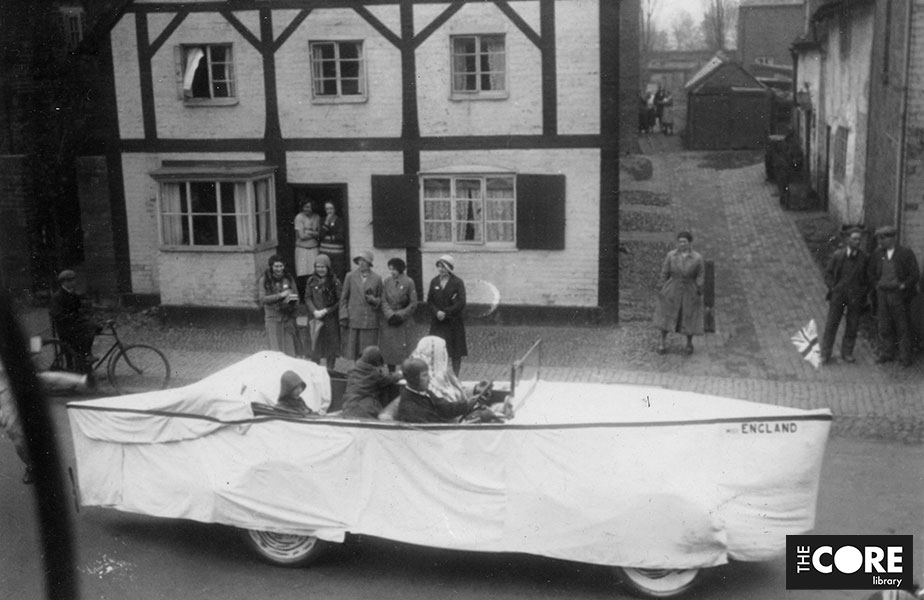
Clearance Order, 1939
On 20th June 1939, a Clearance Order was published, giving Ramsgate residents six months to vacate their homes. At this time, all of the cottages were owned by Mr Leonard James Hobday, who had a furniture shop on the High Street. The residents listed in the Clearance Order were:
- No. 1, Ramsgate – Jacob Hammond (1870-1948)
A bricklayer from Chadwick End, he was recorded as incapacitated by 1939, and was living in Ramsgate with his wife, Sarah (1865-1953) and their daughter, Phoebe May Hammond (born 1900) who was listed as a daily domestic. It looks as if the family lived at Ramsgate for over 40 years, as they appear to be living there from at least the time of the 1901 census, although Phoebe had temporarily left the family home when the 1921 census was taken. She was still nearby, though, working for Mrs Adkins in Church Hill as a live-in servant. - No 2, Ramsgate – Frank Hirons (1878-1971)
Solihull-born Frank Hirons worked for Solihull Council as a carter and had lived at Ramsgate since at least 1921, when he was listed there with his widowed mother, Eliza Louisa, aged 72, whose occupation was given as charwoman. She seems to have died in 1935. At the time of the 1939 Register, Frank was living at Ramsgate with his wife, Jessie Elsie (formerly Middleton, née Matthews) (1887-1977) . The couple had married in 1937. Jessie – who was the daughter of Isaac and Emma Matthews (mentioned above) and grew up in Ramsgate cottages – married her first husband, widower, Joseph George Middleton (born 1856) at St Alphege Church in 1909. - No. 3, Ramsgate – Clara E. Grainger (c.1883-1945)
At the time of the 1939 Register, Miss Grainger was listed as a daily help. It looks as if she died in 1945, although there is an age discrepancy of Clara Eliza Grainger, who died in 1945 aged 65, compared with the 1939 Register entry which gives her date of birth as 1883. - No. 4, Ramsgate – John Edward Thomas Cookes (1888-1957)
An unmarried gardener at the time of the 1939 Register, John Cookes was born in Snitterfield and baptised at Knowle on 3rd June 1888. His parents were listed as John Edward Cookes, farmer, and Elizabeth. - No. 5, Ramsgate – Ann Maria Bennett
Occupied by Ann Maria Bennett at the time of the Clearance Order in June 1939, No 5. Ramsgate was vacant by September 1939 when the 1939 National Register was compiled. However, by 1945, it was occupied by William and Jessie Gibson. William and Jessie had been living in Fazeley Street, Birmingham at the start of the Second World War, with William listed as a caretaker in a rolling mill, as well as volunteering with the Air Raid Precautions Service. - No. 6, Ramsgate – Ann Elizabeth Shervington (1867-1948)
Born in Washwood Heath, Ann Elizabeth Edwards married widower, Samuel Shervington, a carter, at St Alphege Church, Solihull in 1909. Samuel was living in Ramsgate at the time of their marriage, whilst Ann Elizabeth Edwards was in nearby New Road. Samuel died in 1911, just two years after his marriage to Ann. By 1939, Ann was still in Ramsgate, living with her 1st cousin, Mary W. Hudson (née Edwards) (born 1895), who was described as “married, deserted,” and Mary’s daughter Elsie Sylvia Hudson (1919-2008), both of whom were working as daily domestics. In 1943, Elsie Hudson married Valentine William Coley (1920-2002) in Solihull and they were living with Ann Shervington and Mary Hudson at no. 6 in 1945. - No. 7, Ramsgate – Phoebe Ann Sparkes (1866-1947)
At the time of the 1939 Register, 72-year-old widow Phoebe Sparkes (née Hodgkiss) was living at no. 7 with her widowed daughter, 50-year-old Elizabeth Ann Robinson, who was working as a self-employed dressmaker. Phoebe was born in Belbroughton, Worcestershire and had married John Sparkes at St Alphege Church, Solihull in 1887. Their daughter, Elizabeth Sparkes, married Arthur John Robinson (1884-1924) at Solihull in 1914. John Sparkes died in 1932, aged 74. Phoebe Sparkes died in Solihull Hospital on 19th March 1947. It seems that the couple lived in Ramsgate for many years, as they appear to be living in one of the cottages in 1891, with their two young children, and a boarder, James Hodgkins [sic], who was actually Phoebe’s brother. James Hodgkiss, a blacksmith, married in 1894 and was living with his wife and children in New Road, Solihull by 1911. - No. 8, Ramsgate – William John Brown (1892-)
In 1939, William John Brown, a postman, was living at no. 8 with his wife, Edith.
By 1946, no. 8 was occupied by Charles Buxton, who was imprisoned for six weeks in October 1946, having been found guilty of leaving his wife and family chargeable to the authorities at a cost of £67 15s 4d. This offence was committed just a week after he had returned home after serving a sentence for a similar offence. - No. 9, Ramsgate – Edward James Forbes (1881-)
Edward James Forbes, a caretaker, was living at no. 9 in 1939, with his wife, Annie. Edward was born in Poplar, London, and Annie was from Northumberland. They had moved from London to Solihull sometime between 1921-1939 but had moved from Ramsgate by the end of the Second World War.
By 1945, no. 9 was occupied by Doris Hart (1915-2000), who had moved from Mill Lane, where she had lived above the hairdresser’s shop. During the war, she helped out at the evacuees’ school in Herbert Road. She reminisced about Ramsgate to the Solihull News in 1995, for the 50th anniversary of V.E. Day:
“At the end of the war I helped to organise a VE Day party outside Ramsgate cottages, although there were only a few children living in the High Street at the time, but I do remember a little girl from Dascombe’s bakers, two girls who lived in cottages behind the Mason’s Arms, and the two children from the fish and chip shop. My own daughter, Josephine, also joined in the celebrations for which my sister made paper hats, and there was also a bonfire and fireworks later in the evening.” - No. 10, Ramsgate – Frederick Yarnold (1897-1949)
Frederick George Yarnold, a gardener from Rock, Worcestershire, was living at no. 10 in 1939 with his wife, Annie (née Jay), and her son Walter William Jay Yarnold (1915-1985). Annie was from Wolverley, Worcestershire, and the couple had married in the Droitwich district in 1919. - No. 11, Ramsgate – Kate Frankel (1873-1957)
Born in Birmingham in 1873, Kate (née Aspinall) married Manchester-born widower Solomon Frankel (c.1860-1925) in the Kings Norton district in 1912. In 1939, having been widowed 14 years earlier, 66-year-old Kate Frankel was living alone in Ramsgate and working as a daily domestic. - No. 12, Ramsgate – Joseph Samuel Nicholls (1876-)
Living at no. 12 in 1939 was 62-year-old Joseph Nicholls, a labourer at a cycle works, and his 60-year-old wife, Jessie (née Plant), together with their 33-year-old daughter, Gladys Jessie Nicholls, who was working as an assistant in a stationery shop. Joseph was born in Solihull in 1876 and married Jessie in Aston in 1905. They were living in Solihull High Street by 1911, at which time Joseph was recorded as a self-employed cycle maker, repairer and agent. - No. 13, Ramsgate – Frederick Isaac Matthews (1878-
Builder’s labourer Frederick, was living at no. 13 Ramsgate with his wife, Minnie Blanch (née Fletcher). The couple had married at St Alphege Church, Solihull in 1910, at which time 32-year-old Frederick was living in Ramsgate cottages, whilst 29-year-old Minnie was living in New Road, Solihull. Fred, as he seems to have been known, was the son of the above-mentioned Isaac and Emma Matthews, with whom he was living in Solihull High Street (presumably in Ramsgate cottages) at the time of the 1911 census. - No. 14, Ramsgate – Charles Daffon (1869-1953)
A gardener who was born in Barston, Charles seems to have lived at Ramsgate for over 30 years. He married Selina Emily Phillips (1871-1935) in Birmingham in 1894 and they had two daughters and a son. They were living at Ramsgate by 1897 when their eldest child, Hilda Selina, was born.
By 1945, Charles Daffon was living at no. 14 with Robert Allen, Leslie Hart (1904-1967) and Ruby Frances Hart (née Ponting) (1901-1979).
No. 20 High Street was occupied in 1939 by Lucy Martha Rainbow (née Keyte) (1871-1950). Born in Ebrington, Gloucestershire, she married farmer Frank William Rainbow in the Shipston on Stour district in 1898. The couple set up home in Ebrington where five of their six children were born. They moved to Claverdon, Warwickshire in 1909, where their youngest son, Joseph, was born. They had moved to Solihull by 1921 and were living in Widney Road with four of their sons, aged 11-22, at the time of the 1921 census. At this time, Frank Rainbow was working as a cowman at Malvern Park Farm. He died in Solihull in 1936.

Demolition
Despite the Clearance Order, Ramsgate was not demolished for almost 20 years. Presumably, this was because of the outbreak of war before the six months’ notice from the date of the Clearance Order expired. It seems likely that post-war housing pressures further delayed the clearance.
By the end of the war, Ramsgate cottages had a gas supply but no electricity, and water came from one tap that served all the cottages. Until gas was installed, the cottages used oil lamps and cooking was by means of an oven built into the fire grate.
Ramsgate was eventually demolished in June 1957 as part of the town centre redevelopment. A car park and service road were built on the site. Paramo Lounge and The Works now span the “front cottage” and the entrance to Ramsgate.
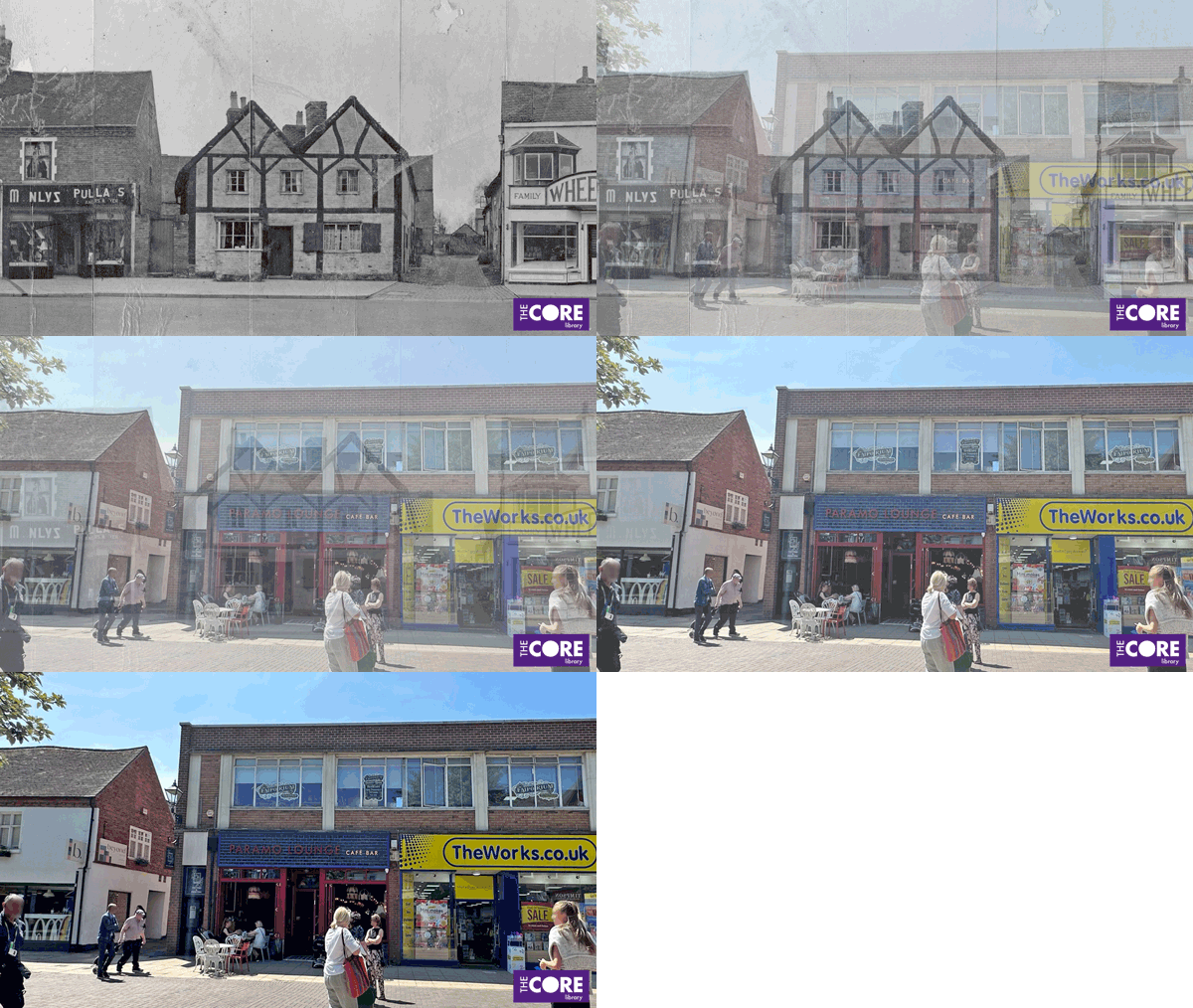
Following the demolition of Ramsgate, a planning application was submitted to Solihull Council in 1960 and a new Burton’s supermarket on the former Ramsgate site on 25th July 1961.
If you have any further information about Ramsgate cottages, High Street, Solihull, please let us know.
Tracey
Library Specialist: Heritage & Local Studies
© Solihull Council, 2023.
You are welcome to link to this article, but if you wish to reproduce more than a short extract, please email: heritage@solihull.gov.uk
 Solihull Life
Leave a comment