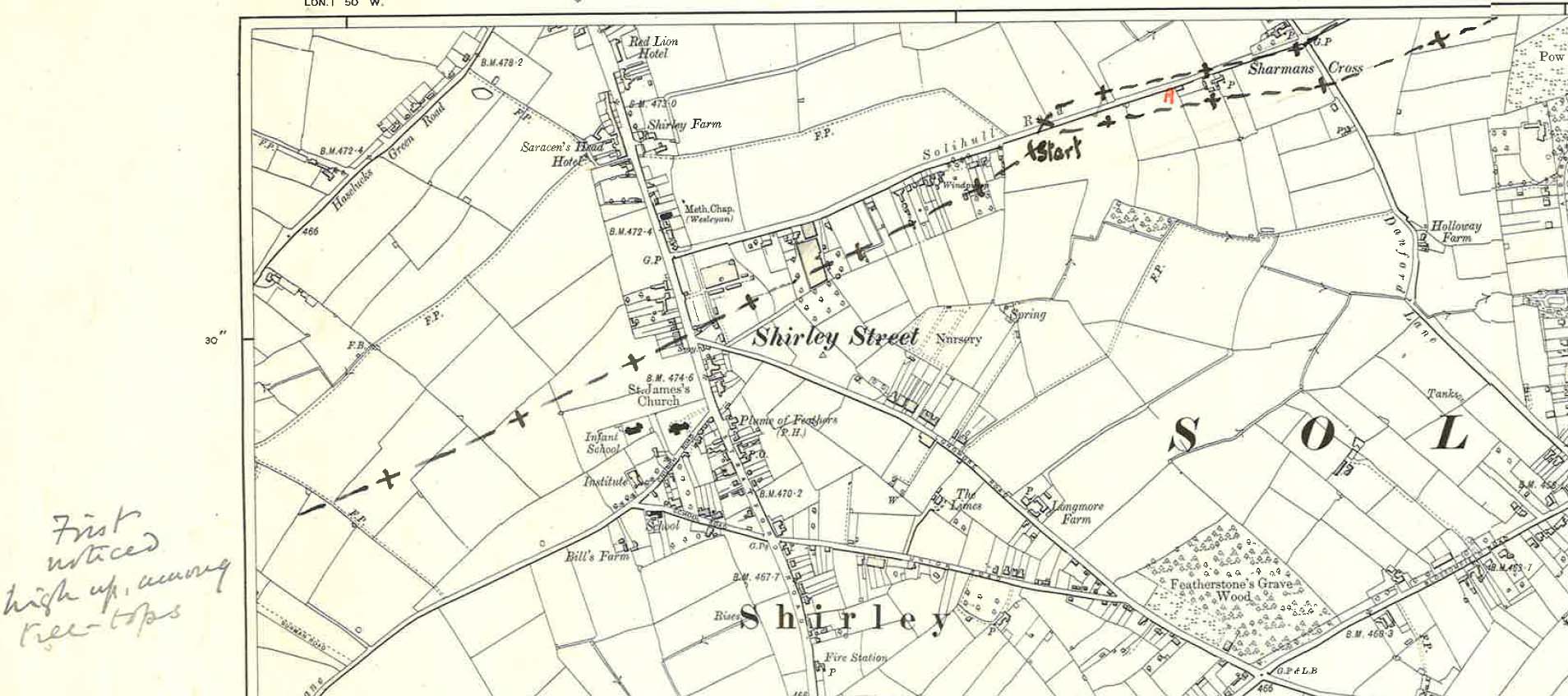
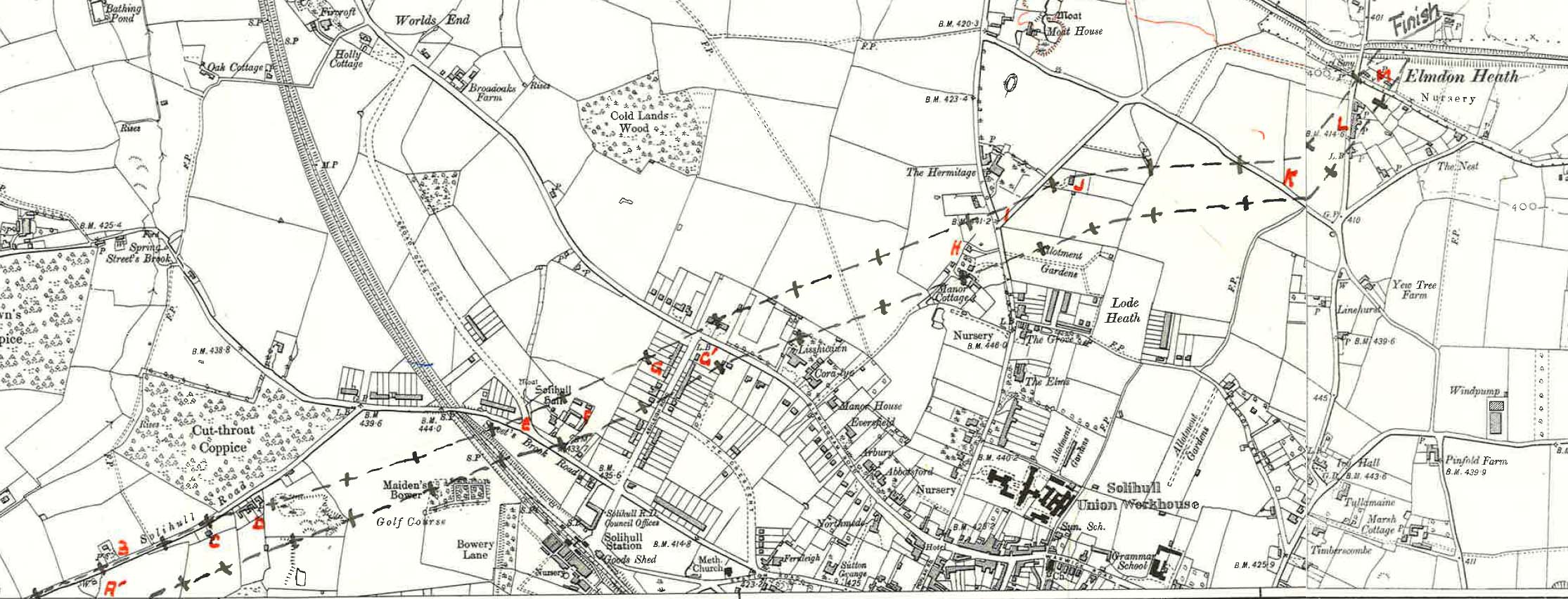
Between 3-4pm on Wednesday 24th October 1923, Solihull was battered by a whirlwind (now believed to have been a tornado) that travelled a path from Sharman’s Cross to Elmdon Heath. A man sheltering in a barn was killed by the storm. Lasting only three or four minutes, reports of the whirlwind, also described as a cyclone in some articles, appeared in newspapers across the country.
The gale was preceded by a thunder and hailstorm (Dundee Evening Telegraph, 25th October 1923) and the onset of the storm was marked “by a roaring and screeching sound” (Westminster Gazette, 26th October 1923).
Eyewitnesses told newspapers that the air took on a grey tinge, and “the gale, resembling a whirlwind, made a noise as if several express trains were travelling abreast.” (Coventry Herald, 26th October 1923).
The wind was first noticed high up above the tree tops in Shirley. Golfers at Robin Hood Golf Club were surprised to notice that the wind suddenly reversed direction and then saw in the distance a murky, swirling cloud travelling at high speed and laden with debris from haystacks, bits of hedges and tree branches.
The tornado first struck at Sharmans Cross where trees were smashed and scattered across roads, telegraph wires were torn down, the corrugated roof was lifted off famer Alfred Richards’ Dutch barn, and hedges were uprooted. An employee of Mr Richards was blown over, as were the horse and cart of which he was in charge. Although badly bruised, a contemporary newspaper reported that had he not fallen over, he would have been struck by a falling tree, which could have resulted in worse injuries.
A signalman at Solihull Station, fearing disaster, warned the next signal box on the line “I am going… in fact, we’re all going in the next few seconds, and I don’t know where!”
A farmer at Solihull reported losing over 150 poultry who just disappeared. Guinea pigs were reportedly blown across two fields and it was said that a hen coop was hurled into a neighbour’s drawing room. Stories abounded of horses being stripped of their harnesses, and mangels and potatoes lying in heaps for winter use were picked up by the wind and carried long distances.
Harold Wragg, Managing Director of Job Wragg Ltd was motoring at Sharmans Cross when the whirlwind struck, lifting his car into the air and causing him then to be hemmed in by fallen trees in front and behind his vehicle.
The cyclone then travelled a path to Elmdon Heath across Streetsbrook Road, Ashleigh Road, Lode Lane and Damson Lane before apparently blowing itself out.
The track of the whirlwind was about fifty yards wide, in which trees were uprooted, telegraph wires blown down, and cottage roofs and chimneys demolished. A hayrick was carried from a field into the road, and a waterproof sheet, lifted from a horse’s back by the wind, was caught in telegraph wires, where it flapped like a sail.
A high wall bounding the grounds of The Hermitage in Lode Lane, Solihull was also demolished.
Roads became impassable and one motorist, held up by a fallen tree, found on turning back that another tree had fallen behind his car so that he could not go either way.
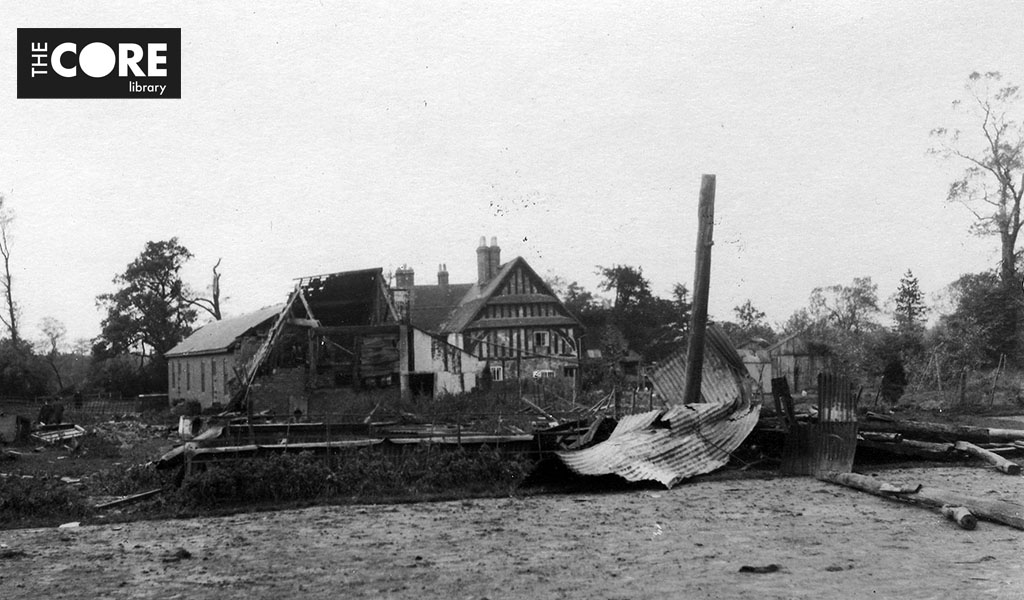
Patrick Murphy, a 42-year-old navvy from Wolverhampton who was lodging in Gerat Francis Street, Birmingham, was killed when the force of the wind caused the collapse of a barn at Silhill Hall (pictured, top) in which he and two colleagues were sheltering.
His two companions, named in newspapers as Christopher Pritchard (45) of Selly Oak and Benjamin Clark (67) of Acocks Green, were badly injured when the roof of the barn was lifted into the air and then crashed down on the men. The three men had apparently been laying a sewer for a new road across the Moat House Farm estate from Ashleigh Road to Birmingham Road.
Silhill Hall was reportedly the oldest domestic building in Solihull, which was illegally demolished by the owner in March 1966.
Tracey
Heritage & Local Studies Librarian
© Solihull Council, 2020.
You are welcome to link to this article, but if you wish to reproduce more than a short extract, please email: heritage@solihull.gov.uk
 Solihull Life
Leave a comment