Three local men lost their lives on 25th September 1918 – Second Lieutenant Clive Marston Beaufoy, 10th Battalion, Royal Warwickshire Regiment; Lieutenant Leonard Stopford Brooke, 110th Squadron, Royal Air Force; and Private John Simpson, 11th Battalion, Worcestershire Regiment.
30th August 1918
Three local men lost their lives on 30th August 1918 whilst on active service – Private Henry Baughan, 1st Battalion, Royal Warwickshire Regiment; Private Robert Woods, 15th Battalion, Royal Warwickshire Regiment; and Private Alline Mountford Woollaston, 11th Battalion, Royal Fusiliers.
31st May 1918
Sergeant Ernest Harold Long DCM MM was killed in action on 31st May 1918 whilst serving with the 10th Battalion, Royal Warwickshire Regiment. The battalion war diary for the day notes “Heavily shelled. Battalion compelled to withdraw about 11am under heavy barrage”.
20th April 1918
Two local men lost their lives on 20th April 1918 whilst on active service in France – 20-year-old Private James Franklin, 10th Battalion, Royal Warwickshire Regiment and 21-year-old Second Lieutenant Frederick Harold Hoyle of 2nd Battalion, West Yorkshire Regiment (Prince of Wales’s Own).
16th April 1918
Two local men lost their lives on 16th April 1918 whilst on active service – Private Jim Birch, 5th Battalion, Tank Corps, and Lance Corporal Harry Moseley, 1st Battalion, Royal Warwickshire Regiment.
24th March 1918
Sapper Harry Beacham, 126th Field Company, Royal Engineers, was killed in action on 24th March 1918. He was the eldest of three children and the only surviving son of parents Alfred (a bricklayer) and Emma (née Whitehead) of Allesley, Coventry. His younger brother, Walter, died in 1888, aged under one year. His sister, Dorothy (1891-1986) died at the age of 94.
21st March 1918
Nine local men lost their lives on the first day of the German Spring Offensive (Operation Michael), which saw British troops subjected to one of the longest artillery bombardments of the war. Lasting for five hours from 4:20am, the barrage of over one million artillery shells smashed vital communication lines, and was followed by waves of elite German troops coming over No Man’s Land, which was shrouded in thick fog. The Germans made swift and significant gains, with the British suffering some 50,000 casualties. British troops were ordered to withdraw, giving up much of the Somme region. However, it was not a decisive defeat, and the British were able to establish new lines of defence, whilst the rapid advance caused German supply lines to become overextended. Continue reading “21st March 1918”
21st December 1917
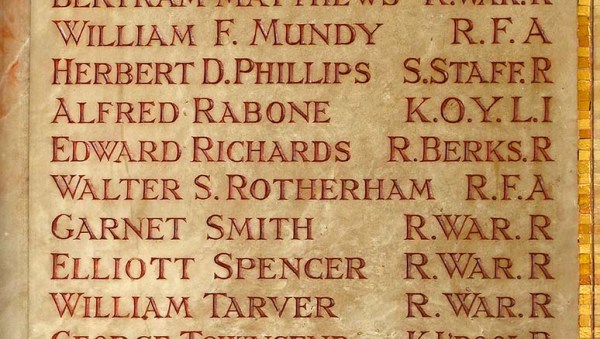
Private Edward Richards died of wounds on 21st December 1917. Aged 42, he had been called up in June 1916 and, although expressing a preference to serve in the Artillery, he was posted to the Royal Irish Fusiliers. He was then transferred to the 87th Company, Labour Corps. 18-year-old John Shirley, lately a Private with the 7th Reserve Battalion, Royal Warwickshire Regiment, died of rheumatic fever on the same day.
2nd November 1917
Second Lieutenant Ralph Thomas Boddington, 1st/10th Battalion, London Regiment, was killed in action in Palestine on 2nd November 1917. He was born in Selly Park, Birmingham, on 8th June 1883 and was the seventh of the ninth children (four sons, three daughters) of woollen merchant, Samuel and his wife Elizabeth Mary (née Pask Hughes), who had married in 1872. Ralph was the second of their sons to die on active service. Their youngest child, Guy Livingston Boddington, was killed in action on 19th December 1916.
30th October 1917
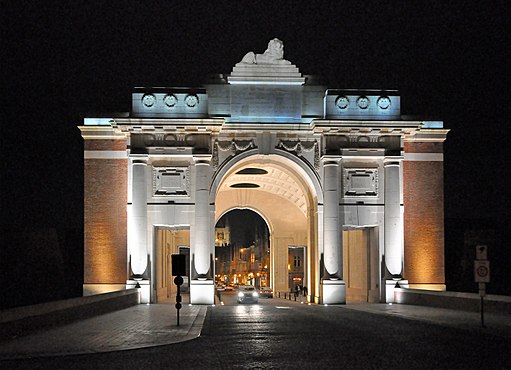
Two local men were killed in action on 30th October 1917, both of whom were serving with the Canadian Infantry and both are commemorated on the Menin Gate, having no known grave. The two men were Private Frank Everard Harrison, and Private Aubrey John Kirby.
 Solihull Life