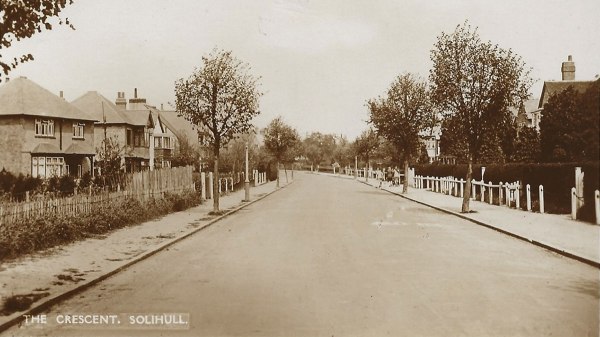
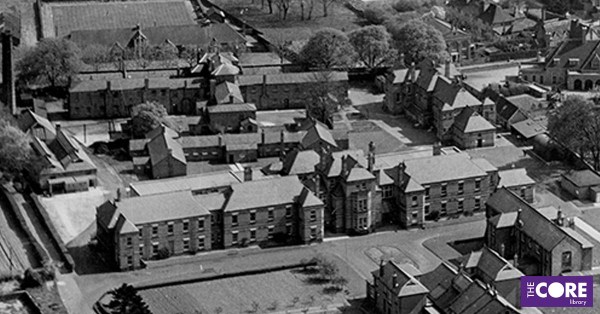
The Crescent Estate was the title given in 1910 to the land enclosed by the houses built along Warwick Road (then Birmingham Road), Ashleigh Road and Streetsbrook Road.
Continue reading “The Crescent Estate”Homer Road, Solihull
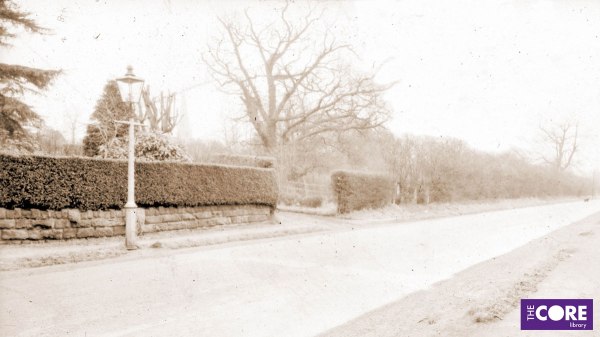
In the 19th and early 20th centuries, Homer Road was a very quiet area, unlike today with its supermarkets, offices and civic buildings. As recently as 1958, despite its proximity to the town centre, the road was described as having a “rural outlook” (Birmingham Daily Post, 11th September 1958). The above picture, from the early 20th century, is believed to show the current site of The Core, looking towards Church Hill Road.
Continue reading “Homer Road, Solihull”Inter-war council housing in Solihull
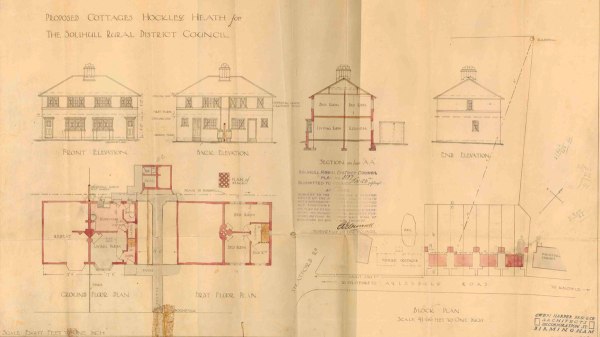
Prior to the late 19th century, housing options were limited to owning property or, as most people did, renting from a private landlord. The Housing of the Working Classes Act 1890 allowed local authorities in London to build council houses, and the first council housing was built in Bethnal Green in 1896. The Housing of the Working Classes Act 1900 extended this to the rest of the country, although it took a further 25 years for the first council houses to be built in Solihull Rural District.
Continue reading “Inter-war council housing in Solihull”Freedom of the Borough
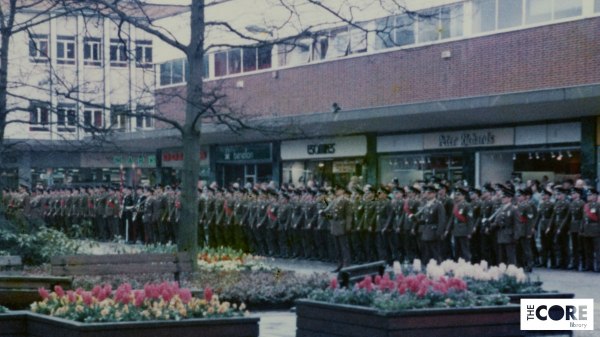
The Freedom of the Borough is the highest award that a council can bestow. The Freedom of the Borough of Solihull has been awarded only twice. The recipients of the honour were the 2nd Battalion Mercian Volunteers in 1985 and Lance Corporal Matt Croucher GC in 2008.
Continue reading “Freedom of the Borough”Parish Councils
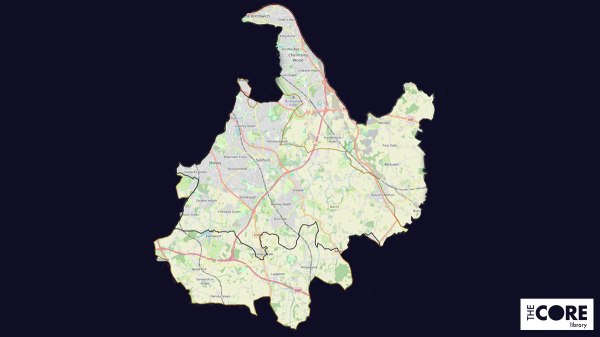
Parish councils came into existence as a result of the Local Government Act 1894, which was also known as the Parish Councils Act. Civil Parishes are the smallest areas of local government administration. The 1894 act allowed for the election of parish councils in rural areas and required the entire area of a parish to be within the same administrative county.
Continue reading “Parish Councils”Christmas in Solihull Workhouse
The Solihull & District Monthly Magazine (the magazine of Solihull parish church), reported in January 1895 on Christmas at Solihull Workhouse. The workhouse was in Lode Lane, Solihull, and was administered by Solihull Poor Law Union. It opened in 1838 to provide accommodation and food for people who were unable to support themselves financially – mostly the sick and elderly.
Continue reading “Christmas in Solihull Workhouse”Isolation hospitals
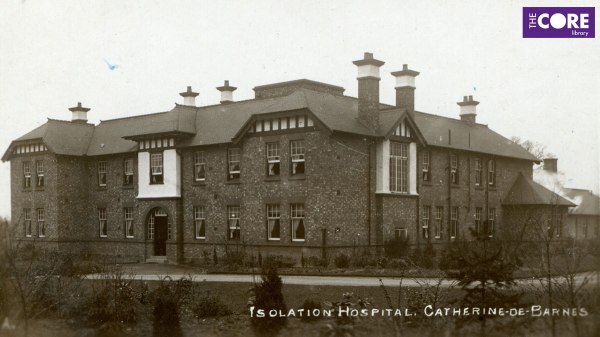
Isolation hospitals were set up to treat people who had infectious diseases such as smallpox, diphtheria, tuberculosis and scarlet fever in an attempt to prevent the diseases from spreading quickly through the population. Solihull is known to have had a “fever shed” and three purpose-built isolation hospitals 1870s-1980s.
Continue reading “Isolation hospitals”Comprehensive education in Solihull
Comprehensive education was introduced in Solihull in September 1974, just over 10 years after Solihull became a County Borough on 1st April 1964 when it took over responsibility for education and schools from Warwickshire County Council.
Continue reading “Comprehensive education in Solihull”Sharmans Cross Senior Schools
Sharmans Cross Senior School was built in 1933 and opened to pupils on 9th January 1934 under headmaster Edgar James Phillipps Orrett (1882-1967). Children aged over 11 from Solihull, Olton and Shirley were transferred from existing all-age elementary schools on this date, with the schools they left then all becoming junior schools.
Continue reading “Sharmans Cross Senior Schools”“Old Billy” helps Solihull’s Salute the Soldier Week, 1944
On 22nd May 1944, a 16-year-old carrier pigeon known as “Old Billy,” travelling at around 60mph, flew into Solihull bearing a cheque for £1,000. The pigeon, owned by Albert James Wager (1880-1947) of 338, Blossomfield Road, was one of the “heroes” of Solihull’s “Salute the Soldier” week, part of a national savings campaign to raise money for field hospitals and military equipment.
Continue reading ““Old Billy” helps Solihull’s Salute the Soldier Week, 1944″