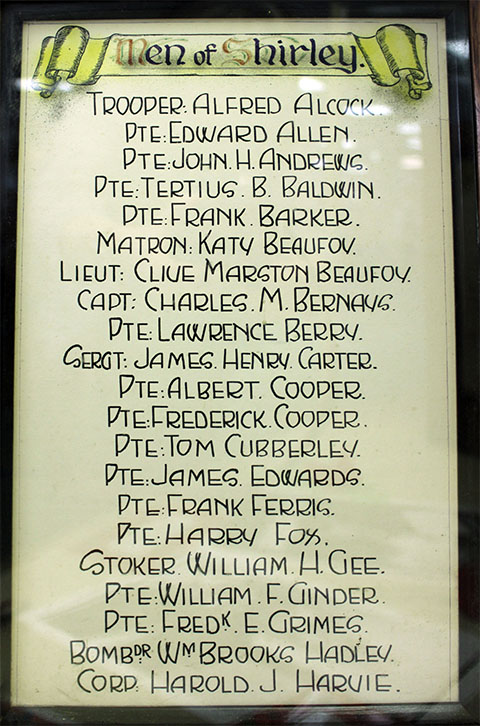
Two local men lost their lives on 23rd October 1917 whilst on active service in Flanders with the Royal Garrison Artillery. Acting Bombardier William Brookes Hadley was serving with “G” Anti-Aircraft Battery, whilst Acting Bombardier Herbert John Snow was with the 155th Heavy Battery.
11th October 1917
Two local men from Shirley were killed in action in Belgium on 11th October 1917. Private James Edwards, aged 41, died serving with the 1st Battalion, Coldstream Guards and Private William John Worrall was killed with the 2nd Battalion, Royal Warwickshire Regiment.
4th October 1917
Nine local men lost their lives on 4th October 1917 whilst on active service:
- Lance Corporal Edwin John Adams, 14th Battalion, Royal Warwickshire Regiment
- Private Eric Ashley Ellis, 13th Company, Machine Gun Corps (Infantry)
- Sergeant Charles Haynes, 1st/5th Battalion, Royal Warwickshire Regiment
- Second Lieutenant Albert Bertini Heywood, 10th Battalion, King’s Own Yorkshire Light Infantry
- Private Lewis James Knight, 30th Battalion, Australian Infantry
- Lance Corporal George Henry Pegg, 1st/6th Battalion, Royal Warwickshire Regiment
- Private William Savage, 1st Battalion, Duke of Cornwall’s Light Infantry
- Private William Thomas Tropman, 1st/8th Battalion, Royal Warwickshire Regiment
- Gunner Arthur Whinfrey, 256th Siege Battery, Royal Garrison Artillery
Opening of Solihull Cemetery 1917
26th September 1917 saw the official opening of Solihull Cemetery, described in the opening brochure as being at the junction of Robin Hood Road and Olton Road, although the cemetery’s address is now usually given as Streetsbrook Road.
The 42-acre-site was chosen as the most suitable place for a cemetery, as it is “easy of access from all parts and is sufficiently removed from the residential districts not to be in any way detrimental to the same.”
Continue reading “Opening of Solihull Cemetery 1917”20th September 1917
Five local men were killed in action on 20th September 1917. This was the first day of the Battle of the Menin Road Ridge, which lasted until 25th September and marked a change in British infantry tactics.
Although previous attacks had penetrated the lightly-defended German front lines, exhausted troops then came under sustained counter-attack and failed to penetrate the second line. The new strategy was designed to attack a small part of the front line, first with heavy bombardment, and then by troops in strength under a creeping barrage 1000 yards deep, protecting the advancing infantry. Once through the lines and having reached their objectives, troops were then to stop and dig in. A second wave of infantry could then pass through to attack the next objective.
Local men who lost their lives in this action were:
- Private Richard Sydney Greaves, 6th Battalion, Wiltshire Regiment
- Private Thomas Henry Lloyd, 10th Battalion, Worcestershire Regiment
- Sergeant Septimus Pryce, 6th Battalion, Oxford and Bucks Light Infantry
- Corporal Percy John Shirley, 10th Battalion, Royal Warwickshire Regiment
- Sergeant Harry Taylor, 10th Battalion, Royal Warwickshire Regiment
6th September 1917
Rifleman Charles James Skidmore, 17th Battalion, King’s Royal Rifle Corps died of wounds on 6th September 1917. He was born in Olton in 1894, and was the seventh of the 10 children (four sons, six daughters) of parents Frederick William (a gardener) and Ellen (née Cleaver). Eldest son, John, died in April 1880, aged 16 days. The family lived in the Solihull area from about 1880-1895, before moving to Willicote, Stratford-upon-Avon.
4th September 1917
21-year-old Private Alfred Richardson of Shirley, Solihull, was killed in action on 4th September 1917, serving with the 2nd/8th Battalion, Royal Warwickshire Regiment.
11th August 1917
23-year-old Private James Howard Watts, 11th Battalion Royal Warwickshire Regiment, was killed in action on 11th August 1917. He was the elder of the two children of parents Stephen Howard and Catherine (née Hodgkinson) who had married in Birmingham between January-March 1893. James and his sister, Kate Elizabeth, had five half-siblings from their mother’s first marriage to Thomas Ripley (1856-1890) – Margaret, Ferdinand(o) (1886-1964), Elsie, Agnes and Thomas.
The two boys also served in the First World War. Ferdinando served as a Sapper in the Royal Engineers, whilst Thomas was a private in the Royal Warwickshire Regiment, serving at home with the 6th (Reserve) Battalion from 2nd November 1914 until being discharged unfit on 2nd August 1916 as a result of valvular heart disease, which he had had for some six years.
31st July 1917
Four local men lost their lives on 31st July 1917, the opening day of the Third Battle of Ypres (also known as Passchendaele, after the surrounding village and ridge). The offensive lasted until the village was taken on 6th November 1917, at a cost of some 310,000 British casualties, and over 260,000 German casualties.
Our local casualties on the first day, the Battle of Pilckem Ridge were:
- Captain Eric Belfield, 4th Battalion, Middlesex Regiment
- Private Rudolph Lawley, 2nd Battalion, Royal Berkshire Regiment
- Private Joseph James Lines, 10th Battalion, Queen’s Own (Royal West Kent Regiment)
- Private Joseph Savage, 1st Battalion, Coldstream Guards
Having no known grave, all of them are commemorated on the Ypres (Menin Gate) Memorial
2nd July 1917
Private William Barry Lane, of Shirley, died on 2nd July 1917 whilst on active service with the 178th Company Mechanical Transport, Army Service Corps. He was the second of the eight children (four boys, four girls) of parents Walter Charles (a billiard marker) and Lizzie (née Barry) who had married in 1886. Of the couple’s eight children, one of the boys and three of the girls had died in infancy by 1911 (Walter Charles 1887-1892, Ethel Annie Mabel 1890-1892, May 1894-1896, and Annie, who was born and died in 1900). Tragically, two more of the boys would die in their 20s – one in the First World War, and one is believed to have died in a private asylum in Knowle.