Three local men died on 18th November 1916: Private Thomas Howard Glover, 10th Battalion, Royal Warwickshire Regiment; Private Robert Hall, 10th Battalion, Worcestershire Regiment; and Second Lieutenant William Douglas Henderson, 1st/8th Battalion, North Staffordshire Regiment.
17th November 1916
On 17th November 1916, Captain Charles Henry Dwyer was shot and killed by a German sniper early in morning while carrying out a difficult reconnaissance. He was 21 years old, and was serving with the 10th Battalion, Worcestershire Regiment.
Merchant mariner Arthur Cecil Johnson, of Barston, also died on 17th November 1916 aboard the cargo vessel, S.S. Serbistan, which went missing at sea.
13th Nov 1916
Private Harry Corbett, 14th Battalion, Worcestershire Regiment, was killed in action on 13th November 1916. He has no known grave, and is commemorated on the Thiepval Memorial. One of eight children (two of whom had died by 1911), he was born in 1878 in Small Heath, Birmingham but moved to Olton with his parents, George and Elizabeth, and siblings sometime between 1881 and 1883.
11th November 1916
Lance Corporal Richard Eric Bullows died on 11th November 1916 serving with the 1st/8th Battalion Royal Warwickshire Regiment. He was the only son amongst the five children of parents William, a carpenter, and Sarah, who lived in a cottage at Little Heath, Castle Bromwich from at least 1891 until at least 1911.
3rd November 1916
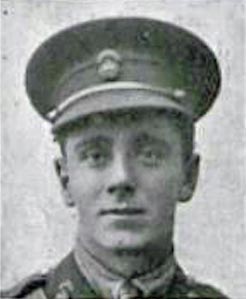
24-year-old Second Lieutenant Shepherd Stones, known as “Shep”, was killed in action on 3rd November 1916, serving with the 5th Battalion Northumberland Fusiliers. The youngest of two children, he was born in Sale, Cheshire on 10th October 1892. His father, John Herbert Stones, a paper merchant, died on 2nd July 1893, aged 30, leaving his widow, Elizabeth (née Holmes) with two sons under the age of three. Tragically, both boys would be killed in the war.
24th October 1916
Second Lieutenant Herbert Denis Phillips was killed in action on 24th October 1916, aged 26. Originally gazetted to the 10th Battalion South Staffordshire Regiment, he was attached to 5th Company Machine Gun Corps (Infantry). He is buried at Stump Road Cemetery, Grandcourt, and is also commemorated on the war memorial at St Margaret’s Church. Olton.
22nd October 1916
Sergeant Hugh James Smith died on 22nd October 1916 serving with the 17th Battalion King’s Royal Rifle Corps.
Although he was born in Bitteswell, Leicestershire, his parents, James and Harriet, were both from Berkswell, and Hugh was brought up in Hampton-in-Arden. Research by Clive Hinsull in Hampton-in-Arden: those who served 1914-18 indicates that Hugh attended George Fentham School in the village before enlisting as a regular soldier in the King’s Royal Rifle Corps. He served in South Africa 1899-1902 and in Somaliland 1902-1904.
21st October 1916
Private Bernard George Wright, 13th Battalion Royal Sussex Regiment, died on 21st October 1916. He was born in Berkswell on 29th May 1879, where his parents Walter Henry and Catherine (née Merry) had been schoolmaster and schoolmistress respectively from at least 1871 until c. 1880. He was baptised at All Saints, Coventry on 29th October 1879. All of his siblings – Arthur Ernest (born 1870), Rose Edith (born 1871), and Frederick Walter (born 6th October 1873) were born in Berkwsell.
15th October 1916
Private Charles Basey, 9th Battalion Gloucestershire Regiment, died of enteric fever on 15th October 1916 and is buried at Salonika (Lembet Road) Military Cemetery, Greece.
Enteric, or typhoid, fever was spread by the ingestion of food or water contaminated by faeces, and was a significant problem given the poor hygiene and lack of sanitation in the trenches. The ever-present vermin and flies ensured that typhoid fever was a common affliction among First World War soldiers.
14th October 1916
Corporal Horace Leslie Hill died as a result of wounds received whilst riding a motor cycle on active service, having enlisted in the motor cycle section of the Royal Engineers in August 1914. Born in Birmingham just three weeks before the 1891 census was taken, Horace was the third of the six children (four boys, two girls) of parents George Frederick (an iron plate manufacturer) and Ellen Elizabeth. He attended Camp Hill Grammar School and, prior to enlistment, was employed by printing company Billings Bros., St Paul’s Square, Birmingham.
Between 1901 and 1911 the family moved from Birmingham to Claremont, St Bernard’s Road, Olton. By this time George Hill was recorded as a galvanizer and japanner. Information from researchers at St Margaret’s Church, Olton is that Horace was one of the church’s first servers.

