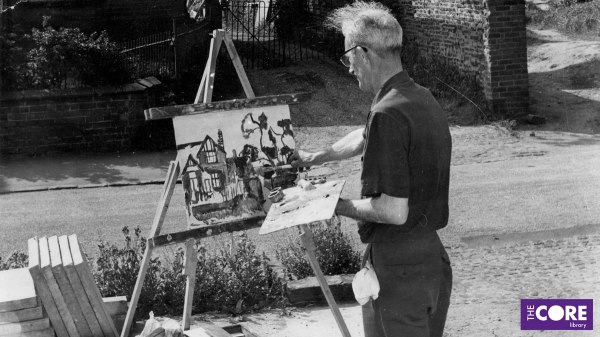
Arthur Stokes was born in Birmingham on 19th February 1871 and was the second of the six children of parents, Peter, a carter, and Ann (née Humphreys) who had married in Bordesley in 1867. He started work on the railways at the age of 13, and spent 44 years as a signalman at Solihull Station. In 1936, he published his memoir, the proceeds of which went towards the Solihull Methodist Church Building Fund.
Continue reading “Arthur Stokes (1871-1953), signalman”Elmdon C of E School
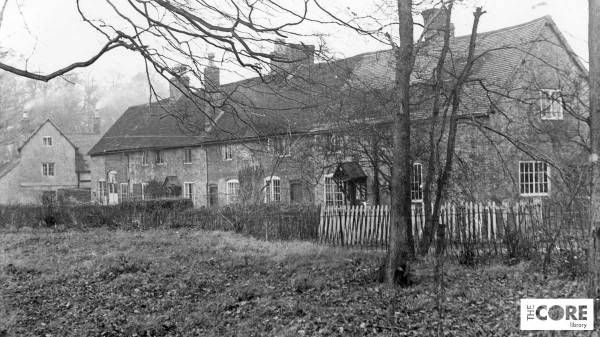
The elementary school in the grounds of Elmdon Park closed for the final time on Christmas Eve, 1943. The entry in the school log book notes the closure for Christmas but it seems that the school never actually reopened. There had been five juniors and 12 infants on the school roll on 10th December 1943, with only 80 per cent of the juniors attending school, and 31.6 per cent of the infants. The following week there were only 10 children registered.
Continue reading “Elmdon C of E School”100 years of Marston Green Lawn Tennis Club
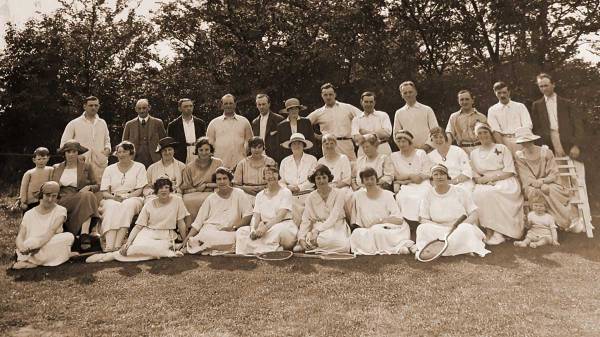
Marston Green Lawn Tennis Club was founded in 1923 and was known as Elite Lawn Tennis Club. The members in 1923 are pictured above. The women wore long dresses and men wore long trousers, and initially, there were more women players than men. The Elite name was dropped in 1926 and it became MGLTC.
Continue reading “100 years of Marston Green Lawn Tennis Club”Olton Remembers the First World War
During the Solihull Remembers project to commemorate each of the Borough’s First World War casualties on the centenary of their death, library staff worked with researchers from across the Borough, including a team from St Margaret’s Church, Olton. The names of the 52 men on the war memorial in the church were researched. It was found that there were at least 30 other casualties with a local connection whose names were not included on the memorial.
Continue reading “Olton Remembers the First World War”A Poem for Shirley
In May 2023, for Local and Community History Month, local historian, Gordon Bragg, led a guided walk around “Shirley Street.” Participants were accompanied by Poetry on Loan poet, Jonny Fluffypunk, who then crafted a poem referencing Shirley’s history.
Continue reading “A Poem for Shirley”Solihull Volunteer Infantry
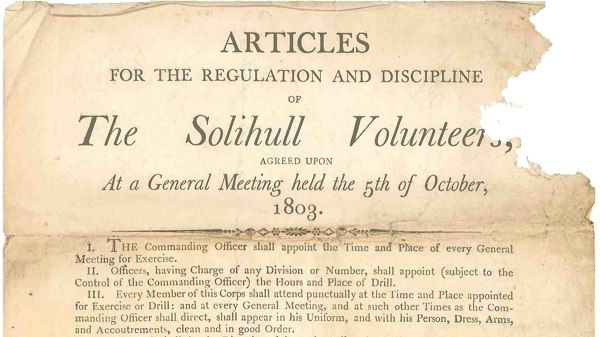
In the face of rising fears of invasion, an association for the defence of Solihull, Knowle and Elmdon was formed in 1797. The association offered to the Lord Lieutenant of Warwickshire a troop of horse at least 50-strong, with volunteers comprising local tradesmen and farmers who agreed to serve only within the bounds of Solihull, Knowle and Elmdon. Unlike the militia, which was raised by public ballot and administered by the War Office, the volunteer forces were self-regulating and would only come under the control of military authorities in the event of an invasion.
Continue reading “Solihull Volunteer Infantry”Korean War
Two local casualties of the Korean War (1951-53) are commemorated on Solihull war memorial. Corporal David Nigel Fellows, aged 20, was killed on 7th August 1951, and 24-year-old Corporal Robert Henry Smith was killed on 8th October 1951.
Continue reading “Korean War”Queen’s Baton Relay, 26th July 2022
Having been on a 294-day journey to all 72 Commonwealth countries, the Commonwealth Games baton returned to England on Monday 4th July 2022 for a 25-day tour of the regions. After visiting Sandwell on 25th July, the baton officially arrived in the Solihull Borough at 8am on Tuesday 26th July 2022, when the day’s first Batonbearer, Wayne Elcock (BB001), carried the baton into the grounds of Castle Bromwich Hall Hotel.
Continue reading “Queen’s Baton Relay, 26th July 2022”Elmdon Park – Solihull YAC exhibition
From 15th July 2023 until 14th September 2023, the Heritage Gallery at The Core hosted an exhibition about Elmdon Park, curated by Solihull Young Archaeologists’ Club (YAC).
Continue reading “Elmdon Park – Solihull YAC exhibition”The Solihull Sonnet(s)
If you look up above the Crescent Arcade in Touchwood, you will see a series of relief sculptures on the bulkhead between the Map Room (now known as the Atrium) and John Lewis. The sculpture group consists of 14 panels and was described by Touchwood’s architect, Eric R. Kuhne (1951-2016) in 2000 as “The Solihull Sonnet.”
Continue reading “The Solihull Sonnet(s)”