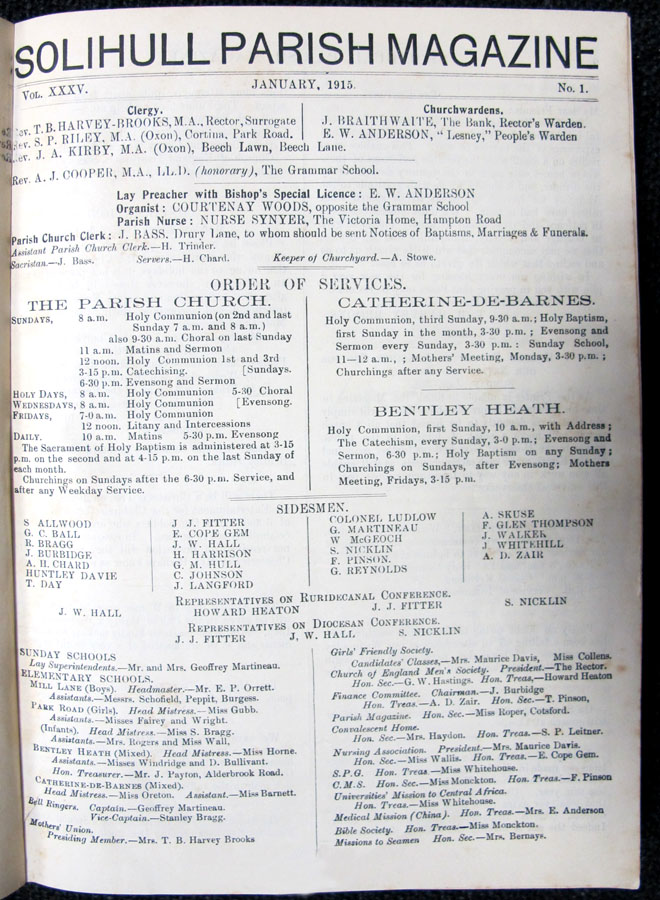
At Solihull Central Library, we have copies of the Solihull parish magazine for the First World War period. The magazines give a fascinating insight into life on the Home Front, and show a tightly-knit, active and caring community.
sharing Solihull's local history
At Solihull Central Library, we have copies of the Solihull parish magazine for the First World War period. The magazines give a fascinating insight into life on the Home Front, and show a tightly-knit, active and caring community.
Paul Gustave Désiré Quinet (surname pronounced key-nay, or keeney by some) was born on 7th April 1899 in Koekelberg, Brussels. At the age of four and a half, he moved with his parents to Persia but returned to Brussels in 1906 to go to boarding school, where he remained until 1914.
His mother died in childbirth in Persia in 1908 and his father remained working there until returning to Brussels in 1913.
In 1914, after Paul proudly told his father that he had seen German troops in nearby woods, the family quickly gathered together belongings and left Brussels for the Belgian coast, taking the last train to leave before the entry of the German troops into the city.
Continue reading “Paul Quinet, a former Belgian refugee”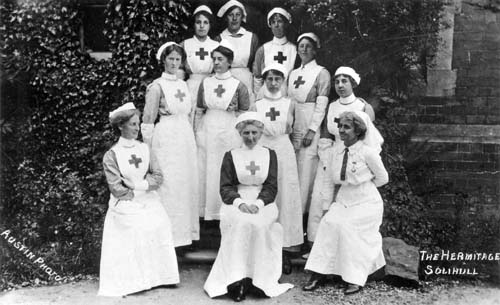
In 1909, the British Red Cross was tasked with helping the Territorial Forces Medical Service in the event of war. It set up local units called ‘Voluntary Aid Detachments’, and members were trained in first aid and nursing.
Auxiliary Hospitals, attached to military hospitals, were established – the following are known to have operated in Solihull:
Solihull was the only former Rural District Council to become a Metropolitan Borough Council in its own right under the 1972 Local Government Act, which came into effect on 1st April 1974. A little more than 40 years before, workers were taking up the cobbles in Solihull’s High Street – a graphic illustration of the incredibly rapid growth of the Borough. The population had more than doubled in 7 years, from just over 25,000 in 1932 to 52,610 by 1939.

When Solihull became a County Borough on 1st April 1964, it also became constituted as a registration and licensing authority for motor vehicles and drivers. From that day, Solihull drivers had to obtain their tax discs from the Local Taxation Officer at the Council House in Poplar Road. The DVLC (later DVLA) took over vehicle licensing from 1974.
Continue reading “First car registered in Solihull”This is an extract of a longer video by local film-makers and photographers, filmed in March 1954 when Princess Margaret presented then Urban District of Solihull with a Royal Charter of Incorporation as a Borough. It shows the area around Poplar Road and Warwick Road, including then Council House (now the Assembly Rooms pub).
Tracey
Heritage & Local Studies Librarian

I love this story from someone who moved to Kingshurst in 1972.
Every Friday my friends and I piled all the kids into big old-fashioned prams and walked over to the new shopping centre at Chelmsley Wood. We’d do our grocery shopping and then buy a big bag of chips, a loaf of bread and a tub of margarine and walk down to the river by the police station. We’d take off the kids’ shoes and socks and let them paddle while we made a mountain of chip butties. We’d sit them all down with a chip butty and pass a big bottle of cheap fizzy pop around and sit on the river bank. Our kids loved it and thought they’d had a super day out!

