So far, we have over 800 names on our list of those from places now in the Solihull Borough, or from the Solihull Rural District, who died as a result of their war service. However, we are struggling to identify in official records some of the people named on local memorials. This can be because there are too many people of the same name, or because we don’t have full names or service details, or because we have found possible individuals but can’t be sure of any local connection.
If you can help with information on any of the following, especially exact dates of death, please let us know:
Corporal Claude Percival Wilks (listed as Wilkes in some records), 2nd Battalion, King’s Royal Rifle Corps, was killed in action at the Battle of Aisne on 26th September 1914, aged 22. He has no known grave and is commemorated on Le Ferté-sous-Jouarre Memorial. He is also commemorated locally on war memorials at Catherine-de-Barnes, Elmdon, and Solihull.
Solihull War Memorial includes two people with the name James Evans – Driver James Evans of the Army Service Corps, and Private James Evans of the Royal Welsh Fusiliers.
We haven’t been able to identify these men on the Commonwealth War Graves website, or in the Soldiers Died in the Great War list.
If you have any information on either of these individuals, please let us know.
Paul Gustave Désiré Quinet (surname pronounced key-nay, or keeney by some) was born on 7th April 1899 in Koekelberg, Brussels. At the age of four and a half, he moved with his parents to Persia but returned to Brussels in 1906 to go to boarding school, where he remained until 1914.
His mother died in childbirth in Persia in 1908 and his father remained working there until returning to Brussels in 1913.
In 1914, after Paul proudly told his father that he had seen German troops in nearby woods, the family quickly gathered together belongings and left Brussels for the Belgian coast, taking the last train to leave before the entry of the German troops into the city.
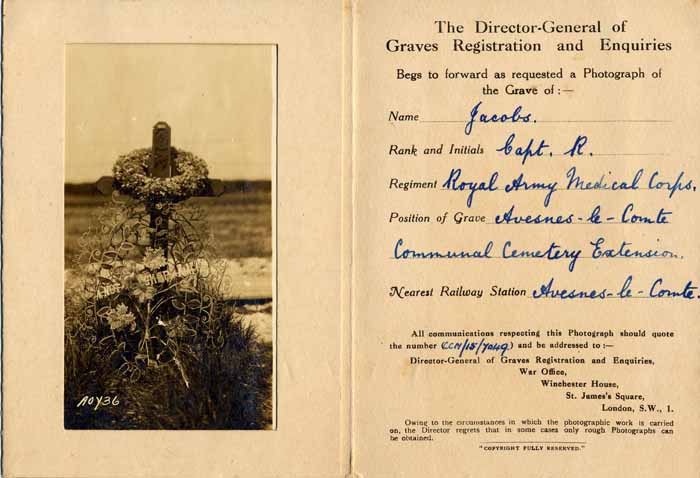
Captain Robert Jacobs of the Royal Army Medical Corps died of wounds on 20th July 1918, aged 39, after an enemy bomb fell on his billet.
He was born in London (his family moved to Solihull between 1901-1911) and he enlisted as a Private in the City of London Sanitary Company two days after the war began. He rose to the rank of Captain within 10 months, and served on the front continuously from his arrival in France on Christmas Day, 1914.
Robert Jacobs’ father, James, died in Spring 1911, so the War Office’s telegram advising of Robert’s death was sent to his mother. She also received a photograph of his grave, marked with a wooden battlefield cross, which was replaced by a Portland Stone memorial in the 1920s/30s.
Photograph sent to his mother, showing the battlefield cross on his grave (Solihull Library ref.: D3/2)
His family gave his medals, and the next-of-kin memorial plaque and scroll they received to Solihull Central Library, as well as the photo of his grave and the telegram sent to his mother notifying his death. These will all be on display in our forthcoming ‘Solihull Remembers’ exhibition.
If you have any more information about him, we’d be delighted to hear from you – please do let us know (email heritage@solihull.gov.uk or phone 0121 704 6977).
As part of the commemorations marking 100 years since the outbreak of the First World War, we’re trying to get together a definitive list of individuals from places now within the Solihull borough (or in the former Solihull Rural District) who died as a result of war service.
2014 marks the 40th/50th/60th anniversary of Solihull becoming a Municipal Borough (1954), County Borough (1964) and Metropolitan Borough (1974).
We’d love to hear your memories of those times – for example, did you see Princess Margaret visit Solihull on Charter Day? Did you attend the teenage dance at the Civic Hall in 1964 to raise funds for the ‘Elevation Day’ clock? Do you remember the creation of the present-day Metropolitan Borough in 1974?
Please tell us what you remember of events then, or let us have your thoughts on how life in the Borough has changed since those times. There’s a memory sheet (PDF) attached below for you to fill in and email back to us at heritage@solihull.gov.uk
This is an extract of a longer video by local film-makers and photographers, filmed in March 1954 when Princess Margaret presented then Urban District of Solihull with a Royal Charter of Incorporation as a Borough. It shows the area around Poplar Road and Warwick Road, including then Council House (now the Assembly Rooms pub).
Solihull is unique in being the only former Rural District (1894-1932) to have grown to the status of Metropolitan Borough in its own right.
2014 marks 60 years since HRH Princess Margaret visited Solihull to present the then Urban District (1932-54) with a Royal Charter of Incorporation as a Borough.
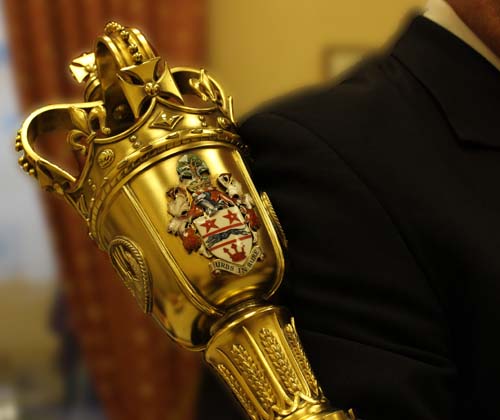
The Mace is the symbol of Royal authority, delegated to the Mayor
Just ten years later, “the village”, as most Silhillians still called it, had grown to such an extent that the Municipal Borough served a population of 100,000. This was considered sufficient to become a County Borough in 1964, and take on responsibilities previously carried out for residents by the County Council.
Another ten years on, and 1974 saw the effect of the Local Government Act 1972, which re-organised local authorities and saw Solihull County Borough merge with Meriden Rural District and Hockley Heath Parish to form the Metropolitan Borough of Solihull we have today.
All this makes 2014 a special year for us: a 40th, 50th and 60th anniversary!
We’re hoping that you’ll be able to tell us your memories of the events in 1954, 1964, and 1974 that marked the rise of Solihull from an Urban District to a Metropolitan Borough.
 Solihull Life