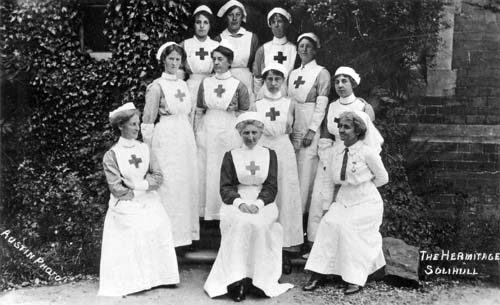
In 1909, the British Red Cross was tasked with helping the Territorial Forces Medical Service in the event of war. It set up local units called ‘Voluntary Aid Detachments’, and members were trained in first aid and nursing.
Auxiliary Hospitals, attached to military hospitals, were established – the following are known to have operated in Solihull:
Captain Robert Jacobs of the Royal Army Medical Corps died of wounds on 20th July 1918, aged 39, after an enemy bomb fell on his billet.
He was born in London in 1879 (his family moved to Ashburnham, 27 Whitefields Road, Solihull between 1901-1911) and he enlisted as a Private in the City of London Sanitary Company two days after the war began. He rose to the rank of Captain within 10 months, and served on the front continuously from his arrival in France on Christmas Day, 1914.
He was twice Mentioned in Despatches, and was congratulated on two occasions by Sir Douglas Haig.
By the time of his death, he was in command of no. 8 Sanitary Section. His knowledge of bacteriology and his inventive genius bought him distinction. He invented a method for the destruction of the ova of lice by heat, which was adopted by Allied armies, and he also invented a means of purifying bath water so that it could be re-used seven times. Amongst other inventions were a self-emptying incinerator and a process of rendering down waste fats to be turned into nitroglycerine for the manufacture of munitions.
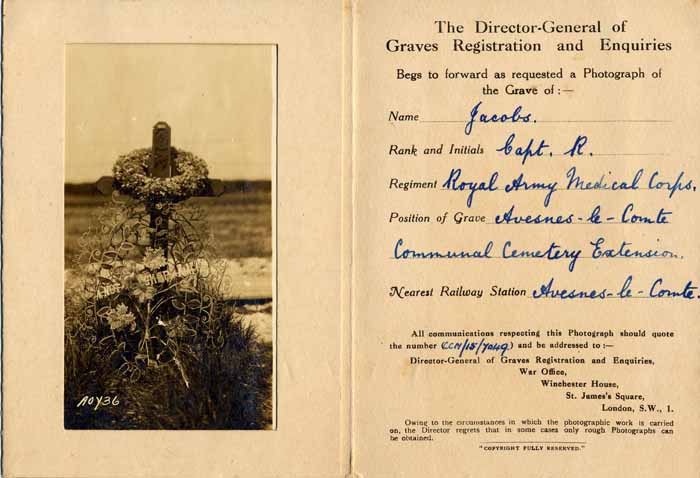
Robert Jacobs’ father, James, a retired joiner, died in Spring 1911, so the War Office’s telegram advising of Robert’s death was sent to his mother, Ellen. She also received a photograph of his grave, marked with a wooden battlefield cross, which was replaced by a Portland Stone memorial in the 1920s/30s.
Photograph sent to his mother, showing the battlefield cross on his grave (Solihull Library ref.: D3/2)
He was the second of three children – his older brother Harry Jacobs (1875-1964) was a bank clerk with Lloyds Bank. The brothers also had a younger sister, Maud Jacobs (1880-1961) who kept house for her brother, Harry. The unmarried siblings remained at Ashburnham, Whitefields Road until at least 1939 and were living at 18 Elmdon Road, Selly Oak, Birmingham at the time of their respective deaths.
Robert Jacobs’ family gave his medals, and the next-of-kin memorial plaque and scroll they received to Solihull Central Library, as well as the photo of his grave and the telegram sent to his mother notifying his death.
If you have any more information about him, we’d be delighted to hear from you – please do let us know (email heritage@solihull.gov.uk or phone 0121 704 6977).
Three more men from places now within the Solihull Borough are known to have died in September 1914. They were:
Private Albert Newell, of West Yorkshire Regiment (Prince of Wales’s Own), died 20th September 1914. He’s commemorated at Bickenhill and Marston Green.
Private George Edward Paston, of King’s (Liverpool Regiment), died 21st September 1914, aged 32. He was apparently born in Berkswell but was living with his wife and his son at his father-in-law’s home in Leicester. His peace-time occupation was a brick-burner. As far as we know, he’s not commemorated in the Solihull Borough, so please tell us if you know differently.
Corporal Claude Percival Wilks, of the 2nd Battalion, King’s Royal Rifle Corps, died 26th September 1914. He’s commemorated on memorials at Catherine-de-Barnes, Elmdon and Solihull.
If you have any information about any of these soldiers, please let us know – email heritage@solihull.gov.uk or phone 0121 704 6977.
As part of the commemorations marking 100 years since the outbreak of the First World War, we’re trying to get together a definitive list of individuals from places now within the Solihull borough (or in the former Solihull Rural District) who died as a result of war service.
The New Year brings a fresh look for “Solihull Life In A Day”, which saw tweets, posts, photos, drawings and one-day diaries archived to give a snapshot of life in the Borough on an ordinary day – Tuesday 12th November 2013. You can see the curated themes at http://storify.com/oursoliday
We felt that Solihull Life shouldn’t just be for one day, so we’ve changed our Twitter and WordPress profiles to reflect our ongoing efforts to capture, preserve and share the life and heritage of the Borough. We’ll be featuring some of our photos and documents, and we’ll be asking for your help with some of our forthcoming projects.
2014 marks one hundred years since the outbreak of the First World War, and library staff have been working with local historians and community groups to find out about those with a connection to Solihull who served and gave their lives.
Less well-known is that 1st April 2014 marks the 40th anniversary of Solihull Metropolitan Borough, the 50th anniversary of Solihull County Borough, and the 60th anniversary of Solihull Municipal Borough, which saw Princess Margaret visit the then Urban District of Solihull to present the Royal Charter.
We’d be delighted to hear from you if you could contribute any anecdotes, stories or memorabilia relating to the First World War or the 40th/50th/60th anniversary of the Borough. Please email Tracey Williams at heritage@solihull.gov.uk