Nine local men lost their lives on the first day of the German Spring Offensive (Operation Michael), which saw British troops subjected to one of the longest artillery bombardments of the war. Lasting for five hours from 4:20am, the barrage of over one million artillery shells smashed vital communication lines, and was followed by waves of elite German troops coming over No Man’s Land, which was shrouded in thick fog. The Germans made swift and significant gains, with the British suffering some 50,000 casualties. British troops were ordered to withdraw, giving up much of the Somme region. However, it was not a decisive defeat, and the British were able to establish new lines of defence, whilst the rapid advance caused German supply lines to become overextended. Continue reading “21st March 1918”
19th March 1918
Private (Acting Corporal) Arthur Llewellyn Cooper, 6th Field Ambulance, Royal Army Medical Corps, died of wounds on 19th March 1918 after having been gassed. He was born in Acocks Green in 1897 and was the second of the three children of parents John (an upholsterer) and Mary Elizabeth (née Llewellyn) who had married in 1895.
17th March 1918
Second Lieutenant John Drummond Wyatt-Smith, 28th Squadron, Royal Flying Corps, died in a flying accident in northern Italy, just a few days after joining the squadron. His plane stalled on take off, nose dived and then crashed to earth. Known as Jack, he was 19 years old, and was the second of two brothers to die on active service. His older brother, Hugh, died of appendicitis on 17th February 1916 after falling ill whilst on embarkation leave.
16th March 1918
Gunner Alfred Bartlett, aged 40, died on 16th March 1918 whilst serving at Boyton Camp, Wiltshire with the 4th “B” Reserve Brigade, Royal Field Artillery. He was born in 1877 in Stow-on-the-Wold and was the third of the ten children of parents George and Elizabeth (née Webb) who had married in Elizabeth’s home parish of Great Rollright, Oxfordshire in 1871.
10th March 1918
Ordinary Seaman William Charles Edward Hadland died of acute nephritis [inflammation of the kidneys] at the Royal Naval Hospital Gosport on 10th March 1918. He had enlisted less than a month previously and was in training on HMS Victory when he became ill.
2nd March 1918
Private Geoffrey Jinks, aged 25, died of illness on 2nd March 1918. He was serving with the 2nd/8th Battalion Worcestershire Regiment, but was transferred to the 288th Area Employment Company, Labour Corps.
1st March 1918
Staff Nurse Edith Mary Cammack, Territorial Force Nursing Service (TFNS), died at the 4th Southern General Hospital in Plymouth on 1st March 1918 as a result of dysentry and malaria contracted whilst on duty in Salonika with 30 Stationary Hospital.
26th February 1918
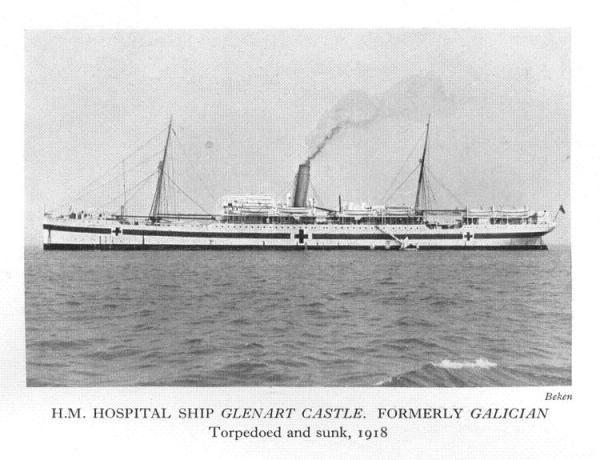
On 26th February 1918, Acting Matron Katy Beaufoy lost her life when HMHS Glenart Castle, the hospital ship on which she was serving with Queen Alexandra’s Imperial Military Nursing Service, was torpedoed by German submarine UC56 ten miles west of Lundy Island. The ship was making her way from South Wales down the Bristol Channel, bound for Brest, France, and was clearly displaying hospital ship markings, including lit Red Crosses and being painted white with green stripe on the sides. The torpedo hit the no. 3 hold at 03:47am, destroying most of the lifeboats in the process, and the ship sank within eight minutes. Only 32 people survived, with 162 losing their lives.
23rd February 1918
Second Lieutenant Claude Charles Langford, 6th Dragoon Guards (Carabiniers) died on 23rd February 1918 at Tidworth Camp. Born in 1897 in Birmingham, he was the eldest of the four sons of parents, Oliver Charles (a cardboard box manufacturer) and Emma Blanche Lillian (née Thompson) who had married in the Solihull Registration District in 1896.
21st February 1918
Lieutenant Colin Sutherland Lynden-Bell, 99th Deccan Infantry, was accidentally killed on 21st February 1918 whist on active service in Nusayrayah, Mesopotamia. He was the second and only surviving son of parents Colonel Edward Horace Lynden Lynden-Bell (1858-1922) and Mary Haigh Lynden-Bell (née Guyon) who had married in December 1891 in Dover. Both parents came from families with a long tradition of military service. Colonel Lynden-Bell was a surgeon in the Royal Medical Corps, whilst his two brothers, Charles Perceval (1862-1934) and Arthur Lynden (1867-1943) were also career officers in the Army. His father, Major-General Thomas Lynden Lynden-Bell, served in the Army for 43 years. Mary’s father was Major-General Gardiner Frederick Guyon.
 Solihull Life