Two local men lost their lives on 12th March 1915. Private Herbert Rushton of Castle Bromwich died, aged 24, whilst serving with the 3rd Battalion, Worcestershire Regiment. On the same day, Acting Corporal Harold Pugh, 2nd Battalion, Royal Scots Fusiliers was killed in action.
10th March 1915
Corporal Ernest Bateman, 2nd Battalion, South Staffordshire Regiment, was killed in action on 10th March 1915 according to Commonwealth War Graves records. Soldiers Died in the Great War lists the date of death as 26th June 1915. Continue reading “10th March 1915”
21st February 1915
Cavalry Officer, 26-year-old Rowland Auriol James Beech, the “apple of his parents’ eye” and a fine horseman, was killed in action on 21st February 1915 serving as a Captain with the 16th Lancers. He was the eldest son of Lieutenant-Colonel Rowland John Beech, who died of illness in 1919 after World War I service, aged 63, and is also recorded as a war casualty on the Commonwealth War Graves site.
18th February 1915
On 18th February 1915, 44-year-old Major Arthur Joseph Clay died of pneumonia at Harpenden, whilst serving with the 2nd/6th Battalion North Staffordshire Regiment. Born on 29th April 1870 at Burton-on-Trent, he was the eldest son of Charles John Clay, barrister at law and Managing Director of Bass Brewery. Arthur’s mother, Agnes Lucy (née Arden) died in 1874, leaving four sons under the age of five. When Arthur was 13, his father married again, and went on to have two daughters with his second wife.
Arthur attended Harrow School and New College, Oxford. He was gazetted Second Lieutenant with the 2nd Volunteer Battalion Prince of Wales’s (North Staffordshire Regiment) in February 1893, and rose to the rank of Captain before resigning his commission in advance of the merger of volunteer units in 1908 to create the Territorial Force. He became a Director of Messrs. Bass, Ratcliffe and Gretton, a Director of the Gordon Hotels and was one of the principal promoters of the Motor Industry in Burton-on-Trent.
15th February 1915
25-year-old Lance Corporal Abraham Rose died on 15th February 1915 whilst serving with the 2nd Battalion, Duke of Cornwall’s Light Infantry. He was born in Langley Green, Oldbury in 1889, to parents John (born in Derby, a labourer at a brewery) and his second wife, Emma (née Salt). His first wife, also called Emma (née Jackson) died in Burton-on-Trent in 1875, seven years after her marriage to John at Marston on Dove in 1868. With three young children, John remarried soon after his wife’s death in 1875, and had moved with his family to Oldbury by 1881.
By 1901, Abraham was aged 12, recorded on the census as “adopted” and living in Oldbury with a John and Phoebe Rose. John was a 24-year-old bricklayer, born in Burton-on-Trent, and appears actually to have been Abraham’s brother. By 1911, John and Phoebe were living in Church Hill, Solihull but Abraham is not with them, and doesn’t appear to have been recorded on census returns elsewhere. It’s possible that he was a regular soldier and was away serving with the Army.
25th January 1915
Private George Brotherton was one of 86 men from the Coldstream Guards to die on 25th January 1915, 68 of whom (including George) are commemorated at Le Touret Memorial, between Bethune and Armentieres in the Pas de Calais, France.
According to Soldiers Died in the Great War, George served with the 1st Battalion and was born in Evesham, lived in Castle Bromwich, and enlisted in Birmingham. It looks as if he must have moved to Castle Bromwich between 1911 and 1915, as he appears on the 1911 census living at 55 Warren Road, Washwood Heath, Saltley with his parents, Samuel and Martha, and his six siblings. He was listed as aged 18, and recorded as being a soldier in the Coldstream Guards. His medal index card shows that he entered a Theatre of War on 13th August 1914.
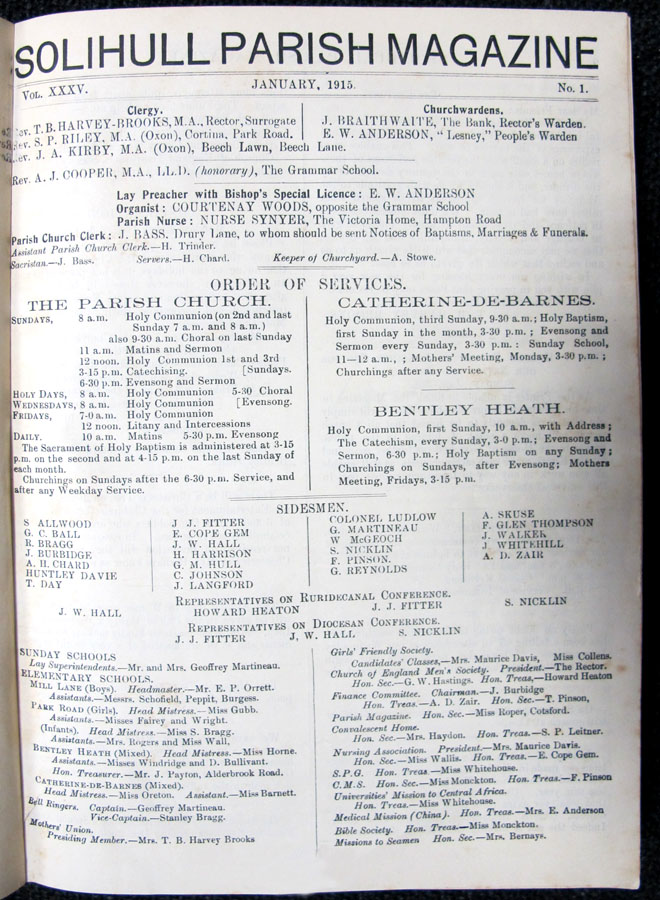
Solihull Parish Magazine, January 1915
At Solihull Central Library, we have copies of the Solihull parish magazine for the First World War period. The magazines give a fascinating insight into life on the Home Front, and show a tightly-knit, active and caring community.
1st January 1915
The first of the 95 casualties from the Solihull area to die in 1915 was Royal Naval Chaplain, Rev. George Brooke Robinson, who died on New Year’s Day 1915 whilst serving on H.M.S. Formidable. This was the first British battleship to be sunk in the First World War. Rev. Robinson was the most senior Royal Navy chaplain to die in the war, and the fourth of 19 navy chaplains to be die on active service 1914-1919.
Born in Bombay, India on 6th April 1870, George Brooke Robinson appears on the 1881 census, aged 10, at boarding school in Brighton. By 1891, he was living in Cambridge with his widowed mother, Agnes. He studied at Pembroke College, Cambridge, obtaining a B.A. in 1894, and an M.A. in 1898. He was ordained as a Deacon in December 1895 at Worcester Cathedral, and served as curate at Solihull 1895-97. Traditionally, the curate at St Alphege took charge of the Mission Church at Catherine-de-Barnes, which is why his name appears on the village war memorial there. Unusually, the war memorial at Catherine-de-Barnes takes the form of a brass plaque on an oak font.

22nd December 1914
Private John Charles Smith was killed in action at Givenchy on 22nd December 1914, aged 21. He died just over four months after enlisting in the Coldstream Guards.
According to the information in De Ruvigny’s Roll of Honour, he was the third son of Joseph and Ann Smith of Park Lane Corner, Berkswell. He was born on 12th April 1893 at Temple Balsall and was educated at Burton Green, near Kenilworth, and Temple Balsall. He enlisted on 18th August 1914 and was posted to France in December, shortly before he was killed.
He is commemorated at Berkswell and he is one of more than 13,400 soldiers with no known grave who is commemorated on the Le Touret Memorial, Pas de Calais, France.
21st December 1914
Private George Henry Carter, aged 27, died of wounds on 21st December 1914 and is buried in Belgium at the London Rifle Brigade Cemetery.