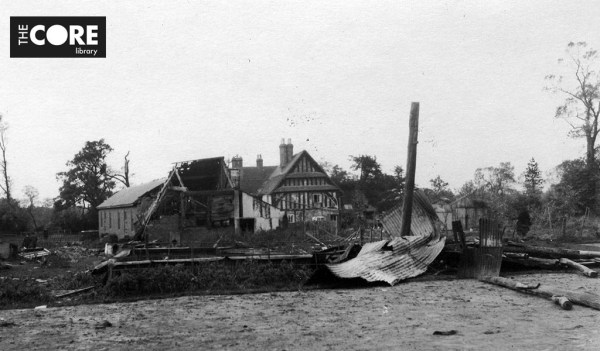
Between 3-4pm on Wednesday 24th October 1923, Solihull was battered by a whirlwind (now believed to have been a tornado) that travelled a path from Sharman’s Cross to Elmdon Heath. A man sheltering in a barn was killed by the storm. Lasting only three or four minutes, reports of the whirlwind, also described as a cyclone in some articles, appeared in newspapers across the country.
Continue reading “The “Solihull Whirlwind” 1923″20th December 1919
Former Private Thomas Paget, Warwickshire Regiment, died on 20th December 1919 at City Isolation Hospital, West Heath, Birmingham aged 43. He was a former labourer and died of TB contracted whilst on active service.
Continue reading “20th December 1919”Solihull’s war shrine
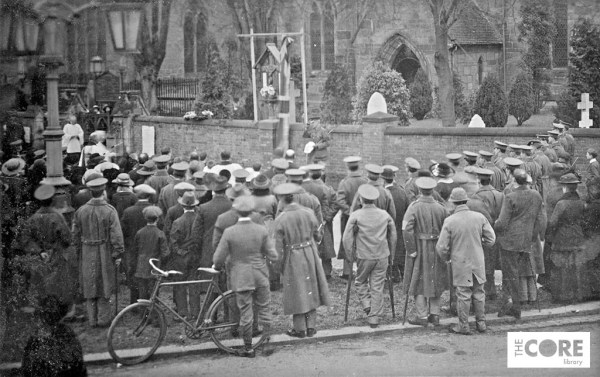
Easter Sunday, 9th April 1917, saw the unveiling in Solihull of a War Shrine to the Fallen of the First World War, pictured above (image courtesy of Gordon Bragg).
The Calvary shrine was the gift of a parishioner and was designed by local artist Elphege Pippet (1868-1942). It was built by Charles Timms of Messrs. Thompson, builders of Knowle, causing the Rector of Solihull to note: “everything connected with it has been done in our village, which is as it should be.”
“Monty” visits Solihull School
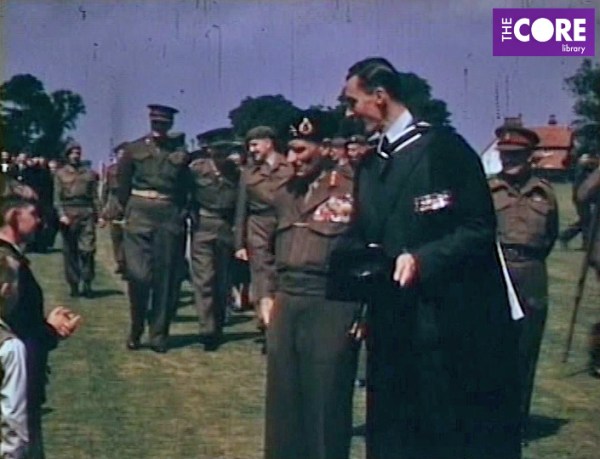
On 10th June 1949, Field Marshal Bernard Law Montgomery (1887-1976), 1st Viscount Montgomery of Alamein, visited Solihull School, inspecting 250 cadets from the school’s Combined Cadet Force (CCF) and having lunch with the Headmaster and 15 senior cadets. “Monty’s” attendance at the school’s annual parade fulfilled a promise made to the school’s Headmaster, Mr Harry Butler Hitchens (1910-1963), ten months’ previously.
2nd April 1919
Former Able Seaman Higher Grade Arthur Whitworth, Royal Naval Volunteer Reserve, died in Queen’s Hospital, Birmingham as a result of infective endocarditis (an infection of the inner lining of the heart). He had be demobilised on 5th January 1919 and is not listed on the Commonwealth War Graves website, although his gravestone notes that he “died from illness contracted in service.”
25th December 1918
Captain Edward Rainsford Harrison, 524th Company, 61st Divisional Train, Army Service Corps, died in hospital in Abbeville, France on Christmas Day, 1918. The cause of death was double pneumonia following influenza contracted whilst on active service.
24th November 1918
Having spent almost all of the war as a Prisoner of War, Private Cornelius Cull, 2nd Battalion, Royal Warwickshire Regiment, died of pneumonia in Germany on 24th November 1918.
21st November 1918
Private Thomas Haydon, 23rd Battalion, Duke of Cambridge’s Own (Middlesex) Regiment, died of wounds in Woking Hospital on 21st November 1918, aged 19. He was born in the Kings Norton district c.1899 and was the younger of the two sons of parents Alfred Charles (a labourer) and Jane (née Reason) who had married in 1890.
8th November 1918
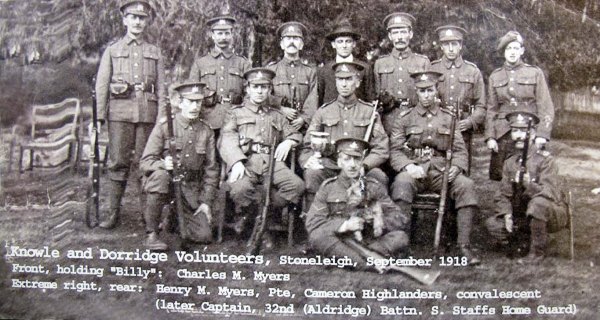
Three men with a local connection died on 8th November 1918 – Gunner John Edward Herbert Harrison, 536th Siege Battery, Royal Garrison Artillery; Private Stephen Hastings, 2nd/4th Field Bakery, Royal Army Service Corps; and Sergeant Howard William Smith, 2nd Battalion (Knowle and Dorridge detachment), Royal Warwickshire Volunteers.
7th November 1918
Three men with a local connection died on 7th November 1918 whilst on active service – Private Edward Allen, Reinforcement Depot, Tank Corps; Private George Terheege, Labour Corps; and Second Lieutenant John Shilvock Wright, 219th Siege Battery, Royal Garrison Artillery.