Old Silhillian, Captain Leslie Kelham Sands, 10th Battalion Lancashire Fusiliers, died of wounds on 28th April 1916 at 2 Casualty Clearing Station, Bailleul, France. He was born on 5th January 1892 in Small Heath, Birmingham, where his father, Rev. Hubert Sands, was vicar at St Oswald’s Church. He was the second of five children: Olive Frances (1890-1969); Havilland Hubert Allport (1896-1970); Arthur Langdale (1899-1954) and Thomas Blakemore (1906-1980).
23rd April 1916
Three local soldiers died in Egypt on Easter Sunday, 23rd April 1916, serving with the Queen’s Own Worcestershire Hussars (Worcester Yeomanry). Corporal (Acting Sergeant) Cyril Henry Coombs and Private Osborn Thomas Smith are both commemorated on the Jerusalem Memorial, and both are listed on the Solihull School war memorial. Leslie St Clair Cheape, a member of the North Warwickshire Hunt, also died on the same day and is commemorated on the Jerusalem Memorial. He was a Captain with the 1st Dragoon Guards, but was attached to the Queen’s Own Worcestershire Hussars.
16th March 1916
Lieutenant Glyn Cuthbert Robertson was shot and killed by a sniper at Neuville St Vaast, France whilst inspecting trenches previously taken over from the French. There is a slight discrepancy in the date of death, with some sources giving this as 15th March.
Although Glyn was born in Southgate, London in 1893, the family actually seems to have been living in Warwickshire for several years. His parents, Arthur (an insurance inspector) and Agnes (née Fitter), were married at Edgbaston parish church in 1889, and his sister, Dorothy, was born in Egbaston in 1890. Glyn was baptised at Hampton-in-Arden on 22nd July 1893, with his parents’ address at the time being recorded as Pembroke House, Bounds Green, London and his father’s occupation as clerk.
21st January 1916
Lieutenant Robert Laurence Needham, known as Laurie, was killed in action in Mesopotamia (modern-day Iraq) on 21st January 1916 during the Siege of Kut el Amara (the First Battle of Kut), 100 miles south of Baghdad.
Born in Brighton on 10th April 1889, Laurie and his younger brother, Frederic Gilbert (known as Gilbert), both attended Solihull School after boarding at a private school in Brighton.
13th October 1915
Four local men lost their lives on 13th October 1915. They have no known grave and are commemorated on the Loos Memorial:
- Second Lieutenant Ostcliffe Harold Beaufort, North Staffordshire Regiment
- Private Donald Ewen, London Regiment (London Scottish)
- Private Joseph Frederick Harding, Gloucestershire Regiment
- Lieutenant (Temporary Captain) Harley Raymond Russell, Gloucestershire Regiment
16th August 1915
Three days after the death of Private Joseph Williams aboard the hospital ship, Valdivia, another local man also died of wounds on board the same ship.
Lance Corporal Charles Thomas Hutchings, only surviving child of parents Thomas (a tailor) and Matilda Hutchings of Bentley Heath, Dorridge and Knowle, died on 16th August 1915, serving with the 9th Battalion Worcestershire Regiment. He is recorded as a Lance Corporal in Soldiers Died in the Great War but as a Private on the Commonwealth War Graves website.
Charles was born in 1895 in Birmingham but by 1901 he and his parents were living at Bentley Heath with his grandfather, Richard Hutchings, who was a widower, aged 54. By 1911, Charles and his parents had moved to Tile House Green, Knowle. Charles was the couple’s only surviving child, but the census notes that he had had a sibling who had died.
Charles was educated at Solihull School and was a member of the Officers’ Training Corps there. He joined the Army on 17th August 1914, and first entered a Theatre of War (Balkans) on 4th July 1915. He is commemorated at Dorridge, Knowle and Hockley Heath war memorials, and at Dorridge Cricket Club, although he is not included on the war memorial at Solihull School.
If you have any further information about Charles Thomas Hutchings, please let us know.
Tracey
Heritage & Local Studies Librarian
Tel.: 0121 704 6977
email: heritage@solihull.gov.uk
2nd August 1915
Two local men lost their lives on 2nd August 1915 whilst on active service – Private William Manton, 1st/4th Battalion, King’s Own Yorkshire Light Infantry, and Sergeant Lawrence Waters, 5th Battalion, Oxford & Bucks Light Infantry.
V. E. Day in Solihull, 1945
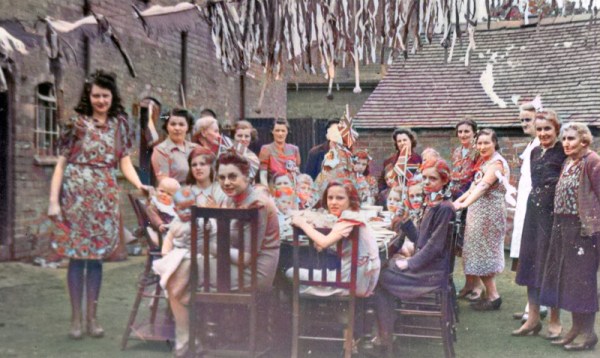
Tuesday 8th May 1945, Victory in Europe Day, saw much rejoicing as the fighting in Europe officially came to an end and some of the men held as prisoners of war started to return home. At 3pm on Monday 7th May Prime Minister Winston Churchill made the official announcement that the following two days would be public holidays. However, it’s clear from newspaper articles in the Warwick County News that people were very mindful that war with Japan was still ongoing. The newspaper summed up the local celebrations as:
Continue reading “V. E. Day in Solihull, 1945”“typical of others throughout the land where people had gathered together to give thanks that the nightmare of the last grey years was over, and, while remembering that men in far distant lands were still in danger of their lives, to enjoy the day that their individual effort had made particularly their own” (Warwick County News, 12th May 1945)
Help us identify Borough casualties
So far, we have over 800 names on our list of those from places now in the Solihull Borough, or from the Solihull Rural District, who died as a result of their war service. However, we are struggling to identify in official records some of the people named on local memorials. This can be because there are too many people of the same name, or because we don’t have full names or service details, or because we have found possible individuals but can’t be sure of any local connection.
If you can help with information on any of the following, especially exact dates of death, please let us know:
Auxiliary Hospitals
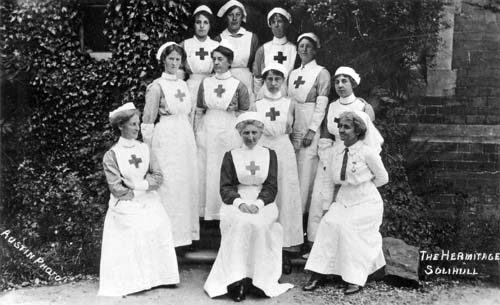
In 1909, the British Red Cross was tasked with helping the Territorial Forces Medical Service in the event of war. It set up local units called ‘Voluntary Aid Detachments’, and members were trained in first aid and nursing.
Auxiliary Hospitals, attached to military hospitals, were established – the following are known to have operated in Solihull:
 Solihull Life