Private George Edward Houlston died of wounds on 18th April 1918 whilst serving in France with the 4th Battalion Machine Gun Corps. He was 20 years old and was born in Solihull in 1897.
10th April 1918
Two local men died on 10th April 1918. Second Lieutenant Percival Horace Batchelor, Royal Warwickshire Regiment attd. 2nd/6th Bn. North Staffordshire Regiment and Private Thomas Teerheege, 3rd Battalion, Worcestershire Regiment.
9th April 1918
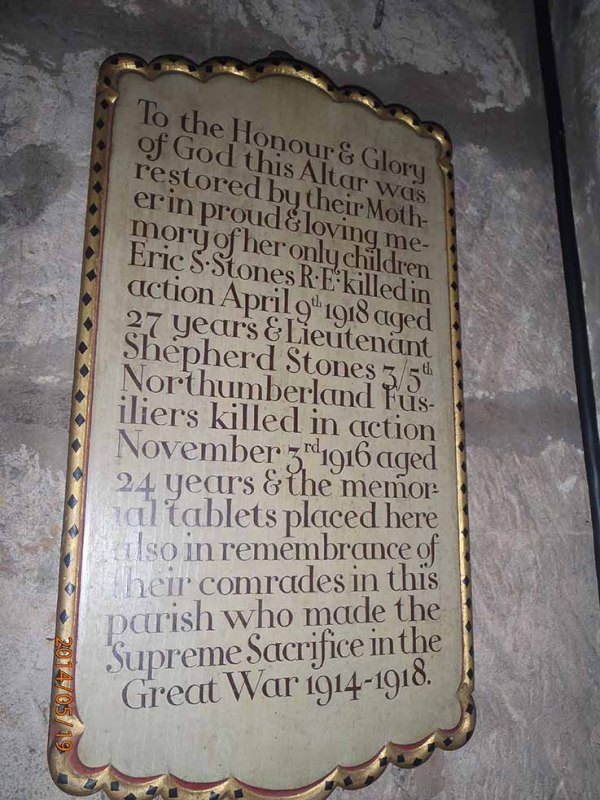
Two local men lost their lives on active service on 9th April 1918. Captain Edward Grafton Herbert MC, Royal Warwickshire Regiment but attached to the Machine Gun Corps, and Pioneer Eric Stones, 3rd Special Company, Royal Engineers. Coincidentally, both men had worked for the same Birmingham brassfoundry.
6th April 1918
20-year-old Sapper Eustace Bertram Wagstaff (listed as Wagstaffe in some records) was killed in action on 6th April 1918 serving with the 69th Field Company, Royal Engineers. He was the second of the four children of parents William Charles (a coachman) and Harriet (née Freeman) who had married in London in 1891.
29th March 1918
On 29th March 1918 Private Philip George Powell, 28th Battalion London Regiment (Artists’ Rifles) died of wounds as a prisoner of war in Mons.
25th March 1918
Two local men lost their lives on active service on 25th March 1918. Fitter John Charles Clinton, “A” Battery, 84th Brigade, Royal Field Artillery and Private James Drew, 10th Battalion, Royal Warwickshire Regiment.
23rd March 1918
Four local men were killed on 23rd March 1918:
- Private Sidney Bickley, 1st Battalion, Royal Berkshire Regiment
- Private Clark(e) Middleton, 5th Battalion, Oxford and Bucks Light Infantry
- Private Harry Prentice, 11th Battalion, 11th Battalion, The Queen’s (Royal West Surrey Regiment)
- Private Albert White, 10th Battalion, Royal Warwickshire Regiment
21st March 1918
Nine local men lost their lives on the first day of the German Spring Offensive (Operation Michael), which saw British troops subjected to one of the longest artillery bombardments of the war. Lasting for five hours from 4:20am, the barrage of over one million artillery shells smashed vital communication lines, and was followed by waves of elite German troops coming over No Man’s Land, which was shrouded in thick fog. The Germans made swift and significant gains, with the British suffering some 50,000 casualties. British troops were ordered to withdraw, giving up much of the Somme region. However, it was not a decisive defeat, and the British were able to establish new lines of defence, whilst the rapid advance caused German supply lines to become overextended. Continue reading “21st March 1918”
23rd February 1918
Second Lieutenant Claude Charles Langford, 6th Dragoon Guards (Carabiniers) died on 23rd February 1918 at Tidworth Camp. Born in 1897 in Birmingham, he was the eldest of the four sons of parents, Oliver Charles (a cardboard box manufacturer) and Emma Blanche Lillian (née Thompson) who had married in the Solihull Registration District in 1896.
16th February 1918
23-year-old Lieutenant Percy Lilico was killed in a flying accident at the Royal Flying Corps airfield at Northolt on 16th February 1918, as a result of his aeroplane nose-diving off a steep, low turn. He was born in Wooler, Northumberland, on 30th April 1894 and was the younger of the two sons of parents, Charles Gordon Lilico (1855-1912) and Emily (née Atkinson) (1864-1955) who had married in Edinburgh on 13th January 1890.
 Solihull Life