14th September 1914

It appears that the first of the World War I casualties in the field from places now within the Borough of Solihull died on 14th September 1914. This was during the First Battle of the Aisne, which marked the change from mobile warfare to trench warfare.

The locally-commemorated men who died were:

  • Rifleman Robert William Baker, born in Olton
  • Rifleman Eric Gordon Birch, born and lived in Castle Bromwich
  • Private Richard William Choate, commemorated at Olton
  • Captain Lord Guernsey, commemorated at Bickenhill and Forest Hall, Meriden
Continue reading “14th September 1914”

5th September 1914

The second casualty from places now within Solihull to die as a result of enemy action appears to be Private William Henry Wright of the Royal Marine Light Infantry (RMLI), also called the Red Marines. He was on board the scout cruiser, H.M.S. Pathfinder, sunk on 5th September 1914 by U-boat U-21 in the North Sea off St Abbs Head, Berwickshire, Scotland with the loss of over 250 men. His name appears in the Birmingham Daily Post 8th September 1914 as one of those missing. This was apparently the first ship ever to be sunk by a locomotive torpedo fired from a submarine.

According to the Royal Navy and Royal Marines War Graves roll on the Ancestry website (available free of charge from computers in Solihull Libraries), William Henry Wright was born in Rowington on 30th October 1895. At the time of the 1901 census, he was still living in Rowington with his parents, John and Anne. John was a general agricultural labourer, who was himself also born in Rowington.

Continue reading “5th September 1914”

Private John Parr – the first British death on the Western Front

One hundred years ago today, 21st August 1914, the first British soldier is believed to have died on the Western Front.

John Henry Parr was the son of a milkman from Finchley, London. He joined the army in 1912, giving his age as 17, although the census a year earlier shows him as 13 years old in 1911. He was baptised at St John’s Church, Holloway on 4th September 1898. He would, therefore, have been about 14 years of age when he joined the Army in 1912 as a Private with the Middlesex Regiment.

Continue reading “Private John Parr – the first British death on the Western Front”

Auxiliary Hospitals

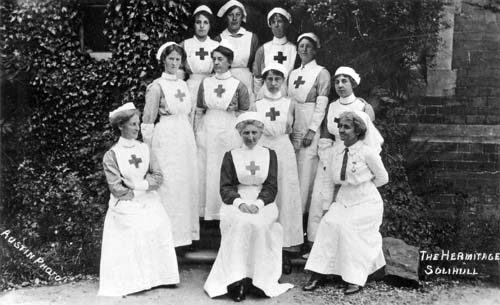
In 1909, the British Red Cross was tasked with helping the Territorial Forces Medical Service in the event of war. It set up local units called ‘Voluntary Aid Detachments’, and members were trained in first aid and nursing.

Auxiliary Hospitals, attached to military hospitals, were established – the following are known to have operated in Solihull:

Continue reading “Auxiliary Hospitals”

Hemlingford

Solihull was the only former Rural District Council to become a Metropolitan Borough Council in its own right under the 1972 Local Government Act, which came into effect on 1st April 1974. A little more than 40 years before, workers were taking up the cobbles in Solihull’s High Street – a graphic illustration of the incredibly rapid growth of the Borough. The population had more than doubled in 7 years, from just over 25,000 in 1932 to 52,610 by 1939.

Continue reading “Hemlingford”

“A mountain of chip butties…”

I love this story from someone who moved to Kingshurst in 1972.

Every Friday my friends and I piled all the kids into big old-fashioned prams and walked over to the new shopping centre at Chelmsley Wood. We’d do our grocery shopping and then buy a big bag of chips, a loaf of bread and a tub of margarine and walk down to the river by the police station. We’d take off the kids’ shoes and socks and let them paddle while we made a mountain of chip butties. We’d sit them all down with a chip butty and pass a big bottle of cheap fizzy pop around and sit on the river bank. Our kids loved it and thought they’d had a super day out!

Continue reading ““A mountain of chip butties…””

Blog at WordPress.com.

Up ↑