Two former inmates of Marston Green Cottage Homes died on 7th May 1915 whilst serving with the 2nd Battalion, King’s Own Yorkshire Light Infantry.
- Sergeant William Barrett
- Private Harry Roath
sharing Solihull's local history
Two former inmates of Marston Green Cottage Homes died on 7th May 1915 whilst serving with the 2nd Battalion, King’s Own Yorkshire Light Infantry.
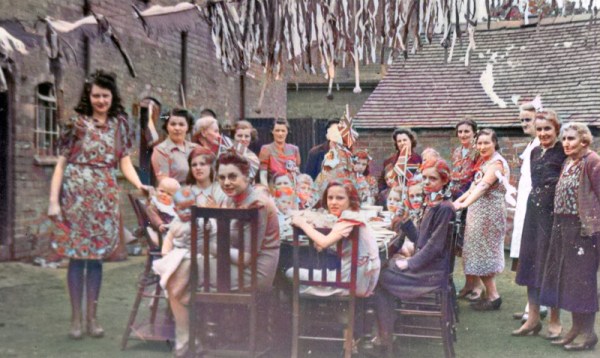
Tuesday 8th May 1945, Victory in Europe Day, saw much rejoicing as the fighting in Europe officially came to an end and some of the men held as prisoners of war started to return home. At 3pm on Monday 7th May Prime Minister Winston Churchill made the official announcement that the following two days would be public holidays. However, it’s clear from newspaper articles in the Warwick County News that people were very mindful that war with Japan was still ongoing. The newspaper summed up the local celebrations as:
Continue reading “V. E. Day in Solihull, 1945”“typical of others throughout the land where people had gathered together to give thanks that the nightmare of the last grey years was over, and, while remembering that men in far distant lands were still in danger of their lives, to enjoy the day that their individual effort had made particularly their own” (Warwick County News, 12th May 1945)
Described as “a Dorsetshire Man” in the announcement of his death in the Leamington Spa Courier of 7th May 1915, Edward Nugent Bankes was actually born on 3rd October 1875 in Wraysbury, Buckinghamshire, and his father, grandfather and great-grandfather were all born in London.
Having emigrated from England to Australia in about 1912, sculptor Percy Walker Corser joined the Australian Infantry of the Australian Imperial Force (A.I.F.) on 14th August 1914, aged 27 years and five months. He was killed at Gallipoli eight months later on 25th April 1915.
Continue reading “25th April 1915”On 30th March 1915, 19-year-old Rifleman Leslie Wilson from Catherine-de-Barnes, died of wounds in France whilst serving with the 2nd Battalion, Rifle Brigade, which had been in France since 6th November 1914, although Leslie joined them on 26th January 1915, according to his medal index card.
On the same day as Private Wilson died in France, Stoker 1st Class, David Bradbury, returning from leave, was fatally injured falling from a train as it passed through Castle Bromwich.
William Asbury was born in Birmingham in 1889 to parents, William (an iron caster) and Emma. He was baptised on 7th July 1889 at St Stephen’s Church, Birmingham. His older sister, Alethea, and younger brother, Thomas, were also baptised there in 1887 and 1894 respectively.
It looks as if their father, William (senior) died in 1894 at the age of 34 and their mother seems to have died, aged 36, at the end of 1897. However, she is still listed as next-of-kin with an address of 51 Princip Street, Birmingham when the three children were all admitted to Marston Green Cottage Homes on 5th January 1898. They seem to have remained there throughout the rest of their childhoods. The Homes had opened in January 1880 to accommodate children who would otherwise have gone into Birmingham Workhouse (now the site of Dudley Road Hospital).
Two local men lost their lives on 12th March 1915. Private Herbert Rushton of Castle Bromwich died, aged 24, whilst serving with the 3rd Battalion, Worcestershire Regiment. On the same day, Acting Corporal Harold Pugh, 2nd Battalion, Royal Scots Fusiliers was killed in action.
Corporal Ernest Bateman, 2nd Battalion, South Staffordshire Regiment, was killed in action on 10th March 1915 according to Commonwealth War Graves records. Soldiers Died in the Great War lists the date of death as 26th June 1915. Continue reading “10th March 1915”
Cavalry Officer, 26-year-old Rowland Auriol James Beech, the “apple of his parents’ eye” and a fine horseman, was killed in action on 21st February 1915 serving as a Captain with the 16th Lancers. He was the eldest son of Lieutenant-Colonel Rowland John Beech, who died of illness in 1919 after World War I service, aged 63, and is also recorded as a war casualty on the Commonwealth War Graves site.
On 18th February 1915, 44-year-old Major Arthur Joseph Clay died of pneumonia at Harpenden, whilst serving with the 2nd/6th Battalion North Staffordshire Regiment. Born on 29th April 1870 at Burton-on-Trent, he was the eldest son of Charles John Clay, barrister at law and Managing Director of Bass Brewery. Arthur’s mother, Agnes Lucy (née Arden) died in 1874, leaving four sons under the age of five. When Arthur was 13, his father married again, and went on to have two daughters with his second wife.
Arthur attended Harrow School and New College, Oxford. He was gazetted Second Lieutenant with the 2nd Volunteer Battalion Prince of Wales’s (North Staffordshire Regiment) in February 1893, and rose to the rank of Captain before resigning his commission in advance of the merger of volunteer units in 1908 to create the Territorial Force. He became a Director of Messrs. Bass, Ratcliffe and Gretton, a Director of the Gordon Hotels and was one of the principal promoters of the Motor Industry in Burton-on-Trent.

