Gunner Abraham Birch Stowe, of Solihull, was killed in action on 10th June 1917 serving with the 138th Heavy Brigade, Royal Garrison Artillery. A regular soldier, he joined the Royal Garrison Artillery in October 1908 and, in 1911, was stationed at Fort Tigné, Malta.
15th August 1916
Lieutenant Theodore Newman Hall died at Rouen on 15th August 1916 from wounds received on 23rd July whilst serving with the Oxford & Bucks Light Infantry. He was an only child and was born on 12th November 1894 in Sligo, Ireland.
His father, Rev. William Aidan Newman Hall, known as Aidan, was a minister with the Congregational Church, who moved to Sligo in July 1892, having previously attended Mount Pleasant Church, Hastings and been a student at Cheshunt Hall, Hertfordshire. He married his wife, Alice, in the same year.
14th June 1916
30-year-old Private William Thomas Badger died at No. 10 Casualty Clearing Station of wounds sustained at Mount Sorrel, Belgium and is buried at Lijssenthoek Military Cemetery. He was serving as a Private with the 3rd Battalion Canadian Pioneers, having emigrated to Canada by 1906.
3rd May 1916
Private Christopher James, recorded as aged 36, died on 3rd May 1916, serving with the 11th Battalion, Royal Warwickshire Regiment. There is a slight discrepancy with his age, as he would actually have been 39 when he died. He was born in 1876 in Pencoyd, Ross, Herefordshire to parents James (a farm labourer) and Harriet. Soldiers Died in the Great War also has an error in the birthplace – listing his place of birth as St Leonard’s, Hertfordshire.
25th January 1916
On 25th January 1916, two local men died as a result of their war service:
- Temporary Captain, John Harry Hartill, aged 52, General List
- Private William Lovegrove, aged 23, 1st Battalion, Royal Warwickshire Regiment
9th October 1915
The war memorials at Catherine-de-Barnes and Solihull both include the name of Lance Corporal James Uriah Hill of the Coldstream Guards, although his local connection with the area isn’t known. He was killed in action at Vermelles, on 9th October 1915.
He was born in Saltley to parents James Uriah and Mary Ann (née Wragg) who had married at Nechells in 1877. His birth was registered in 1892, although there is a slight discrepancy in age with other official records suggesting a date of birth of 1889/1890. The couple did have another son called James Uriah, born 8th September 1883 at Nechells but this child seems to have died aged one, and is buried in Witton Cemetery, Birmingham. It was common practice in the past for a child to have the same name as a dead sibling to ensure that a favourite name continued for another generation. Mary Ann herself died in 1900, aged 44, and James Uriah married Sarah Clay in 1905.
17th May 1915
Regular soldier Sydney Alfred Cockayne, from Catherine-de-Barnes, died of wounds on 17th May 1915 whilst serving as Acting Sergeant Major with the 1st Battalion, King’s Royal Rifle Corps.
He was actually baptised as Alfred Sidney Cockayne, and appears as Alfred on the 1891 and 1901 censuses before being recorded as Sidney Cockayne in 1911. Presumably, preferring to be known by his middle name, he switched the order of his Christian names when he joined the Army. Certainly, all his Army records refer to him as S. A. Cockayne.
V. E. Day in Solihull, 1945
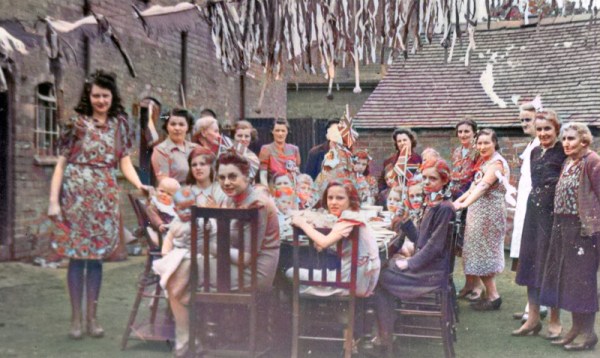
Tuesday 8th May 1945, Victory in Europe Day, saw much rejoicing as the fighting in Europe officially came to an end and some of the men held as prisoners of war started to return home. At 3pm on Monday 7th May Prime Minister Winston Churchill made the official announcement that the following two days would be public holidays. However, it’s clear from newspaper articles in the Warwick County News that people were very mindful that war with Japan was still ongoing. The newspaper summed up the local celebrations as:
Continue reading “V. E. Day in Solihull, 1945”“typical of others throughout the land where people had gathered together to give thanks that the nightmare of the last grey years was over, and, while remembering that men in far distant lands were still in danger of their lives, to enjoy the day that their individual effort had made particularly their own” (Warwick County News, 12th May 1945)
30th March 1915
On 30th March 1915, 19-year-old Rifleman Leslie Wilson from Catherine-de-Barnes, died of wounds in France whilst serving with the 2nd Battalion, Rifle Brigade, which had been in France since 6th November 1914, although Leslie joined them on 26th January 1915, according to his medal index card.
On the same day as Private Wilson died in France, Stoker 1st Class, David Bradbury, returning from leave, was fatally injured falling from a train as it passed through Castle Bromwich.
1st January 1915
The first of the 95 casualties from the Solihull area to die in 1915 was Royal Naval Chaplain, Rev. George Brooke Robinson, who died on New Year’s Day 1915 whilst serving on H.M.S. Formidable. This was the first British battleship to be sunk in the First World War. Rev. Robinson was the most senior Royal Navy chaplain to die in the war, and the fourth of 19 navy chaplains to be die on active service 1914-1919.
Continue reading “1st January 1915” Solihull Life