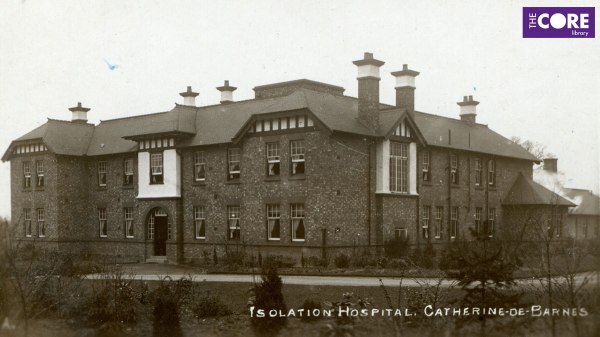
Isolation hospitals were set up to treat people who had infectious diseases such as smallpox, diphtheria, tuberculosis and scarlet fever in an attempt to prevent the diseases from spreading quickly through the population. Solihull is known to have had a “fever shed” and three purpose-built isolation hospitals 1870s-1980s.
Continue reading “Isolation hospitals”[New] Berry Hall
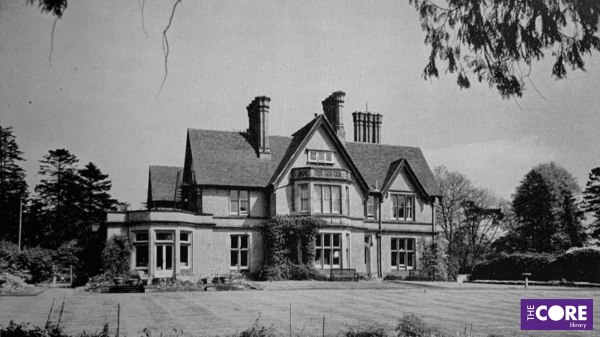
Berry Hall is a name that has been used for two different buildings in Solihull. The name originally referred to the 15th-century half-timbered farm house on Ravenshaw Lane. However, this building was renamed Berry Hall Farm after the estate was bought by Birmingham steel pen-nib manufacturer, Joseph Gillott (junior), from Henry Ludlow on 21st January 1867.
Joseph Gillott transferred the Berry Hall name to a new mansion which was designed for him by architect Julius Alfred Chatwin. Work on the new house apparently began in 1870 and was completed in 1880.
Continue reading “[New] Berry Hall”Catherine-de-Barnes War Memorial
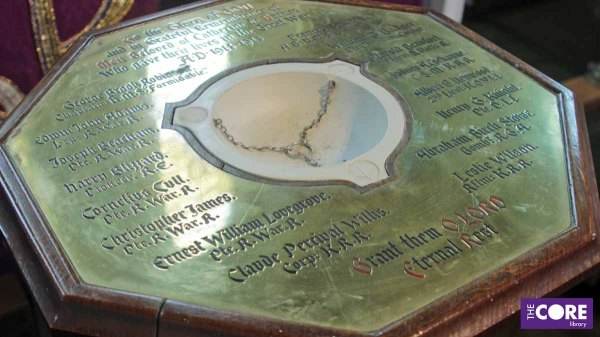
At 5pm on Trinity Sunday, 22nd May 1921, the Bishop of Birmingham dedicated the war memorial at Catherine-de-Barnes mission church, five years after a war memorial fund was begun.
Continue reading “Catherine-de-Barnes War Memorial”Coronation Day 1937
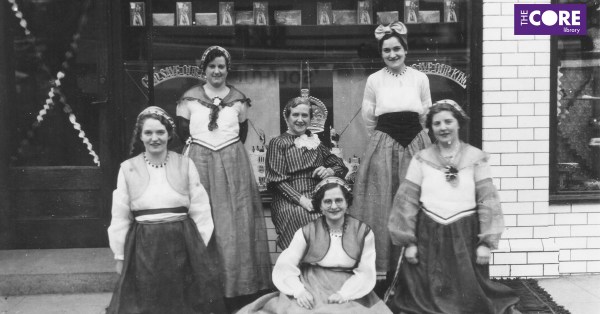
Wednesday 12th May 1937 saw the coronation at Westminster Abbey in London of King George VI and Queen Elizabeth. The date had been chosen for the coronation of King Edward VIII who had become king on the death of his father George V in January 1936. Although Edward VIII’s abdication in December resulted in a new king and queen on the throne, the coronation date of 12th May was retained.
In Solihull, the event was marked by a three-day carnival, which ran into the Whitsuntide weekend, and many of the villages now in the borough held their own celebrations.
1st December 1918
Pioneer William Henry Blizzard, Royal Engineers, died on 1st December 1918 as a result of influenza, complicated by broncho-pneumonia and epitaxis. Known as Harry, he was born at Catherine-de-Barnes and his baptism is recorded in St Alphege Church records as being on 11th October 1891.
24th November 1918
Having spent almost all of the war as a Prisoner of War, Private Cornelius Cull, 2nd Battalion, Royal Warwickshire Regiment, died of pneumonia in Germany on 24th November 1918.
27th May 1918
Three local men died on 27th May 1918 whilst on active service.
- Private Edward George Cakebread, 2nd Battalion, Devonshire Regiment
- Private Henry George Knight, 22nd Battalion, Durham Light Infantry
- Private Frank Victor Perks, 5th Battalion, Yorkshire Regiment
All three have no known grave and are commemorated on the Soissons Memorial, France.
22nd March 1918
Two local casualties lost their lives on active service on 22nd March 1918. Private Edward Vernon Barker, 10th Battalion Royal Warwickshire Regiment, and Private Joseph Beecham, 2nd/6th Battalion Royal Warwickshire Regiment.
23rd December 1917
Two local men lost their lives on active service on 23rd December 1917 – Sergeant Walter Henry Mitchell, 111th Company, Machine Gun Corps, and Able Seaman John Henry Williams, Royal Naval Reserve, serving on HMS Surprise.
4th October 1917
Nine local men lost their lives on 4th October 1917 whilst on active service:
- Lance Corporal Edwin John Adams, 14th Battalion, Royal Warwickshire Regiment
- Private Eric Ashley Ellis, 13th Company, Machine Gun Corps (Infantry)
- Sergeant Charles Haynes, 1st/5th Battalion, Royal Warwickshire Regiment
- Second Lieutenant Albert Bertini Heywood, 10th Battalion, King’s Own Yorkshire Light Infantry
- Private Lewis James Knight, 30th Battalion, Australian Infantry
- Lance Corporal George Henry Pegg, 1st/6th Battalion, Royal Warwickshire Regiment
- Private William Savage, 1st Battalion, Duke of Cornwall’s Light Infantry
- Private William Thomas Tropman, 1st/8th Battalion, Royal Warwickshire Regiment
- Gunner Arthur Whinfrey, 256th Siege Battery, Royal Garrison Artillery