Two local men died on 17th September 1916 whilst serving in the Armed Forces. 19-year-old Lieutenant John Cyril Hodges, Royal Flying Corps, was born in Lerwick, Shetland and was killed in a flying accident at Castle Bromwich aerodrome. 26-year-old Private John Frederick Lewis Hornsby died in France whilst serving with the Wellington Regiment, New Zealand Expeditionary Force.
25th August 1916
Berkswell-born Rifleman John Timms, 7th Battalion, King’s Royal Rifle Corps, died of wounds in hospital in France on 25th August 1916, aged 19, and is buried at Dernancourt Communal Cemetery Extension, France. He is also commemorated locally on Berkswell war memorial. An employee of the Rover works before the war, he enlisted in the Army in November 1915, five days after his 19th birthday, and embarked for France on 18th April 1916, just over four months before he was fatally wounded.
27th June 1916
Temporary Second Lieutenant Thomas Jessop Weiss, aged 27, died of wounds on 27th June 1916, serving with the 151st Brigade, Royal Field Artillery (although some sources do record that he was killed in action). He apparently lived at Mount Pleasant, Berkswell and was described by the Vicar of Berkswell in the Coventry Evening Telegraph, 3rd August 1916, as a “quiet, retiring man… esteemed for his generous nature and straightforward simplicity of life.”
Thomas is buried at Cerisy-Gailly Military Cemetery, France and is also commemorated on Berkswell War Memorial.
1st June 1916
Two local men lost their lives on 1st June 1916. Private Harold Hackett, aged 25, serving with the 2nd Battalion, Royal Warwickshire Regiment, and Stoker 1st Class Charles Simmons, aged 21, serving aboard H.M.S. Tipperary.
21st April 1916
Former gamekeeper, George Liddamore, was killed in action in Mesopotamia (modern-day Iraq) on 21st April 1916, serving as a Private with the 9th Battalion, Royal Warwickshire Regiment. Born in Bury St Edmonds, Suffolk, he seems to have moved to Berkswell sometime between 1911 and 1915. As he was a gamekeeper, it seems possible that he worked on a local estate, maybe Berkswell Hall, although his name isn’t included on the local war memorial in Berkswell. He is commemorated on the Basra Memorial, Iraq and on the war memorial at St John the Baptist Church, North Luffenham.
Berkswell Rectory Red Cross Auxiliary Hospital
Berkswell Rectory was used as an Auxiliary Hospital during the First World War. These hospitals for wounded soldiers were administered by the British Red Cross Society, and were used as convalescence hospitals – a stepping stone between treatment at a general hospital and discharge home.
The Red Cross had set up Voluntary Aid Detachments (V.A.D.) in each county to provide supplementary aid to the Territorial Forces Medical Services in the event of war. Members came to be known as ‘V.A.D.s’ and were all trained in first aid and nursing.
Continue reading “Berkswell Rectory Red Cross Auxiliary Hospital”
Help us identify Borough casualties
So far, we have over 800 names on our list of those from places now in the Solihull Borough, or from the Solihull Rural District, who died as a result of their war service. However, we are struggling to identify in official records some of the people named on local memorials. This can be because there are too many people of the same name, or because we don’t have full names or service details, or because we have found possible individuals but can’t be sure of any local connection.
If you can help with information on any of the following, especially exact dates of death, please let us know:
Auxiliary Hospitals
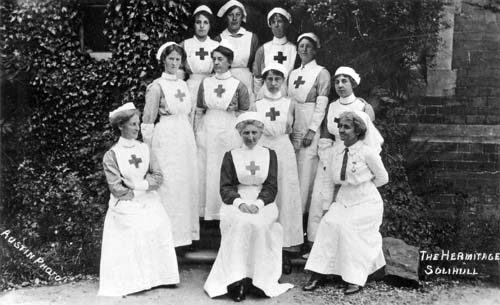
In 1909, the British Red Cross was tasked with helping the Territorial Forces Medical Service in the event of war. It set up local units called ‘Voluntary Aid Detachments’, and members were trained in first aid and nursing.
Auxiliary Hospitals, attached to military hospitals, were established – the following are known to have operated in Solihull:
Hemlingford
Solihull was the only former Rural District Council to become a Metropolitan Borough Council in its own right under the 1972 Local Government Act, which came into effect on 1st April 1974. A little more than 40 years before, workers were taking up the cobbles in Solihull’s High Street – a graphic illustration of the incredibly rapid growth of the Borough. The population had more than doubled in 7 years, from just over 25,000 in 1932 to 52,610 by 1939.
 Solihull Life