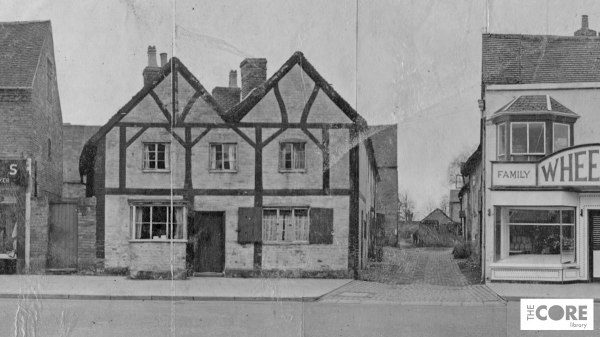
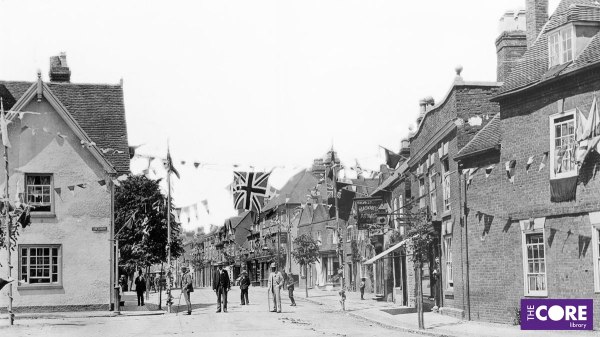
Ramsgate, just off Solihull High Street, was perhaps the closest to back-to-back housing that Solihull had. One of the cottages (no. 20. High Street, pictured above) faced the High Street, whilst 14 other cottages together with wash-houses, water-closets, coal-houses, ash-pits and a communal pump were situated around a courtyard off a party entrance from the High Street.
Continue reading “Ramsgate, High Street, Solihull”Hampton Manor
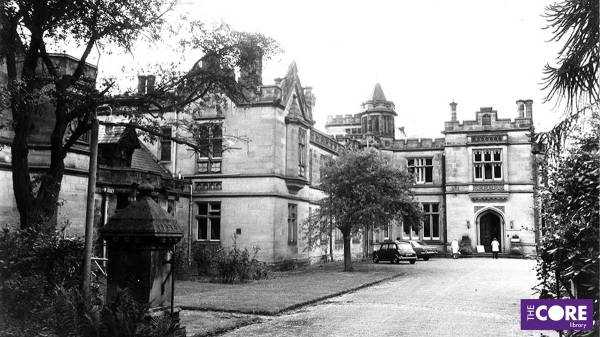
The first recorded mention of Hampton Manor estate appeared in the Domesday Book of 1086, and today the current manor house still stands in the heart of the village of Hampton-in-Arden just along from the Parish church where a church has stood since Saxon times.
Continue reading “Hampton Manor”Coronation celebrations in Solihull
To mark the Coronation of King Charles III on Saturday 6th May 2023 – the first coronation of a British sovereign for 70 years – library staff have been researching how previous coronations were celebrated in Solihull.
Continue reading “Coronation celebrations in Solihull”Royal Visits: Queen Elizabeth II
Her late Majesty, Queen Elizabeth II, made six official visits to the Solihull Borough during her 70-year reign. There were other visits when she passed through the Borough, e.g. arriving at or leaving from Birmingham Airport, but there were only these six official visits, as far as we are aware.
Continue reading “Royal Visits: Queen Elizabeth II”The King’s Accession Proclamation
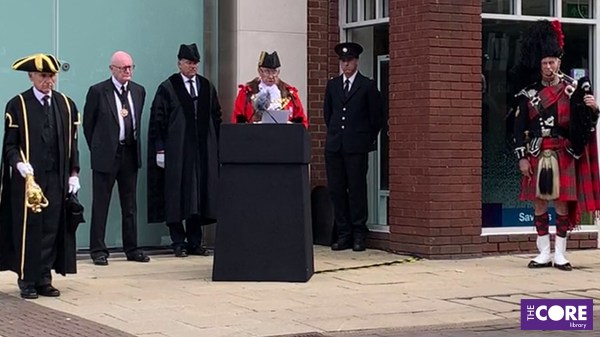
On Sunday 11th September 2022 in Solihull High Street, the Worshipful the Mayor of Solihull, Councillor Ken Meeson, read the official Proclamation of the Accession of King Charles III. It seems that this was the first local Accession Proclamation ever to have been read officially in Solihull.
Continue reading “The King’s Accession Proclamation”Mayer Society
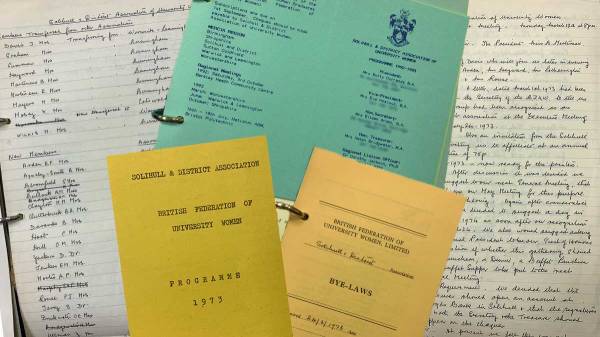
The Mayer Society evolved from the Solihull branch of the British Federation of University Women, which was established in 1973. In 1993, the Solihull association decided to separate from the national group and take the name of the branch’s second president – Marjorie Mayers (1898-1982) – whose widower, James (“Jack”) Bowen Mayers (1901-1990), bequeathed £250 to the group. For the sake of simplicity, the ‘s’ was left off the group’s name. The Mayer Society closed in October 2021.
Continue reading “Mayer Society”Hobs Moat Ancient Monument
The Middle Ages were a turbulent time and moated properties were quite a common sight. Although they were initially built for defence they were later used more as status symbols. The Hobs Moat site has been traditionally referred to as a castle, so was probably fortified.
Continue reading “Hobs Moat Ancient Monument”Sgt Cecil Francis Beechey (1920-1943)
On 28th January 1943 22-year-old Pilot Sgt Cecil Francis Beechey 656761, a pilot with 197 Squadron RAF, was killed when the tail of his Typhoon IB DN364 broke off and the aircraft crashed in East Linton, East Lothian, Scotland. His family home was in Hall Green and he was buried at Robin Hood Cemetery, Solihull on 4th February 1943.
Continue reading “Sgt Cecil Francis Beechey (1920-1943)”Midnight burial at Knowle 1899
According to various contemporary newspaper reports, at just after midnight on Thursday 19th January 1899, four hearses entered the Warwickshire village of Knowle. Each hearse carried the coffin of a deceased person whose remains had been disinterred (with Home Office permission) from Key Hill Cemetery, Birmingham.
The four people were all related and their remains were interred in a family vault in the churchyard of Knowle Parish Church. By the dim light of a lantern, the Vicar read a portion of the burial service, and the ceremony was witnessed by a police sergeant, overseer and the relatives of the deceased.
Continue reading “Midnight burial at Knowle 1899”Elizabeth Grant (c.1765-1823)
The grave of Elizabeth Grant in the churchyard of St Nicholas’ Church, Elmdon suggests to the casual reader that she was a local servant as the inscription mentions 43 years of faithful service. However, she seems to have been a wealthy and literate woman and the “faithful service” may be a description of her work on behalf of the church rather than in domestic service.
Continue reading “Elizabeth Grant (c.1765-1823)”